
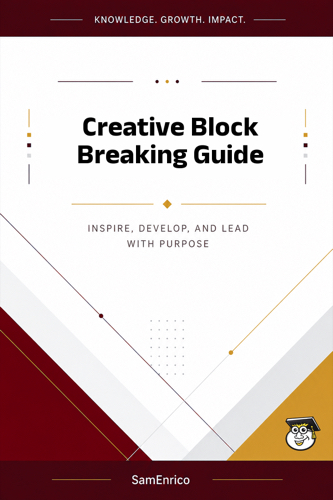
Creative Block Breaking Guide eBook
Overcome creative paralysis with practical confide
Overcome creative paralysis with practical confidence building exercises.
Formats
Free sample
Chapter 1: The Diagnosis Trap...--Most creative people treat every block the same. They wake up one morning, stare at the blank page, the empty canvas, the blinking cursor, or the silent instrument, and they think: I’m stuck. Just stuck. Generic stuck. Universal stuck.That single word—“stuck”—is the first lie we tell ourselves.
It is the diagnosis trap, and it has derailed more creative careers than lack of talent ever could.Imagine walking into a doctor’s office and saying, “I don’t feel well.” The doctor nods, writes a prescription for antibiotics, and sends you on your way. No examination. No questions about your symptoms. No blood test. No distinction between a viral infection, a broken bone, or food poisoning.
Just a single diagnosis for every possible ailment.Ridiculous, right? You would never accept that level of care for your body. But you accept it for your creativity every single day.When you say “I’m stuck,” you are treating every creative block as if it were identical. A fear-based block requires a completely different solution than an environmental block, which requires a different solution than a perceptual block. Applying the wrong remedy doesn’t just fail to help—it actively makes things worse.
You try journaling your way out of a clutter problem, and when it doesn’t work, you conclude that you are beyond help. You try reorganizing your desk to fix a fear of failure, and when the fear remains, you conclude that the block is permanent.The diagnosis trap is the belief that all blocks feel the same, so they must be the same. They are not.This chapter is your diagnostic intake. By the end of it, you will not say “I’m stuck.” You will say, “I have an emotional block triggered by last Tuesday’s feedback,” or “I have an environmental block caused by my phone being in the same room,” or “I have a perceptual block—I can’t see what’s missing because I’ve been staring too long.”You cannot unblock what you cannot name. Let us begin.The Six Faces of Creative Paralysis Drawing from decades of research in creativity studies—including James Adams’ foundational work in Conceptual Blockbusting and contemporary neuroscience—creative blocks fall into six distinct categories.
Each has a different cause, different symptoms, and crucially, a different cure.Before we explore each one, take a breath. You will likely recognize yourself in multiple categories. That is normal. Blocks are rarely pure; they are usually cocktails. The goal is not to find your “one true block type” but to identify which flavor is dominant right now, in this project, at this moment.1.
Perceptual Blocks: The Invisible Problem Perceptual blocks occur when you cannot see the problem clearly. You are staring directly at your work, but something is missing, and you cannot figure out what. It is the creative equivalent of a word on the tip of your tongue—frustrating, vague, and surprisingly common.Symptoms: You re-read the same paragraph ten times without knowing why it feels wrong. You step back from a painting and sense imbalance but cannot locate the source. You listen to a mix you have been working on for hours and know something is off, but you have lost the ability to hear it.Root cause: Perceptual blocks happen when you have been looking at the same thing for too long.
Your brain, which is designed to conserve energy, begins to “smooth over” details. What was once a landscape of possibilities becomes a flat, familiar terrain. You are not stupid; you are habituated.Typical triggers: Long hours on a single project. Fatigue. Working in the same environment without breaks.
The pressure to finish.The trap: People with perceptual blocks often try to think harder. They squint. They concentrate. They apply more effort to the same flawed approach. This is like trying to see a hidden image in a stereogram by pressing your face closer to the page—the solution is distance, not intensity.First aid: Distance.
Physical distance (walk away), temporal distance (sleep on it), or perceptual distance (look at your work in a mirror, upside down, or through a different medium). We will build specific exercises for perceptual blocks in Chapter 8.2. Emotional Blocks: The Body Says No Emotional blocks are the most painful and the most misunderstood. These are blocks rooted in fear, anxiety, shame, past trauma, or deep-seated beliefs about your worth as a creator. When you have an emotional block, you are not lazy.
You are not undisciplined. Your nervous system has decided that creating is unsafe, and it is protecting you the only way it knows how—by making the creative act feel unbearable.Symptoms: Physical dread before sitting down to work. A feeling of nausea or tightness in the chest when you think about your project. Procrastination that feels less like distraction and more like aversion. The voice in your head that says, “Who do you think you are?”Root cause: The amygdala—your brain’s threat-detection system—cannot distinguish between a sabertooth tiger and a blank page.
Both trigger the fight-or-flight response. If you have experienced criticism, rejection, or failure in the past, your brain has learned that creativity = danger. It is not trying to sabotage you; it is trying to keep you alive.Typical triggers: Past harsh feedback. A childhood experience where your creative work was mocked. Impostor syndrome.
Perfectionism (which is often fear dressed in fancy clothes). Comparing yourself to others.The trap: Trying to think your way out of an emotional block. You cannot logic away fear. You cannot argue with your amygdala. Emotional blocks require somatic (body-based) and compassionate (Inner Mentor) approaches.First aid: Regulation before creation.
Breathing exercises. Movement. The Inner Critic work we will do in Chapter 2. Emotional blocks are the focus of Chapters 2, 5, and 9.3. Cultural Blocks: The World Is Watching Cultural blocks come from outside you—from societal expectations, family pressure, or the invisible rules of your profession.
These are the messages that say: “Real artists suffer for their work.” “Creativity must be original or it doesn’t count.” “You should be productive every single day.” “If you charge money for your art, you’ve sold out.”Symptoms: You feel judged even when no one is watching. You measure your output against an impossible standard of “real” creativity. You believe that taking breaks, making money, or enjoying the process somehow invalidates your work.Root cause: Cultural blocks are internalized norms. At some point, you absorbed a message about what creativity should look like, and now that message is running the show. The irony is that most of these “rules” are recent inventions.
The starving artist myth is barely two hundred years old. The idea that creativity must be solitary is a Romantic era fantasy.Typical triggers: Social media (where everyone’s highlight reel becomes your baseline). Family members who ask, “But what’s your backup plan?” Professional gatekeepers who define what “counts” as art. The productivity industrial complex.The trap: Trying to comply. You cannot satisfy contradictory cultural demands.
Society wants you to be authentic and commercially viable and original and prolific and humble and confident. It is a…
This is the end of the free sample. Get the eBook to keep going. Buy now
About this book
Details
- Author
- Mercado Janell
- Publisher
- SamEnrico
- Language
- English
- Genre
- Non-Fiction, Self-Help, Creative Block
- Released
- 2026-06-06
- Pages (approx.)
- 136
- Available as
- eBook, Audiobook

Read better in the ZLOADR app
Your eBooks on your phone or tablet. Sign in with your SamEnrico account and start reading.
More by Mercado Janell
 Body Scan For DialysisMercado Janell$11.99
 Blue Collar Work AddictionMercado Janell$11.99
 Sumatra Jungle Survival LeaderMercado Janell$11.99
 Domestic Violence Advocate StressMercado Janell$11.99
 Self Esteem For Post Burn Scar RecoveryMercado Janell$11.99
 Automatic Negative Thought GuideMercado Janell$11.99
 Real World ImpactMercado Janell$11.99
 Charlemagne's Dream: The Carolingian Renaissance AwakensMercado Janell$11.99
 The Forgotten Philanthropist: How a 19th-Century Tea Merchant Secretly Funded a RevolutionMercado Janell$11.99
 The Smiths: Romance and ResistanceMercado Janell$11.99
 Growing CyathodesMercado Janell$11.99
 Appointment Booking Systems for BusinessesMercado Janell$11.99
You may also like
 Creative Failure Fear GuideHeld Jay$11.99
 Overcoming Creative Block WorkbookTuck Markita$11.99
 Self Doubt Creative Block GuideMccullough Latina$11.99
 Art Account Like ComparisonBurnett Bong$11.99
 Self Talk for CreativesStanley Shannon$11.99
 Overcoming Creative BlockBoudreau Florance$11.99
 Art Comparison on Social MediaMeredith Kathlyn$11.99
 The Creative Envy GuideRojas Viviana$11.99