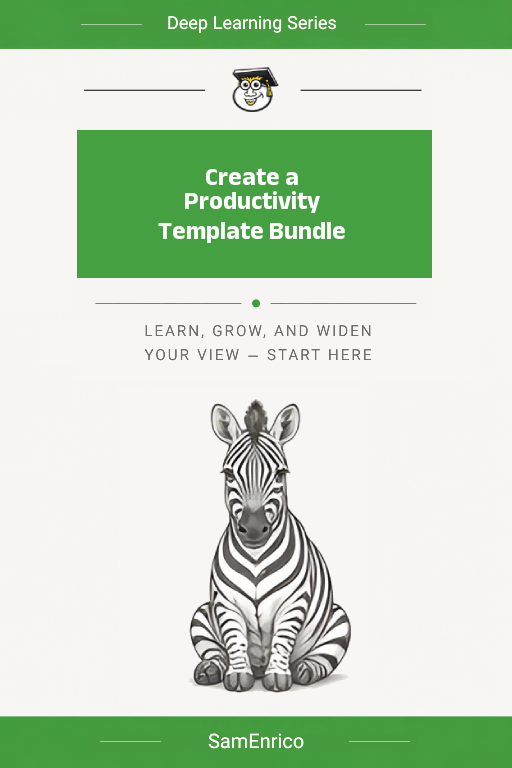
Create a Productivity Template Bundle eBook
Bundle multiple Notion, Excel, or PDF templates in
Bundle multiple Notion, Excel, or PDF templates into a higher-value product offering.
Formats
Free sample
Chapter 1: The Invisible Ceiling--–- In 2019, a graphic designer named Mariana launched her first productivity template on Etsy. It was a simple habit tracker built in Excel—checkboxes for thirty-one days, a progress bar that turned green when you hit 80%, and a motivational quote that changed every week. She priced it at 4.99.Inthefirstmonth,shesoldforty−sevencopies.After Etsy′sfeesandthecostofa Canvasubscription,shenettedroughly4.99. In the first month, she sold forty-seven copies. After Etsy's fees and the cost of a Canva subscription, she netted roughly 4.99.Inthefirstmonth,shesoldforty−sevencopies.After Etsy′sfeesandthecostofa Canvasubscription,shenettedroughly180.
She was thrilled.Eighteen months later, Mariana had twenty-three individual templates in her shop. Habit trackers, budget planners, meal prep logs, content calendars, project dashboards, and a popular "Anxiety Tracker" that included a breathing timer. She was working forty hours a week on customer support, template updates, and new product development. Her monthly revenue had grown to 2,400.Buthereisthenumber Marianadidnotcalculate:hereffectivehourlywagehaddroppedto2,400. But here is the number Mariana did not calculate: her effective hourly wage had dropped to 2,400.Buthereisthenumber Marianadidnotcalculate:hereffectivehourlywagehaddroppedto11.30.
She was earning less than a barista, and she was infinitely more exhausted.Mariana's story is not unusual. It is the invisible ceiling of the template economy—the point where selling individual templates becomes a job, not a business. Thousands of creators hit this ceiling every year. They double down on volume. They build more templates.
They lower prices to compete with the endless flood of $3.99 planners from sellers in lower-cost markets. And eventually, they burn out.This book exists because there is a way through that ceiling. The solution is not more templates. It is better bundles.The $4.99 Trap Let us name the problem directly. Selling a single template for $4.99 is not a scalable business model.
It is a transactional grind that punishes creativity and rewards volume above all else. Here is why.First, customer acquisition cost does not scale down with template price. Whether you sell a 5templateora5 template or a 5templateora97 bundle, you still need to attract a buyer. You still need product photography, SEO optimization, social media presence, and either paid advertising or organic content. The cost of acquiring a customer—in time, money, and attention—is roughly the same regardless of the price point.
When you sell a 5template,youarespending5 template, you are spending 5template,youarespending5 of effort to acquire a customer who gives you 5.Thatisbreak−evenatbest.Whenyousella5. That is break-even at best. When you sell a 5.Thatisbreak−evenatbest.Whenyousella97 bundle, you are spending roughly the same acquisition cost to earn nearly twenty times the revenue.Second, the refund rate on cheap templates is paradoxically higher. Data from multiple digital marketplace studies suggests that products priced below 10haverefundratesbetween810 have refund rates between 8% and 12%, while products priced between 10haverefundratesbetween840 and 100haverefundratesbetween3100 have refund rates between 3% and 5%. The reason is psychological: customers who pay very little feel no sunk cost.
They download the template, glance at it for thirty seconds, decide it does not perfectly match their mental image, and request a refund without guilt. A customer who pays 100haverefundratesbetween397, by contrast, has made a deliberate investment. They will spend time learning the template, troubleshooting, and extracting value. They are more likely to leave a positive review and become a repeat buyer.Third, the support burden per dollar earned is inverted. A 5templatebuyerexpectsthesamelevelofsupportasa5 template buyer expects the same level of support as a 5templatebuyerexpectsthesamelevelofsupportasa97 bundle buyer.
They will email you with the same questions about broken formulas, corrupted files, and missing features. But with a 5template,youareearningfivedollarstoanswerthatemail,troubleshoottheissue,andpotentiallyissuearefund.Witha5 template, you are earning five dollars to answer that email, troubleshoot the issue, and potentially issue a refund. With a 5template,youareearningfivedollarstoanswerthatemail,troubleshoottheissue,andpotentiallyissuearefund.Witha97 bundle, you are earning enough margin to justify an hour of support, a video tutorial, or even a live onboarding call. The economics of support only work when your average order value is high enough to absorb the cost of human attention.This is the invisible ceiling. It is not a wall that appears suddenly.
It is a gradual slope where your revenue grows linearly while your exhaustion grows exponentially. And most creators never notice the ceiling until they hit their head on it.The Bundle Shift: From Tools to Systems If the $4.99 template is a tool, then the bundle is a system. And customers do not buy tools—they buy outcomes.Consider the difference. A $5 habit tracker is a tool. It helps you check boxes.
But it does not answer the deeper question: why am I failing to build habits in the first place? A habit tracker cannot diagnose whether you are trying to change too many behaviors at once, whether your environment is undermining your willpower, or whether you need an accountability partner.A bundle, properly constructed, answers those deeper questions. The anchor template (the flagship product) might still be a habit tracker. But the support templates might include a "Trigger and Reward Log" to identify environmental cues, a "Weekly Reflection Dashboard" to analyze failure patterns, and a "Commitment Contract" template to share with an accountability partner. The bonuses might include a PDF guide titled "The Science of Habit Stacking" and a printable calendar for thirty-day challenges.Suddenly, the customer is not buying a spreadsheet.
They are buying a system for behavior change. And that system is worth far more than $4.99.This distinction between tools and systems is the single most important concept in this book. Everything else—the Bento Box method, the pricing psychology, the launch strategy—exists to help you build systems, not tools.Let me prove this with data from the digital product economy. A study of Gumroad's top 1,000 sellers found that sellers offering bundles (three or more related products) had average revenue per customer 3.7 times higher than sellers offering only individual products. More strikingly, bundle sellers reported refund rates 42% lower.
And when surveyed, customers who purchased bundles were 2.3 times more likely to purchase again from the same creator within ninety days.Why? Because a bundle creates relationship. A single template is a transaction. A bundle is an investment. When a customer buys a bundle, they are signaling that they trust you to solve a meaningful problem.
That trust is the foundation of a repeatable, scalable business.The Psychology of the Curated Collection To understand why bundles work, we need to understand two psychological forces: the IKEA Effect and the Curated Collection bias.The IKEA Effect is a cognitive bias discovered by researchers at Harvard, Yale, and Duke. It describes the tendency for people to value products more highly when they have invested effort in assembling or customizing them. The original study found that participants valued their own IKEA furniture (which they had assembled themselves) at roughly 60% higher than identical pre-assembled furniture.At first glance, this seems to argue against bundles. After all, a bundle is pre-assembled. You, the creator, have done the work of selecting and organizing the templates.
Shouldn't that reduce the customer's sense of ownership?No, because the IKEA Effect applies to solution assembly, not physical assembly. When a customer buys a bundle, they are not just buying files. They are buying a solution that they will customize to their own life. They will enter their own data, rename the tabs, delete the columns they do not…
This is the end of the free sample. Get the eBook to keep going. Buy now
About this book
Details
- Author
- Mattison Sallie
- Publisher
- SamEnrico
- Language
- English
- Genre
- Non-Fiction, First 30 Days, Bundling
- Released
- 2026-05-30
- Pages (approx.)
- 140
- Available as
- eBook, Audiobook

Read better in the ZLOADR app
Your eBooks on your phone or tablet. Sign in with your SamEnrico account and start reading.
More by Mattison Sallie
 Pre Reading Strategies for TextbooksMattison Sallie$11.99
 March On Washington PlanningMattison Sallie$11.99
 Sheppard Defense Attorney BellamyMattison Sallie$11.99
 Money and Debt TalksMattison Sallie$11.99
 The Study ChallengeMattison Sallie$11.99
 Bird Loss GriefMattison Sallie$11.99
 Morning Routine JournalMattison Sallie$11.99
 Goal Setting For DepressionMattison Sallie$11.99
 The Plague Fighters: Tycho Brahe and the Birth of EpidemiologyMattison Sallie$11.99
 The Great Canadian Whiskey Heist: The Ransomware of the Prohibition EraMattison Sallie$11.99
 Service Providers Guide to Advertising AgenciesMattison Sallie$11.99
 How to Produce Kite AccessoriesMattison Sallie$11.99