
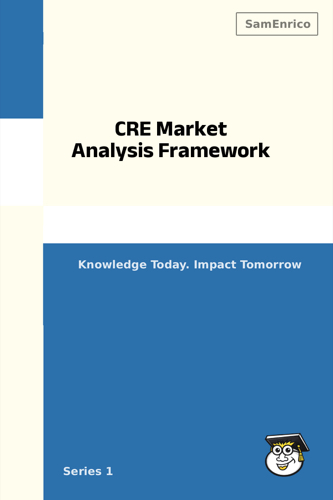
Non-FictionBusiness BriefMarket Research
CRE Market Analysis Framework eBook
Evaluate supply demand and rent growth trends befo
Evaluate supply demand and rent growth trends before committing capital to any market.
Formats
Free sample
Chapter 1: The Three-Body Problem--–- On a Tuesday morning in March 2022, a family office in Dallas wired $47 million to acquire a newly constructed luxury apartment complex in Austin, Texas. The underwriting was pristine. Rents in the submarket had grown 22 percent over the previous twelve months. Physical vacancy sat at 4 percent. The local economy was adding tech jobs faster than almost any city in America.
The sponsor had a decade of experience and a stack of glowing references. By every conventional measure, this was a textbook acquisition.Eighteen months later, the same property appraised for $31 million. Rents had fallen 18 percent. Vacancy had climbed to 11 percent. The family office missed a debt service payment and began negotiating with the special servicer.
The building itself had not changed. The management team was the same. The location, the construction quality, the amenity package—all identical to the day they bought it. What changed was not the property but the three invisible systems that determine every real estate investment outcome: the Space Market, the Capital Market, and the Asset Market.The family office made the same mistake that destroys more capital in commercial real estate than bad property management, tenant defaults, or physical obsolescence combined. They looked at one market—the Space Market—and assumed the other two would cooperate.
The Space Market told them rents were rising. It did not tell them that the Capital Market was about to tighten, that interest rates would rise 300 basis points, or that cap rates would expand from 4.5 percent to 6.5 percent. They bought a building based on rent trends alone. That is like buying an airplane based solely on the quality of the seats while ignoring the engines and the fuel gauge.This chapter introduces the fundamental framework that underpins every subsequent chapter in this book: the Three-Body Problem of commercial real estate. The name is borrowed from physics, where the motion of three celestial bodies interacting through gravity is famously impossible to predict with simple equations.
In CRE, the three bodies are the Space Market, the Capital Market, and the Asset Market. Each moves according to its own logic. Each influences the others. And the investor who looks at only one of them is not investing—they are gambling.The Three Markets That Move Independently Most real estate professionals grow up in the Space Market. They learn about rent rolls, occupancy rates, lease expirations, tenant improvements, and concessions.
They can tell you the difference between gross and net leases, the nuances of CPI adjustments, and the typical downtime between tenants. This is valuable knowledge. It is not sufficient knowledge.The Space Market is where tenants exchange money for the right to occupy physical space. Its primary metrics are asking rents, effective rents (after concessions), physical vacancy, and net absorption (the change in occupied square footage over a period). The Space Market operates on lease cycles of three to ten years.
It moves slowly, often with a lag of six to eighteen months behind changes in the broader economy. When the Space Market is healthy, landlords raise rents and concessions shrink. When it weakens, face rents may continue rising even as effective rents fall—a divergence that fools the unwary.The Capital Market is where lenders and equity providers decide how much money to allocate to real estate, at what price, and under what terms. Its primary metrics are interest rates, loan-to-value ratios, debt service coverage ratios, and spreads over risk-free benchmarks like the ten-year Treasury. The Capital Market operates on cycles of weeks and months.
It can turn overnight. On a single day in 2022, the average quoted cap rate for multifamily assets in Austin expanded by 40 basis points not because any building changed hands or any lease was signed, but because the Federal Reserve raised its target rate and the ten-year Treasury moved 25 basis points. The Capital Market does not care about your rent roll. It cares about inflation expectations, monetary policy, and the relative attractiveness of real estate versus bonds and equities.The Asset Market is where investors price properties based on the interaction of Space Market cash flows and Capital Market discount rates. Its primary metric is the cap rate—technically the net operating income divided by the purchase price, but more usefully understood as the yield an investor demands for taking the risks of owning a specific property.
The Asset Market operates somewhere between the slow crawl of the Space Market and the lightning speed of the Capital Market. Prices change when either NOI changes (the Space Market) or cap rates change (the Capital Market). The relationship is mathematical and unforgiving: Value equals NOI divided by cap rate. A 10 percent increase in NOI is exactly offset by a 10 percent increase in the cap rate. Value goes nowhere.
A 10 percent increase in NOI combined with a 20 percent increase in the cap rate destroys value even as the building becomes more profitable.Why Conventional Analysis Always Fails at Turning Points The family office in Dallas made a common but catastrophic error. They projected rent growth based on trailing twelve-month trends. They assumed vacancy would remain low because it had been low. They modeled a 5.25 percent cap rate because that was what comparable properties had traded at six months earlier. Every input to their model looked backward.
Every assumption assumed that the world would continue as it had.This is not negligence. It is the standard practice of most commercial real estate investors, and it works perfectly well—until it doesn't. The problem is that the three markets are not independent in the way most models assume. They are coupled. The Space Market influences the Asset Market through NOI growth.
The Capital Market influences the Asset Market through cap rates. The Capital Market influences the Space Market because higher interest rates make development loans more expensive, reducing future supply. The Space Market influences the Capital Market because lenders underwrite to expected cash flows, and those expectations are shaped by Space Market conditions.Conventional analysis treats these relationships as static. In reality, they are dynamic and nonlinear. A small change in the Capital Market can trigger a large change in the Asset Market even when the Space Market remains healthy.
A small change in the Space Market (a few points of vacancy, a few percent of concessions) can trigger a dramatic repricing when the Capital Market is already nervous. The three bodies do not move in isolation. They pull on each other.The Austin 2022 crash illustrates the mechanism perfectly. In early 2022, the Space Market was sending a clear signal: rents up, vacancy down, construction pipeline expanding but not yet delivering. A conventional investor reading only the Space Market saw green lights everywhere.
But the Capital Market was already turning. The Federal Reserve had signaled rate hikes. The ten-year Treasury had moved from 1.5 percent to 2.8 percent. Lenders were tightening underwriting standards. The spread between cap rates and Treasuries—a key measure of risk premium—had compressed to historic lows.The Asset Market reacted to the Capital Market before the Space Market showed any weakness.
Cap rates began expanding in mid-2022 even as rents continued rising. By the time Space Market metrics turned negative in late 2022, prices had already…
This is the end of the free sample. Get the eBook to keep going. Buy now
About this book
Details
- Author
- Zamora Yanira
- Publisher
- SamEnrico
- Language
- English
- Genre
- Non-Fiction, Business Brief, Market Research
- Released
- 2026-06-11
- Pages (approx.)
- 140
- Available as
- eBook, Audiobook

Read better in the ZLOADR app
Your eBooks on your phone or tablet. Sign in with your SamEnrico account and start reading.
More by Zamora Yanira
 Library Reading NookZamora Yanira$11.99
 Loving Kindness for an Endangered SpeciesZamora Yanira$11.99
 Letting Go of Friendship HurtsZamora Yanira$11.99
 1031 Exchange Reverse Exchange ParkingZamora Yanira$11.99
 The Attention Recovery PlanZamora Yanira$11.99
 Cover Letter Resume PairingZamora Yanira$11.99
 Flying SR 71 BlackbirdZamora Yanira$11.99
 Bill Gates MicrosoftZamora Yanira$11.99
 Gold and Guns: The Hidden Costs of Vietnam's First WarZamora Yanira$11.99
 The Lost Tongues of the Cosmos: Decoding Earth's First Space LanguageZamora Yanira$11.99
 The Last Flight of the Enola Gay: The Untold Story of Hiroshima’s ShadowZamora Yanira$11.99
 Understanding Alopecia Contractures Dwarfism Mental RetardationZamora Yanira$17.99
You may also like
 Hong Kong Handover 1997Dunn Johnnie$11.99
 Zumba For Postnatal Recovery CourseNeal Christian$11.99
 Zumba for BeginnersLadner Nikia$11.99
 YouTube Comment Mining GuideHumes Pandora$12.99
 Worry Box MeditationCarlin Rudy$11.99
 Workplace Stress MeditationNguyen Lynn$11.99
 Workplace Stress and Sleep RepairHawley Ivory$11.99
 Workplace Perfectionism CureDelaney Jeffry$11.99
 Workplace Injustice Anger GuideWallen Isabelle$11.99
 Work Addiction and Burnout LinkGreenwood Ester$11.99
 Women in Yoga and WellnessBeattie Galina$11.99
 Women in Stand Up ComedyChun Evangeline$11.99