
Non-FictionBusiness BriefSustainability
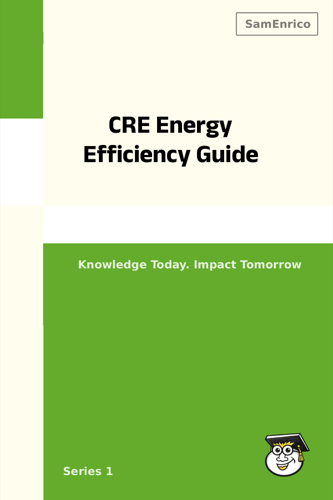
CRE Energy Efficiency Guide eBook
Upgrade lighting HVAC and controls to lower operat
by Hare Russel
Upgrade lighting HVAC and controls to lower operating costs and attract tenants.
Formats
Free sample
Chapter 1: The $50,000 Closet--The first time I walked into the mechanical closet of a mid-sized office building in Columbus, Ohio, I almost tripped over a space heater. It was July. The air conditioner was running at full capacity, struggling to keep the second floor below 78 degrees, and yet someone had plugged in a 1,500-watt space heater and left it running overnight. The building engineer shrugged when I asked about it. "Janitor gets cold," he said.
"Been doing it for years."That space heater, running twelve hours a day, three hundred days a year, cost the building owner $1,350 annually in electricity. It was one heater. When we did a full walkthrough, we found twenty-three similar anomalies: lights on in storage rooms that hadn't been opened in months, a rooftop HVAC unit running at 4 AM in an empty building, a leaking steam trap venting heat into the parking garage, and a digital thermostat that had been manually overridden to 72 degrees year-round because someone "didn't like the programming."The total annual waste from that single building? Just over $50,000. The cost to fix it?
Less than $3,000 in labor and a few hundred dollars in parts. The owner had been losing $50,000 every year for at least five years. That is a quarter of a million dollars thrown into the literal wind, hidden inside a closet no one thought to open.This chapter is about why that closet exists in your building too, why you have probably been walking past it for years, and how understanding the new economics of commercial real estate will force you to open it today.The Old Paradigm: Utilities as Fixed Costs For most of commercial real estate history, energy was treated like gravity. It was just there. It was a cost of doing business, an unchangeable line item on the operating statement that property managers paid without question and owners ignored during investment committee meetings.
The prevailing wisdom was simple: utilities are pass-through expenses. If the bill goes up, raise the rent or adjust the CAM charges. The tenant pays. Who cares?This mindset is not just outdated. It is financially reckless.The old paradigm treated energy as a fixed cost because it was relatively cheap, and buildings were relatively simple.
A thermostat controlled the boiler. A light switch controlled the fluorescents. The building engineer showed up at 8 AM, turned things on, left at 5 PM, turned things off, and hoped nothing broke overnight. There was no data, no accountability, and no financial incentive to change. Utility bills arrived in an envelope, got stamped "paid," and filed in a drawer.That world is over.The Paradigm Shift: Energy as a Controllable Variable Three forces have permanently shattered the old paradigm: price volatility, regulatory pressure, and tenant demand.First, electricity and natural gas prices have become wildly unpredictable.
In 2022, European natural gas prices increased by 400 percent in six months. In the United States, electricity rates have doubled in some markets over the past decade. A cost that used to be predictable and low is now volatile and significant. The average commercial office building spends $1.50 to $3.00 per square foot annually on energy. For a 200,000-square-foot building, that is $300,000 to $600,000 per year.
That is not a rounding error. That is real money that comes directly off the bottom line.Second, regulators have decided that buildings cannot hide anymore. New York City's Local Law 97 imposes fines of $268 per ton of carbon dioxide over the limit. Boston's BERDO requires net-zero emissions by 2050 with escalating penalties. Washington DC's BEPS fines start at $10 per square foot for non-compliance.
Denver, Seattle, Los Angeles, and a dozen other major cities have followed suit. These are not future threats. The fines are real, they are growing, and they apply to buildings that do nothing.Third, tenants have changed what they demand. A decade ago, a tenant asked about energy efficiency only if the rent was negotiable. Today, the largest and most creditworthy tenants require it.
JLL's 2023 Global Sustainability Report found that 78 percent of corporate tenants will only lease space in buildings that meet specific environmental performance standards. The federal government, which leases hundreds of millions of square feet, requires all new leases to be in buildings with ENERGY STAR scores above 75. When the single largest tenant in the country refuses to rent from you, your building becomes a liability.Together, these three forces have transformed energy from a fixed cost into a controllable variable. And that transformation creates the single greatest opportunity for value creation in commercial real estate today.The Dual Mandate: Cutting Op Ex and Raising Revenue Every commercial real estate owner understands Net Operating Income. NOI is the engine of asset value.
Increase NOI by $1, and you increase asset value by roughly $15 to $20, depending on your market cap rate. The math is simple: Value equals NOI divided by cap rate.Energy efficiency attacks NOI from both sides simultaneously. This is the Dual Mandate.First, cutting operating expenses directly increases NOI. Reduce your utility bill by $50,000, and that $50,000 drops straight to the bottom line. There is no lease-up cost, no commission, no tenant improvement allowance.
It is pure, immediate, recurring savings. A $50,000 annual utility reduction at a 6 percent cap rate creates $833,000 in additional asset value. That is a 16x multiple on annual savings.Second, efficient buildings command higher rents. The data is overwhelming. A 2023 CBRE study of 4,500 office buildings found that ENERGY STAR certified buildings achieved rents 6.2 percent higher than non-certified peers.
LEED-certified buildings achieved premiums of 8.5 to 11.2 percent. A separate Co Star analysis found that buildings with both ENERGY STAR and LEED sold for 13 percent more per square foot than comparable buildings with neither certification. These premiums exist because tenants understand that efficient buildings mean lower occupancy costs, healthier indoor environments, and lower carbon risk for their own corporate reporting.The Dual Mandate means that energy efficiency is not a trade-off. You do not have to choose between lowering costs and attracting tenants. Efficiency does both.
It is the rare investment that improves both the numerator (NOI) and the denominator (risk profile) of your valuation equation.The Virtuous Cycle of Efficiency This book introduces a framework that will appear throughout every chapter: The Virtuous Cycle of Efficiency. It works like this:Lower operating costs from energy savings → Those savings fund further efficiency upgrades → The upgraded building attracts premium tenants willing to pay higher rent → Higher NOI increases overall asset value → The increased value provides capital for the next round of improvements → Repeat.The Virtuous Cycle is self-reinforcing. Each turn of the cycle makes the next turn easier. The building becomes more efficient, more valuable, and more attractive to tenants and lenders simultaneously. Most owners never start the cycle because they are waiting for a perfect plan or a big capital budget.
But the cycle does not require perfection. It requires momentum. The first turn is always the hardest. After that, the building pays for its own improvements.A case study from our work illustrates the cycle in action. A 150,000-square-foot Class B office building in Atlanta had an ENERGY STAR score of 42.
The owner was frustrated by high vacancy and rising utility bills. We started with the cheapest measures first: LED retrofits, occupancy sensors, and weekend HVAC scheduling. Total…
This is the end of the free sample. Get the eBook to keep going. Buy now
About this book
Details
- Author
- Hare Russel
- Publisher
- SamEnrico
- Language
- English
- Genre
- Non-Fiction, Business Brief, Sustainability
- Released
- 2026-06-06
- Pages (approx.)
- 125
- Available as
- eBook, Audiobook

Read better in the ZLOADR app
Your eBooks on your phone or tablet. Sign in with your SamEnrico account and start reading.
More by Hare Russel
 Creek Stone SittingHare Russel$11.99
 Meth Recovery Sleep Restoration ManualHare Russel$11.99
 Chunking for Middle SchoolHare Russel$11.99
 Letting Go of Old StoriesHare Russel$11.99
 Giving Difficult Feedback ManualHare Russel$11.99
 Broken Bonds Mended Self HandbookHare Russel$11.99
 Resume Qatar Specific GuideHare Russel$11.99
 Body Neutrality GuideHare Russel$11.99
 Silent Witnesses: The Unseen Guardians of the TitanicHare Russel$11.99
 The Siege of Rhodes: The Last Stand of the Knights (1480 AD)Hare Russel$11.99
 The Raven's Prophecy: A Lakota Hero's TrialHare Russel$11.99
 Audience Behavior MappingHare Russel$11.99
You may also like
 Hong Kong Handover 1997Dunn Johnnie$11.99
 Zumba For Postnatal Recovery CourseNeal Christian$11.99
 Zumba for BeginnersLadner Nikia$11.99
 YouTube Comment Mining GuideHumes Pandora$12.99
 Worry Box MeditationCarlin Rudy$11.99
 Workplace Stress MeditationNguyen Lynn$11.99
 Workplace Stress and Sleep RepairHawley Ivory$11.99
 Workplace Perfectionism CureDelaney Jeffry$11.99
 Workplace Injustice Anger GuideWallen Isabelle$11.99
 Work Addiction and Burnout LinkGreenwood Ester$11.99
 Women in Yoga and WellnessBeattie Galina$11.99
 Women in Stand Up ComedyChun Evangeline$11.99