
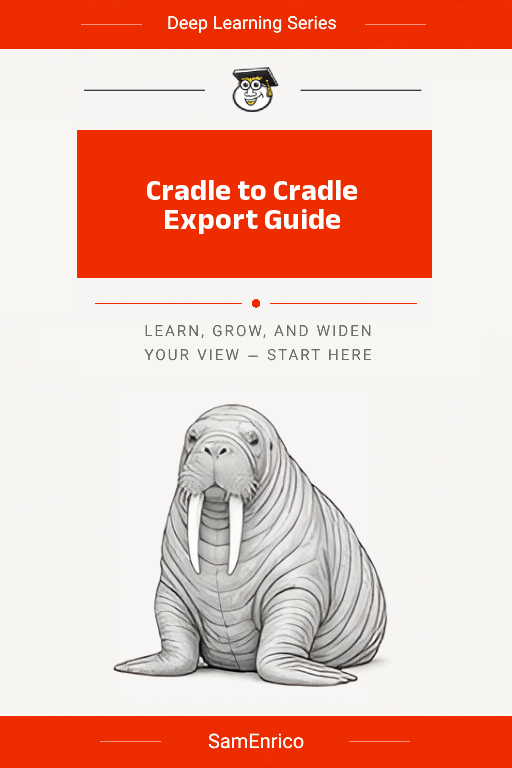
Cradle to Cradle Export Guide eBook
Achieve Cradle to Cradle certification for circula
Achieve Cradle to Cradle certification for circular economy exports, assessing material health and recyclability for premium European industrial buyers.
Formats
Free sample
Chapter 1: The Export Graveyard...--The port of Rotterdam is the largest and most sophisticated entry point for industrial goods in the European Union. Every day, thousands of containers arrive from manufacturing hubs across Asia, the Americas, and Eastern Europe. Inside those containers are products that manufacturers believed were destined for premium European markets—automotive components bound for Stuttgart, construction materials headed to Amsterdam, textiles contracted for Parisian fashion houses.And every day, a growing number of those containers are rejected.Not because the products are defective. Not because the quality is poor. Not because the pricing is uncompetitive.
The containers are rejected because the manufacturer cannot answer three questions that European buyers and customs authorities are now legally empowered to ask: What is in your product? Where will it go when it is no longer useful? And can you prove both of those claims with verifiable, third-party audited data?Welcome to the new industrial reality. The era of shipping products to Europe based solely on price and quality is ending. It is being replaced by a regime where circularity, material transparency, and demonstrated environmental responsibility are not differentiators—they are market access requirements.
This book is written for the exporters who understand that shift and want to turn it from a threat into their greatest competitive advantage.The Graveyard of "Less Bad"For decades, manufacturers operated under a simple, comfortable assumption: doing less harm was good enough. You reduced the amount of plastic in your packaging. You switched from virgin to recycled content. You installed slightly more efficient lighting in your factory. You published a sustainability report with photos of trees.
These were all steps in the right direction, certainly better than doing nothing. But they were fundamentally built on a flawed premise—the premise of being "less bad."The "less bad" approach accepts the underlying linear model of take-make-dispose. It assumes that products will eventually become waste. It tries to minimize the damage along the way: less energy consumed, less toxic runoff, less landfill volume. But it never challenges the fundamental assumption that products are destined for disposal.Europe has rejected this premise.
Not rhetorically—legislatively, with binding regulations and enforcement mechanisms that are already in effect and accelerating. The governing framework is now circularity: the principle that products should be designed, manufactured, and managed so that their materials never become waste. They cycle endlessly between biological nutrients (returning safely to the biosphere) and technical nutrients (feeding new production cycles).The manufacturer who proudly proclaims "our packaging contains thirty percent recycled content" is still admitting that seventy percent is virgin material and that one hundred percent will eventually require disposal. That is not a value proposition in contemporary European procurement. It is a liability statement.The Two Policies That Changed Everything To understand why circularity has moved from environmental idealism to hard legal requirement, exporters must understand two specific EU policy frameworks.
Neither is a suggestion. Neither offers waivers for non-European manufacturers. Both apply to any product placed on the EU market, regardless of its country of origin.The Carbon Border Adjustment Mechanism (CBAM)The Carbon Border Adjustment Mechanism, which entered its transitional phase in October 2023 and becomes fully effective in 2026, is the simpler of the two to understand. It imposes a carbon tariff on imported goods based on the emissions generated during their production. If a manufacturer in Vietnam, Brazil, or the United States produces steel, aluminum, cement, fertilizer, or electricity with higher carbon intensity than the equivalent EU production, that manufacturer pays a tariff equalizing the difference.The immediate implication is obvious: carbon-intensive exporters will become progressively less price-competitive.
But the deeper implication is more significant for this book. CBAM requires detailed emissions data across the supply chain—not estimates, not industry averages, but facility-specific, audited data. The manufacturer who cannot trace and report the carbon footprint of every production stage cannot comply with CBAM. And without compliance, the product cannot enter at any price.CBAM is currently limited to a specific set of carbon-intensive sectors. But its logic—that environmental externalities must be priced at the border—is expanding.
The framework for that expansion is the second, more comprehensive policy.The Ecodesign for Sustainable Products Regulation (ESPR)The Ecodesign for Sustainable Products Regulation, which took effect in July 2024, is the more ambitious and far-reaching of the two. While CBAM addresses carbon specifically, the ESPR addresses circularity comprehensively. It applies to virtually all physical products placed on the EU market, with phased implementation by product category.The ESPR does three things that fundamentally change the export landscape. First, it prohibits the destruction of unsold consumer goods in specified categories—textiles, footwear, electronics—forcing manufacturers to design for reuse and remanufacturing rather than planned obsolescence. Second, it establishes mandatory repairability and recycled content requirements across product categories.
Third, and most significantly for this book, it creates the Digital Product Passport framework.Here is a critical clarification that many exporters miss: the ESPR framework is active now, but its specific Digital Product Passport requirements are being phased in by product category beginning in 2026-2027. Batteries face the earliest deadlines, requiring full DPP compliance by February 2027. Textiles and footwear follow in mid-2027. Toys, consumer electronics, furniture, paints, detergents, and chemicals roll out thereafter. This staged implementation means exporters have time to prepare—but not time to ignore the trend.The Digital Product Passport is not an optional label or a marketing badge.
It is a mandatory data architecture. Every product covered by the ESPR must carry a scannable data carrier—typically a QR code—linked to a digital record containing comprehensive information about the product's composition, origin, environmental impact, repairability, and end-of-life handling. Without a compliant Digital Product Passport, the product cannot be placed on the EU market.This is not a future hypothetical. The technical standards for the Digital Product Passport are being finalized now. The central registry that will house all DPP data must be established by July 19, 2026.
Major European buyers are already piloting DPP systems with their suppliers. The manufacturers who wait until their category deadline arrives will find themselves locked out while their competitors have already integrated.Why Buyers Are Demanding C2C Now Understanding the regulatory landscape explains why European buyers are mandating Cradle to Cradle certification in procurement contracts—not as a nice-to-have, but as a baseline requirement for supplier qualification.German automotive manufacturers face their own regulatory pressures. The End-of-Life Vehicles Directive requires progressively higher rates of recyclability for new vehicles. The Corporate Sustainability Reporting Directive (CSRD) requires these manufacturers to report on environmental and social performance across their entire value chain, including purchased components. A Tier 1 supplier without C2C certification creates reporting risk for the automaker.
A certified supplier reduces that risk.Dutch construction firms operate under similar constraints. The Green Deal on Circular Construction, adopted by the Dutch government, sets specific circular procurement targets for public infrastructure projects. The DGNB (German Sustainable Building Council) and LEED v5 certification systems award optimization points for buildings that incorporate C2C-certified materials. A construction company that cannot document the circularity of its materials cannot win public tenders. Therefore, it will not buy from suppliers who cannot provide that documentation.The pattern is consistent across sectors.…
This is the end of the free sample. Get the eBook to keep going. Buy now
About this book
Details
- Author
- Almanza Edison
- Publisher
- SamEnrico
- Language
- English
- Genre
- Non-Fiction, Business Brief
- Released
- 2026-06-01
- Pages (approx.)
- 157
- Available as
- eBook, Audiobook

Read better in the ZLOADR app
Your eBooks on your phone or tablet. Sign in with your SamEnrico account and start reading.
More by Almanza Edison
 Hypertension and Kidney DiseaseAlmanza Edison$11.99
 Retail Precedent Multiples CourseAlmanza Edison$11.99
 Volcanic Ash CrossingAlmanza Edison$11.99
 Somme Thiepval MonumentAlmanza Edison$11.99
 Holiday Spending AddictionAlmanza Edison$11.99
 Even a Penny Helps GuideAlmanza Edison$11.99
 Sugar Detox for Migraine SufferersAlmanza Edison$11.99
 Substance Use BipolarAlmanza Edison$11.99
 The Fall of the Venezuelan Slugger: David Concepción’s Unfulfilled PromiseAlmanza Edison$11.99
 The Blood Oath: Syria's Prohibition-Era Prison CoupAlmanza Edison$11.99
 A Collector's Handbook to the Ford Rs1600Almanza Edison$11.99
 Oracle Virtual Internship GuideAlmanza Edison$12.99
You may also like
 Hong Kong Handover 1997Dunn Johnnie$11.99
 Zumba For Postnatal Recovery CourseNeal Christian$11.99
 Zumba for BeginnersLadner Nikia$11.99
 YouTube Comment Mining GuideHumes Pandora$12.99
 Worry Box MeditationCarlin Rudy$11.99
 Workplace Stress MeditationNguyen Lynn$11.99
 Workplace Stress and Sleep RepairHawley Ivory$11.99
 Workplace Perfectionism CureDelaney Jeffry$11.99
 Workplace Injustice Anger GuideWallen Isabelle$11.99
 Work Addiction and Burnout LinkGreenwood Ester$11.99
 Women in Yoga and WellnessBeattie Galina$11.99
 Women in Stand Up ComedyChun Evangeline$11.99