
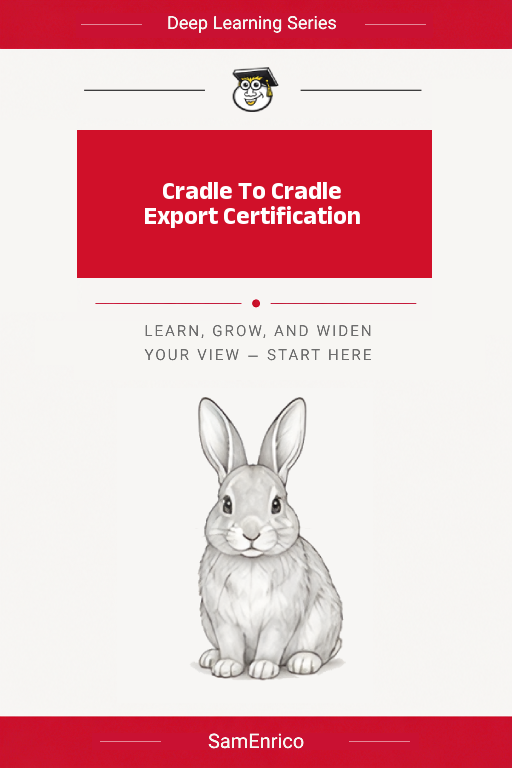
Cradle To Cradle Export Certification eBook
Achieve material health and circularity scores for
by Lanier Viva
Achieve material health and circularity scores for premium sustainable product exports worldwide.
Formats
Free sample
Chapter 1: The Container That Never Arrived--November 17, 2025. The Port of Hamburg. Forty-one refrigerated containers, each packed with precision-engineered furniture from a family-owned factory in Vietnam, sat idle on the dock. The shipment had cleared customs. It had passed all standard safety inspections.
It had arrived on time, undamaged, and fully compliant with every regulation the exporter knew to check.But the buyer—a German office furniture consortium—refused to take delivery.The reason appeared in a single line of text on the buyer's new automated procurement platform: "Product Circularity Score: Below Minimum Threshold. Digital Product Passport Incomplete."Two years of preparation. Four million dollars in production. A twelve-year relationship with the buyer. None of it mattered.
The container never arrived—not because the product was unsafe, not because the paperwork was wrong, but because the exporter had not yet understood what "export-ready" would mean after March 2026.This book exists because that story is about to become commonplace. And because it does not have to be your story.The End of "Less Bad" as a Strategy For the past three decades, exporting a product to premium markets like the European Union, the United States, Japan, or the Gulf Cooperation Council countries has followed a relatively predictable compliance path. You ensured your product met the relevant "less bad" regulations: Ro HS for hazardous substances in electronics, REACH for chemical safety in the EU, the Consumer Product Safety Improvement Act for children's products in the US, or the Toxic Substances Control Act for industrial chemicals. You paid for testing. You filled out declarations of conformity.
You shipped your containers. The system rewarded compliance, but it did not reward ambition. The goal was to be not harmful enough to be stopped.That era is ending.The shift began quietly, with sustainability reports and voluntary certification schemes. But it accelerated abruptly with three concurrent developments between 2024 and 2026. First, the European Union finalized the Ecodesign for Sustainable Products Regulation (ESPR) and its centerpiece, the Digital Product Passport (DPP)—a mandatory digital record of a product's environmental and circularity performance that will be required for virtually all products sold in the EU by 2028.
Second, the Cradle to Cradle Products Innovation Institute released Version 5.0 of its certification standard, fundamentally rewriting the rules for what counts as a "circular" or "material healthy" product. Third, major procurement platforms—from Amazon Business to SAP Ariba—began integrating circularity scores directly into their purchasing algorithms, making certification a machine-readable precondition for visibility, not just a marketing badge.The common thread across these three developments is the death of the compliance floor and the birth of the performance staircase. Under the old model, if you met the regulation, you were in. Under the new model, meeting the regulation merely grants you the right to be considered—but you will be ranked, scored, and compared against every other exporter on metrics you may not have even known existed.This book is the map for that new territory. It is not a philosophy book.
It is not a design manifesto. It is a tactical, operational, chapter-by-chapter guide to achieving the material health and circularity scores that will unlock premium export markets in the Version 5.0 era. And it begins with a single, non-negotiable premise: you can no longer compete on price alone. You must compete on Material Health Transparency.Why "Less Bad" Is a Losing Strategy To understand why the compliance floor is collapsing, we must first understand what it was designed to do. Regulations like Ro HS (Restriction of Hazardous Substances) and REACH (Registration, Evaluation, Authorisation, and Restriction of Chemicals) were created to eliminate the worst offenders from the market.
They set thresholds for specific toxic substances: lead, mercury, cadmium, hexavalent chromium, certain phthalates and flame retardants. If your product stayed below those thresholds, you passed. If it exceeded them, you failed. The system was binary. It was also, by design, minimal.There is nothing wrong with minimal standards.
They have removed billions of pounds of toxic chemicals from global commerce. But minimal standards do not create competitive advantage. They create a race to the bottom disguised as compliance. When every exporter meets the same Ro HS thresholds, meeting Ro HS becomes a cost of entry, not a differentiator. And when every exporter claims to be "REACH compliant," the claim becomes noise, not signal.The premium markets have recognized this problem.
And they have responded by moving the goalposts.Consider the following data points, each of which represents a structural shift in how export markets evaluate products:The EU Digital Product Passport (DPP): By 2028, the DPP will be required for all products sold in the EU across the electronics, textile, construction, and battery sectors. The DPP is not a voluntary label. It is a mandatory digital record that must include, among other data points, the product's durability, repairability, recycled content, and—critically—its Cradle to Cradle certification score if the manufacturer holds one. The DPP is designed to be machine-readable, meaning procurement algorithms will sort and rank products based on these scores before a human ever sees them. A product without a DPP, or with a low circularity score, will simply not appear in search results.The ESPR Circularity Requirements: The Ecodesign for Sustainable Products Regulation goes beyond information disclosure.
It empowers the EU to ban products that do not meet minimum circularity standards—including requirements for recycled content, design for disassembly, and the absence of substances that "hamper circularity" (i.e., toxic chemicals that contaminate recycling streams). The first product categories targeted include textiles, electronics, and construction materials—the same categories that represent the highest volume of premium exports.Consumer Willingness to Pay for Material Health: A 2024 study across the EU, US, Japan, and GCC markets found that consumers in the top income quartile (the buyers of premium exports) were willing to pay premiums ranging from 17% to 34% for products with verified non-toxic material chemistry. The highest premiums were observed in baby products (34%), cosmetics (28%), and indoor furniture (22%). Critically, the study found that generic claims like "non-toxic" or "safe" had no measurable premium—only third-party certified claims (specifically C2C, EWG Verified, and Blue Angel) moved the needle.AI Procurement Agents: Amazon Business, Alibaba, and Thomas Net have all confirmed that their next-generation procurement platforms will include filters for circularity scores, material health certifications, and DPP completeness. For B2B buyers, the default search view will exclude products that do not meet a minimum threshold—typically C2C Bronze or equivalent.
This means that uncertified products will not be invisible to consumers (where they might still be found with effort) but invisible to algorithms—which is far worse, because there is no workaround for algorithmic invisibility except certification.Taken together, these data points describe a new export environment. The old game was about avoiding penalties. The new game is about earning access. And the currency of that access is Material Health Transparency—the verified, machine-readable, third-party-audited proof that your product contains no substances that harm human health or block circularity.The Cradle to Cradle Advantage (Not a Philosophy Chapter)At this point, some readers may be expecting a philosophical treatise on the beauty of eco-effectiveness or the poetry of biological and technical nutrients. This book respects those ideas, but it will not…
This is the end of the free sample. Get the eBook to keep going. Buy now
About this book
Details
- Author
- Lanier Viva
- Publisher
- SamEnrico
- Language
- English
- Genre
- Non-Fiction, Business Brief
- Released
- 2026-06-01
- Pages (approx.)
- 154
- Available as
- eBook, Audiobook

Read better in the ZLOADR app
Your eBooks on your phone or tablet. Sign in with your SamEnrico account and start reading.
More by Lanier Viva
 Assertiveness For New MothersLanier Viva$11.99
 The Monk Who Healed LepersLanier Viva$11.99
 Strength Training For Fat LossLanier Viva$11.99
 Meditation Cushion Setup ManualLanier Viva$11.99
 Nightmare and AsthmaLanier Viva$11.99
 Gut Health for PsoriasisLanier Viva$11.99
 The Soup Kitchen RegularLanier Viva$11.99
 Grief Journal for Anticipatory LossLanier Viva$11.99
 Zara Fast Fashion CompulsionLanier Viva$11.99
 Marco Polo's Lost Kingdom: Secrets of the Silk RoadLanier Viva$11.99
 Neon Labyrinth: The Hidden Blueprint of Tokyo’s UndergroundLanier Viva$11.99
 Concrete Dreams: The Rise and Fall of Pruitt-IgoeLanier Viva$11.99
You may also like
 Hong Kong Handover 1997Dunn Johnnie$11.99
 Zumba For Postnatal Recovery CourseNeal Christian$11.99
 Zumba for BeginnersLadner Nikia$11.99
 YouTube Comment Mining GuideHumes Pandora$12.99
 Worry Box MeditationCarlin Rudy$11.99
 Workplace Stress MeditationNguyen Lynn$11.99
 Workplace Stress and Sleep RepairHawley Ivory$11.99
 Workplace Perfectionism CureDelaney Jeffry$11.99
 Workplace Injustice Anger GuideWallen Isabelle$11.99
 Work Addiction and Burnout LinkGreenwood Ester$11.99
 Women in Yoga and WellnessBeattie Galina$11.99
 Women in Stand Up ComedyChun Evangeline$11.99