
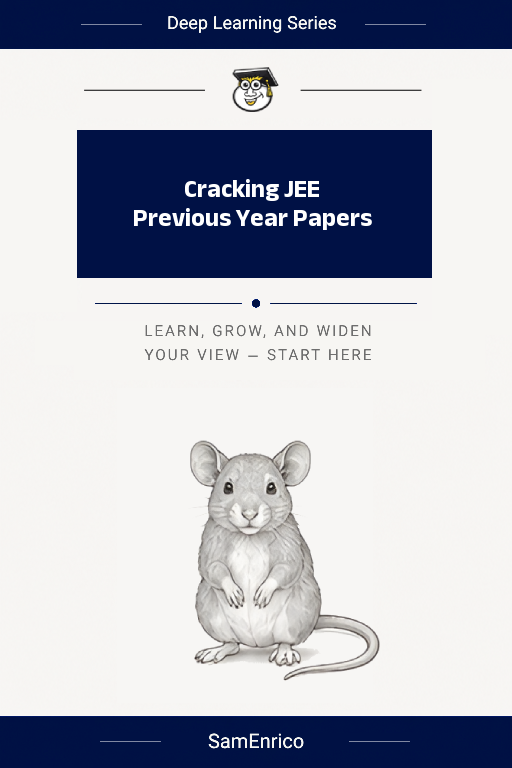
Cracking JEE Previous Year Papers eBook
Analyze past 10 years JEE papers to identify repea
by Brooks Marco
Analyze past 10 years JEE papers to identify repeated question patterns and high weightage topics.
Formats
Free sample
Chapter 1: The Pulley’s Secret...--–- Most JEE aspirants begin their Physics preparation the wrong way. They open a thick textbook, start with the first chapter—Kinematics—and methodically solve every problem from page 1 to page 500. By the time they reach Rotational Motion, they have memorized 87 formulas, solved 400 problems, and retained approximately 12% of it. This is not a failure of effort. It is a failure of strategy.The students who crack JEE Main with 99+ percentile do something fundamentally different.
They do not study Physics linearly. They study it strategically. They have discovered what this chapter will teach you: that Mechanics is not a collection of 15 unrelated topics. It is a small set of repeating question patterns dressed in different clothing. Once you see the patterns, the subject transforms from a mountain of content into a manageable puzzle with predictable solutions.This chapter reveals the hidden architecture of Mechanics as tested in JEE Main over the last decade.
You will learn exactly which topics deliver the highest marks, which question types repeat obsessively, and most importantly, how to recognize and solve them in under 90 seconds. By the end of this chapter, you will never look at a Mechanics problem the same way again.The Real Weightage: Why Mechanics Demands Your Attention First Before we dive into patterns, let us examine the data. Between 2015 and 2025, JEE Main has consistently allocated 25-30% of the Physics paper to Mechanics. In a typical 25-question Physics paper, this translates to 7-9 questions worth 28-36 marks. No other area of Physics comes close to this consistency.But here is what the data tables do not tell you.
Within that 25-30%, the distribution is not uniform. Three topics—Rotational Motion, Newton’s Laws of Motion (NLM) with Friction, and Work-Energy-Power (WEP)—account for nearly 70% of all Mechanics questions. The remaining 30% is spread across Kinematics, Gravitation, Fluid Mechanics, and Properties of Matter.This concentration is your first pattern. If you master just these three topics, you have already secured approximately 20 marks from Mechanics alone. The rest is optimization.Let us examine each of these high-yield areas in detail.Rotational Motion: The Most Repeated Topic in JEE Physics If there is one topic that separates serious aspirants from the rest, it is Rotational Motion.
Over the last ten years, this topic alone has delivered 2-3 questions every single year. No other topic in Physics can match this consistency.Why Rotational Motion is the Examiner’s Favorite The NTA loves Rotational Motion for three reasons. First, it seamlessly combines concepts from multiple areas—forces, torque, energy, and angular momentum—into a single problem. Second, it offers endless variations while testing the same core principles. Third, it reliably separates students who understand concepts from those who simply memorize formulas.The Three Question Types That Appear Every Year Through analysis of the last decade, three specific question types account for 85% of all Rotational Motion problems.Type 1: Moment of Inertia Comparisons The examiner gives you two or three objects (hoop, disc, sphere, solid cylinder, hollow cylinder) and asks you to compare their moments of inertia, or to find the one that will roll down an incline the fastest, or to determine which has greater rotational kinetic energy for the same angular velocity.The pattern is so predictable that we can state it as a rule.
When comparing objects rolling down an incline without slipping, the order of acceleration is always: solid sphere > solid cylinder > hollow sphere > hollow cylinder > hoop. This order never changes because it depends only on the shape’s moment of inertia factor (k²/R²), not on mass or radius.Type 2: Conservation of Angular Momentum A classic setup involves a person standing on a rotating platform holding weights. When the person pulls the weights inward, what happens to the angular velocity? Or a disc rotating freely, and a smaller disc is dropped onto it. Find the new angular velocity.The underlying pattern is always the same: initial angular momentum equals final angular momentum.
The moment of inertia changes, so the angular velocity must change inversely. The chapter provides a three-step template for all such problems.Type 3: Torque and Rotational Dynamics A pulley with mass (not massless) has a string wrapped around it with a hanging mass. Find the acceleration of the hanging mass. Or a rod hinged at one end is released from horizontal. Find its angular acceleration at the instant of release.The pattern here involves writing two equations: linear force balance on the hanging mass and torque balance on the pulley or rod.
The constraint links linear acceleration to angular acceleration (a = αR). Solve simultaneously.Key Pattern Revealed: The Rolling Without Slipping Condition The single most tested concept in Rotational Motion is the rolling without slipping condition: v = ωR. This appears in 80% of problems. Yet students routinely forget to use it. When you see a problem mentioning “rolling” or “does not slip,” immediately write v = ωR and a = αR.
This single reflex will solve half the problem before you have read the rest of the question.Newton’s Laws of Motion: The Pairing Rule If you open any JEE Main paper from the last ten years and look at the NLM questions, you will notice something striking. Newton’s Laws are never asked alone. Never.The NLM Pairing Rule The examiner always pairs Newton’s Laws with either friction on an inclined plane or circular motion (at the top of a loop, on a banked road, or on a rotating platform). This is not a coincidence. It is a deliberate design choice because isolated NLM problems are too simple for JEE Main.When you see a problem that seems to be about NLM, your first question should be: “What is it paired with?” The answer tells you which additional formulas you will need.The Incline-Plane-Friction Pattern This is the most common pairing.
A block is placed on an inclined plane. You are given the angle, coefficient of friction (static or kinetic), and sometimes an applied force. You are asked whether the block slides, its acceleration, or the minimum force to start motion.The pattern always reduces to comparing the component of gravity along the incline (mg sinθ) with the maximum static friction (μ_s mg cosθ). If mg sinθ exceeds μ_s mg cosθ, the block slides. If it slides, kinetic friction applies (μ_k mg cosθ), and acceleration = g(sinθ - μ_k cosθ).This appears so frequently that you should be able to solve it in under 60 seconds without pausing to think.The Circular Motion Pairing A block on a rotating disc, a car on a banked road, a cyclist taking a turn, or a mass tied to a string moving in a vertical circle.
These all test NLM in the context of centripetal force.The pattern: the net force toward the center equals mass times centripetal acceleration (mv²/R or mω²R). Identify all forces acting on the object. Resolve them into radial and tangential components. Set the radial sum equal to mv²/R. Solve for the unknown.The most repeated variation is the “maximum speed without slipping” problem on a banked road or flat curve.
For a flat curve, the maximum speed v_max = √(μ_s g R). For a banked road with no friction, v…
This is the end of the free sample. Get the eBook to keep going. Buy now
About this book
Details
- Author
- Brooks Marco
- Publisher
- SamEnrico
- Language
- English
- Genre
- Non-Fiction, Student's Shortcut
- Released
- 2026-06-01
- Pages (approx.)
- 127
- Available as
- eBook, Audiobook

Read better in the ZLOADR app
Your eBooks on your phone or tablet. Sign in with your SamEnrico account and start reading.
More by Brooks Marco
 Spending Addiction and InsomniaBrooks Marco$11.99
 MBSR Body Scan FoundationBrooks Marco$11.99
 Agency Client Bankruptcy FalloutBrooks Marco$11.99
 The Chemistry Nobel Lithium BatteryBrooks Marco$11.99
 Rocking Motion as PacifyingBrooks Marco$11.99
 Nobel Prize Semiconductor PioneersBrooks Marco$11.99
 Beginner Meditation Timer GuideBrooks Marco$11.99
 Voyageurs DisappearancesBrooks Marco$11.99
 The Vanishing of the Pharaoh’s GoldBrooks Marco$11.99
 Whispers from the Black Sun: The Lost Oracle of Delphi’s Final ProphecyBrooks Marco$11.99
 SQL for Data Analysts: FoundationsBrooks Marco$11.99
 CTA for Joint VenturesBrooks Marco$12.99
You may also like
 LSE Online Program LengthAgee Letisha$11.99
 Harvard Extension School for Working AdultsRoush Yer$11.99
 LSE Online Reading ListAshford Ludivina$11.99
 LSE Online Language RequirementsWhitten Daphine$11.99
 LSE Online Class SizeHughey Garret$11.99
 LSE Online Alumni MentorshipWild Lyla$11.99
 London School of Economics Alumni NetworkDutton Chantal$11.99
 Harvard Extension School Student SupportCantrell Christene$11.99
 Harvard Extension School Library AccessSantana Adah$11.99
 Harvard Extension School Degree CompletionBray Wyatt$11.99
 Harvard Extension School Course AuditingAbbott Craig$11.99
 Harvard Extension School Extension DiplomaNew Joane$11.99