
Non-FictionHealth & WellnessTreatment
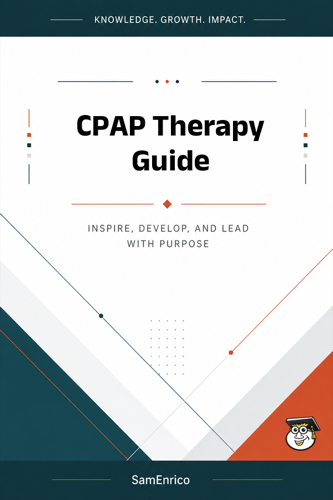
CPAP Therapy Guide eBook
Teaches continuous positive airway pressure setup
by Caruso Chet
Teaches continuous positive airway pressure setup and use.
Formats
Free sample
Chapter 1: The Silent Siege...–- It happens around 2:47 AM. The exact time varies, but the mechanics are always the same. You are lying on your back, deep in REM sleep, your jaw muscles completely relaxed. Gravity pulls your soft palate and tongue backward into your throat. The airway—a flexible tube about the width of a garden hose—collapses shut.
Your diaphragm contracts against a closed airway, creating a negative pressure of minus 50 to minus 80 centimeters of water in your chest. Your oxygen saturation begins to fall: 94 percent… 90 percent… 85 percent. Your brain, starved of oxygen and flooded with carbon dioxide, screams an emergency signal. You do not fully wake. Instead, you surge from deep sleep into a lighter stage, your body jerks, you take a gasping, snorting breath that sounds like a drowning person breaking the surface, and then you fall back asleep.
You will repeat this cycle anywhere from 15 to over 100 times per hour. You will remember none of it in the morning.This is obstructive sleep apnea. And if you are reading this book, there is a very high probability that this scene describes your nights.The Snoring Lie That Keeps You Sick For decades, sleep apnea was dismissed as "a snoring problem." Spouses complained about the noise. The person with apnea was labeled a bad bedfellow, a nuisance, someone who needed to sleep on the couch. Even today, many primary care doctors ask only one question about sleep: "Do you snore?" If you answer yes, they might nod and move on.
If you answer no, they might rule out sleep apnea entirely—a dangerous mistake, because up to 20 percent of people with moderate to severe sleep apnea do not snore audibly. Their airways close silently, and they suffer in silence.The snoring lie has caused immeasurable harm. Snoring is not the disease. Snoring is a symptom—like a check engine light that you have learned to ignore. The real disease is what happens inside your body during those 10-to-60-second pauses in breathing.
And the damage is not theoretical. It is biochemical. It is structural. It is cumulative. And it is largely reversible if you start CPAP therapy correctly and consistently.Let me be direct with you: untreated sleep apnea will shorten your life.
It will damage your heart, your brain, your metabolism, and your mental health. It will make you age faster than your calendar says you should. And every night you sleep without treatment, the damage compounds.But here is the good news—the reason I wrote this book. CPAP therapy, when set up correctly, stops this damage cold. Within the first week of proper use, your body begins to repair itself.
Within three months, some of the damage to your blood vessels can reverse. Within a year, your risk of stroke and heart attack can drop to near-normal levels. The machine on your nightstand is not a punishment. It is a shield. And this chapter will show you what it is shielding you from.The Oxygen Roller Coaster Your Body Cannot Tolerate To understand why sleep apnea is so destructive, you must first understand oxygen.
Your body is a combustion engine. Every cell—in your brain, your heart, your kidneys, your muscles—burns fuel (glucose and fats) in the presence of oxygen to create energy. This process is called aerobic respiration. It is efficient, clean, and sustainable. Without oxygen, your cells switch to anaerobic respiration, which produces far less energy and leaves behind toxic byproducts like lactic acid.During normal sleep, your oxygen saturation stays between 94 and 98 percent.
It is a flat line, steady and boring. During sleep apnea, your oxygen saturation looks like a mountain range. You drop from 96 percent to 85 percent in 20 seconds. Then you gasp and surge back to 94 percent. Then you drop again.
This pattern—chronic intermittent hypoxia—is the core insult of sleep apnea. And your body was never designed to handle it.Every time your oxygen drops, your blood vessels constrict to shunt blood to your brain and heart. Your blood pressure spikes by 15 to 30 points. Your heart rate fluctuates wildly. Your sympathetic nervous system—the fight-or-flight system—activates, flooding your bloodstream with adrenaline and cortisol.
These stress hormones raise your blood sugar, suppress your immune system, and keep your body in a state of low-grade inflammation.Now multiply that by 30 episodes per hour, 8 hours of sleep, 365 days per year. That is 87,600 oxygen drops annually. That is 87,600 spikes in blood pressure. That is 87,600 cortisol surges.No human body can tolerate that indefinitely.The Heart: Your Most Vulnerable Organ Your heart is a muscle that beats approximately 100,000 times per day. It requires a steady supply of oxygen-rich blood delivered through the coronary arteries.
When your oxygen saturation drops during sleep apnea, your heart does not simply complain—it suffers structural damage.The first consequence is hypertension. This is so well-established that the American Heart Association now lists sleep apnea as a secondary cause of high blood pressure. When your airway collapses, you continue trying to inhale against a closed tube. This creates a negative pressure inside your chest that literally pulls blood into your heart. Your heart stretches like a balloon.
This stretching signals your kidneys to retain sodium and water, increasing blood volume. Simultaneously, the adrenaline surges constrict your blood vessels. The result is blood pressure that stays high even during the day, even when you are breathing normally.Here is what most doctors do not tell you: standard blood pressure medications are less effective in people with untreated sleep apnea. You can take two, three, or four drugs, and your morning blood pressure will remain stubbornly elevated because you are trying to treat the symptom (high pressure) without treating the cause (intermittent hypoxia). CPAP therapy, by contrast, lowers blood pressure as effectively as adding a medication—without the side effects.The second cardiac consequence is atrial fibrillation.
This is an irregular, often rapid heart rhythm that originates in the upper chambers of the heart. Atrial fibrillation doubles your risk of stroke and quadruples your risk of heart failure. The link to sleep apnea is so strong that the American College of Cardiology recommends that every patient with atrial fibrillation be screened for sleep apnea. When you treat sleep apnea in a patient with atrial fibrillation, the arrhythmia becomes easier to control with medications and less likely to recur after procedures like cardioversion or ablation.The third consequence is heart failure. Your right ventricle pumps blood to your lungs.
When your airway collapses, the pressure in your pulmonary artery rises dramatically. Your right ventricle has to work harder with every beat. Over months and years, this leads to right ventricular hypertrophy (thickening) and eventually right heart failure. This form of heart failure causes fluid retention, leg swelling, and shortness of breath with minimal exertion.I have sat with patients who insisted they did not need CPAP because "I don't feel that bad." Then I watched them develop heart failure at age 55. Then I watched them struggle to walk to their mailbox.
Then I watched them die a decade earlier than their siblings who did not have apnea. Do not let this be you.The Brain: Silent Drowning and the…
This is the end of the free sample. Get the eBook to keep going. Buy now
About this book
Details
- Author
- Caruso Chet
- Publisher
- SamEnrico
- Language
- English
- Genre
- Non-Fiction, Health & Wellness, Treatment
- Released
- 2026-06-06
- Pages (approx.)
- 160
- Available as
- eBook, Audiobook

Read better in the ZLOADR app
Your eBooks on your phone or tablet. Sign in with your SamEnrico account and start reading.
More by Caruso Chet
 Romantic Partner Nonverbal CuesCaruso Chet$11.99
 Call of Duty Compulsive Play FixCaruso Chet$11.99
 Atomic Habits For CourageCaruso Chet$11.99
 The Confidence After Maternity LeaveCaruso Chet$11.99
 Remote Work HR GuideCaruso Chet$11.99
 Puncture Wound Depth RiskCaruso Chet$11.99
 Loci Method For StudentsCaruso Chet$11.99
 Whispers of the Silent City: The Forgotten Library of AshurCaruso Chet$11.99
 Growing BulbocodiumCaruso Chet$11.99
 Bible and Religious Text CitationCaruso Chet$12.99
 Ghana Dropshipping Mobile MoneyCaruso Chet$12.99
 How to Produce Musical Keyboard Bags and CasesCaruso Chet$11.99
You may also like
 Hong Kong Handover 1997Dunn Johnnie$11.99
 Zumba For Postnatal Recovery CourseNeal Christian$11.99
 Zumba for BeginnersLadner Nikia$11.99
 YouTube Comment Mining GuideHumes Pandora$12.99
 Worry Box MeditationCarlin Rudy$11.99
 Workplace Stress MeditationNguyen Lynn$11.99
 Workplace Stress and Sleep RepairHawley Ivory$11.99
 Workplace Perfectionism CureDelaney Jeffry$11.99
 Workplace Injustice Anger GuideWallen Isabelle$11.99
 Work Addiction and Burnout LinkGreenwood Ester$11.99
 Women in Yoga and WellnessBeattie Galina$11.99
 Women in Stand Up ComedyChun Evangeline$11.99