
Non-FictionInformativeEducational
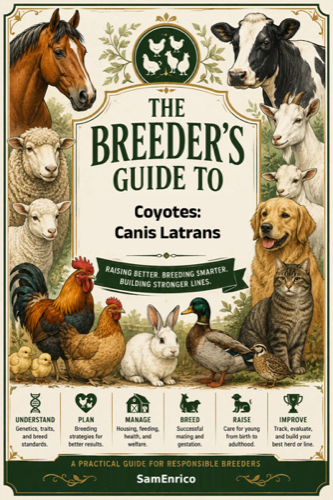
Coyotes: Canis Latrans
This wildlife publication, published by SamEnrico,
by Land Nada
This wildlife publication, published by SamEnrico, covers Coyotes: Canis Latrans
Formats
About this book
Free sample
Chapter 1: The Song Dog’s Secret...–- The animal that refused to vanish begins with a whisper, not a roar. In the pale light just before dawn, a sound rises from the chaparral-covered hills outside Los Angeles. It starts as a single quavering note, then splits into a cascade of yips, howls, and staccato barks. To the uninitiated, it sounds like a dozen animals. In truth, it is often just two.
This is the voice of Canis latrans — the barking dog — and it is the most successful predator’s song in the modern history of North America. But to understand why that song now echoes from downtown Chicago to the suburbs of Toronto, from the Bronx to the highlands of Costa Rica, we must first answer a deceptively simple question: What, exactly, is a coyote? The answer is not merely a matter of taxonomy. It is a story of evolutionary grit, endurance, and a genetic heritage that has allowed this animal to do what wolves, bears, and mountain lions could not: thrive in the age of humans.The Name and the Misunderstanding The scientific name Canis latrans was bestowed by the naturalist Thomas Say in 1823, during a poorly provisioned expedition to the rocky outcroppings near the present-day border of Colorado and Nebraska. Say heard the animal’s nightly chorus and, lacking a better descriptor, called it the “barking dog.” It was a dismissive label, the kind given to something considered a lesser cousin of the true wolf.
For much of the next two centuries, that dismissal would prove costly — not for the coyote, but for the ranchers, trappers, and government agents who tried to eradicate it. Underestimating Canis latrans has always been a mistake. The name itself is a misdirection, for the coyote does not merely bark. It sings, whispers, growls, and howls in a vocabulary so nuanced that researchers have identified at least eleven distinct vocalizations, each with variations that shift according to region, season, and even the presence of human listeners.Taxonomically, the coyote sits within the Kingdom Animalia, Phylum Chordata, Class Mammalia, Order Carnivora, Family Canidae, and…
This is the end of the free sample. Get the eBook to keep going. Buy now
Contents
- Chapter 1
- Chapter 2
- Chapter 3
- Chapter 4
- Chapter 5
- Chapter 6
- Chapter 7
- Chapter 8
- Chapter 9
- Chapter 10
- Chapter 11
- Chapter 12
Details
- Author
- Land Nada
- Publisher
- SamEnrico
- Language
- English
- Genre
- Non-Fiction, Informative, Educational
- Released
- 2026-05-07
- Pages (approx.)
- 119
- Available as
- eBook, Audiobook

Read better in the ZLOADR app
Your eBooks on your phone or tablet. Sign in with your SamEnrico account and start reading.
More by Land Nada
 Corporate Culture StatementLand Nada$11.99
 Car Horn Etiquette and AngerLand Nada$11.99
 Postpartum for Surrogate MothersLand Nada$11.99
 BI RADS Score ExplainedLand Nada$11.99
 Meditation for Financial AnxietyLand Nada$11.99
 Scarcity Marketing StrategiesLand Nada$11.99
 Constraints for DancersLand Nada$11.99
 Anticipatory Grief MedicationLand Nada$11.99
 The Silent Betrayal: How a Trusted Advisor Toppled a DynastyLand Nada$11.99
 The Maori Tattooed Muse: How a Polynesian Beauty Revolutionized Ancient FashionLand Nada$11.99
 How to Produce Cookie and Brownie DoughLand Nada$11.99
 Health Insurance for Argentina Students WorkbookLand Nada$12.99
You may also like
 Hong Kong Handover 1997Dunn Johnnie$11.99
 Zumba For Postnatal Recovery CourseNeal Christian$11.99
 Zumba for BeginnersLadner Nikia$11.99
 YouTube Comment Mining GuideHumes Pandora$12.99
 Worry Box MeditationCarlin Rudy$11.99
 Workplace Stress MeditationNguyen Lynn$11.99
 Workplace Stress and Sleep RepairHawley Ivory$11.99
 Workplace Perfectionism CureDelaney Jeffry$11.99
 Workplace Injustice Anger GuideWallen Isabelle$11.99
 Work Addiction and Burnout LinkGreenwood Ester$11.99
 Women in Yoga and WellnessBeattie Galina$11.99
 Women in Stand Up ComedyChun Evangeline$11.99