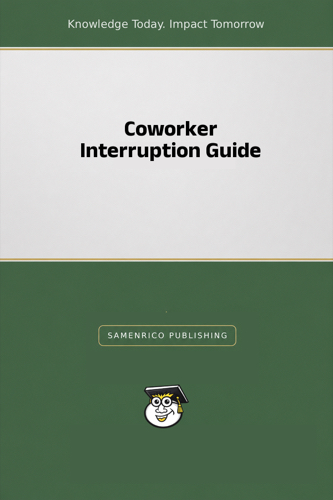
Coworker Interruption Guide eBook
Sets polite but firm boundaries with colleagues.
Sets polite but firm boundaries with colleagues.
Formats
Free sample
Chapter 1: The Focus Theft Epidemic--–- You are being robbed. Not of your wallet, your identity, or your sense of security—but of something far more precious. You are being robbed of your attention, your cognitive momentum, and your ability to do the work that actually matters. The thief does not wear a mask or carry a weapon. The thief knocks on your office door, taps your shoulder, pings you on Slack, or "just has a quick question." The thief is your colleague.
And the theft happens dozens of times per day, often with your explicit permission.The Quiet Crisis of the Open Office Let us begin with a simple experiment. Think back to yesterday. How many times were you interrupted while trying to focus on a single task? Not the times you checked your phone voluntarily or wandered into a meeting you did not need to attend. The times someone else—a coworker, a manager, a well-meaning teammate—broke your concentration.
If you are like most knowledge workers, the number is somewhere between seven and fifteen. Now multiply that by the number of working days in a year. You are being interrupted somewhere between 1,500 and 3,500 times annually. Each interruption, research from the University of California Irvine has shown, costs an average of twenty-three minutes and fifteen seconds to recover from fully. Do the math.
You are losing somewhere between fifty and one hundred thirty hours of focused work per year to interruptions that almost never need to happen in the first place.This is not a productivity problem. It is a crisis of workplace culture, and it has been hiding in plain sight for decades.The modern office celebrates the "open door" policy. We praise leaders who are accessible. We promote collaboration as the highest virtue. We design floor plans without walls because we believe that serendipitous encounters spark innovation.
And all of these things are true—to a point. Collaboration is essential. Accessibility is a leadership quality. But somewhere along the way, we confused constant availability with good teamwork. We mistook the absence of boundaries for generosity.
And we normalized a rhythm of work in which no one can focus for more than eleven minutes—the actual average interval between interruptions, according to a study published in the journal Organization Science—without someone else demanding a piece of their attention.The Cost You Can Feel but Cannot Name You know the feeling. You are deep in a spreadsheet, a report, a line of code, a strategic plan. Your mind is in that sweet spot where time seems to disappear and the work flows effortlessly. You are solving problems, making connections, building something meaningful. Then comes the knock.
Or the Slack ping. Or the cheerful "Got a sec?" You look up. You smile. You say yes because you are a good colleague. And just like that, the flow state evaporates.
What follows is not just the time spent answering the question. It is the disorientation, the mental whiplash, the five minutes of staring at your screen wondering where you left off. It is the fifteen minutes of re-reading what you had already written to remember your train of thought. It is the quiet resentment that builds over the course of the day, the exhaustion that has nothing to do with the difficulty of your actual work and everything to do with the constant starting and stopping.Most people call this "being busy." They blame themselves. "If I were more disciplined," they think, "I could just ignore the interruptions." Or, "If I were better at saying no, I would not feel so drained at the end of the day." But the problem is not your discipline or your assertiveness.
The problem is the system itself. You have been trained—by workplace norms, by politeness culture, by fear of being seen as difficult—to say yes to every interruption. And no one has ever given you permission to say no with grace.The Data Behind the Distraction Let us look more closely at the numbers because they matter. The University of California Irvine study that established the twenty-three-minute recovery time is not a niche academic finding. It has been replicated across industries, from software development to financial analysis to healthcare administration.
The mechanism is consistent: when you are interrupted, your brain does not simply pause and resume. It must disengage from Task A, switch attention to Task B, process the new information, respond, and then—crucially—re-establish the context of Task A. This re-establishment phase is where the minutes vanish. You have to remember what you were doing, why you were doing it, what you had already decided, and what came next. That process takes time, and it takes energy.A separate study from Florida State University found that even brief interruptions—as short as 2.8 seconds—doubled the error rate on a subsequent task.
A two-second interruption. The time it takes to glance at a Slack notification. The time it takes someone to say your name from across the room. In that blink of an eye, your error rate doubles. Now imagine the cumulative effect of dozens of interruptions per day.
You are not just losing time. You are doing worse work.And yet, the average knowledge worker checks email seventy-four times per day and switches tasks every ten and a half minutes, according to research by Gloria Mark at the University of California Irvine. Eleven minutes of focus, then a switch. Eleven minutes, then a switch. By the end of the day, you have spent more time switching than doing.
You have exhausted yourself not with the work but with the friction of the work.The Collaboration Fallacy Here is where the guilt sets in for most readers. "But my job requires collaboration," you might be thinking. "I cannot just hide in a cave. My team depends on me." This is the Collaboration Fallacy, and it is the most dangerous belief in the modern workplace. The fallacy is this: the belief that constant availability is the same as good collaboration.True collaboration is not constant chatter.
True collaboration is structured, intentional, and asynchronous where possible. A thirty-minute meeting scheduled in advance is collaboration. A thoughtful email that allows the recipient to respond on their own time is collaboration. A shared document with comments and suggested edits is collaboration. A tap on the shoulder to ask a question that could have been an email is not collaboration.
It is theft dressed up as teamwork.The distinction between true collaboration and false urgency is one of the most important skills you will learn in this book. A simple framework: if the question can wait thirty minutes without negative consequences, it is not urgent. If the answer can be found in a shared document, a search bar, or by thinking for sixty seconds, it is not a collaboration—it is a dependency. And if the interruption serves the interrupter's need for immediate gratification but does not advance the team's most important priorities, it is not teamwork. It is a boundary violation.The People Pleaser's Trap Why do we tolerate this?
Why do you say "sure, come in" when you are drowning? Why do you respond to Slack messages within sixty…
This is the end of the free sample. Get the eBook to keep going. Buy now
About this book
Details
- Author
- Gandy Jerrell
- Publisher
- SamEnrico
- Language
- English
- Genre
- Non-Fiction, Self-Help, Office Dynamics
- Released
- 2026-06-08
- Pages (approx.)
- 117
- Available as
- eBook, Audiobook

Read better in the ZLOADR app
Your eBooks on your phone or tablet. Sign in with your SamEnrico account and start reading.
More by Gandy Jerrell
 Loneliness in Small TownsGandy Jerrell$11.99
 David Fathi ACLU ReformGandy Jerrell$11.99
 Sensory Reconnection GuideGandy Jerrell$11.99
 Bedtime Gratitude MeditationGandy Jerrell$11.99
 The Immigrant Franchise KingGandy Jerrell$11.99
 Dream Incubation for WritersGandy Jerrell$11.99
 Fear of Failure for TherapistsGandy Jerrell$11.99
 The Match That Lit the Inferno: The Deadly Arson Plot of the 1870sGandy Jerrell$11.99
 The Bloodied Banners of Goryeo: Admiral Yi Hoe's Last Stand at Ganghwa (1232 AD)Gandy Jerrell$11.99
 How to Produce Vehicle Service ManualsGandy Jerrell$11.99
 How to Produce a Lancashire LoomGandy Jerrell$11.99
 Perfect Competition ExcelGandy Jerrell$12.99