
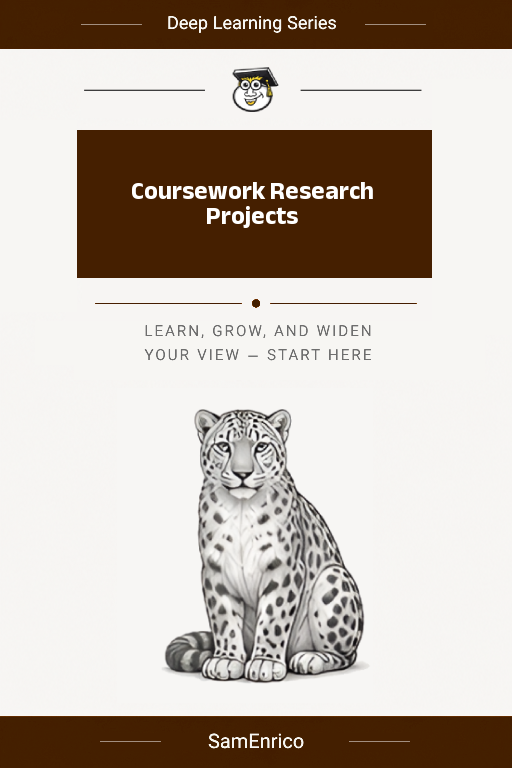
Coursework Research Projects eBook
Turns advanced course research papers and projects
by Cousins Art
Turns advanced course research papers and projects into evidence of research capability for PhD applications.
Formats
Free sample
Chapter 1: The Portfolio Lie--Every ambitious undergraduate and master's student has been told the same lie, whispered in advising offices, repeated in online forums, and reinforced by anxious peers. The lie sounds like this: Get straight A's, score well on standardized tests, and the Ph D admissions committee will recognize your potential. The lie is seductive because it promises a clear path. Study harder. Write better papers.
Earn higher grades. The formula worked for getting into college. It worked for getting into graduate school. Surely it will work for getting into a doctorate.It will not.I have watched hundreds of applicants with perfect 4.0 GPAs receive rejection letters from mid-tier Ph D programs while candidates with B+ averages and compelling research portfolios received funded offers from Ivy League institutions. The difference was never about intelligence or diligence.
The difference was about evidence. Admissions committees do not admit students because they are good at taking classes. They admit students because they believe those students can become independent researchers. And nothing in your coursework—no grade, no exam score, no beautifully formatted bibliography—proves research capability unless you learn to see your assignments differently.This book exists to teach you that skill. Before we build anything, we must first demolish the assumptions that have kept generations of talented students trapped in the consumer mindset, mistaking academic compliance for intellectual promise.The GPA Deception Let us begin with an uncomfortable truth.
Grades measure obedience as much as they measure understanding. A student who follows instructions precisely, cites the required number of sources, and submits work on time will reliably earn a B+ or higher in most courses. That same student may have zero capacity for tolerating ambiguity, formulating original questions, or persisting through failed experiments. The Ph D, by contrast, is a four-to-seven-year exercise in tolerating ambiguity, formulating questions that have no textbook answers, and persisting through failure after failure.I have sat on admissions committees where the conversation went exactly like this: "This applicant has a 3.9 GPA and excellent GRE scores." Pause. "But what can they do?
What research have they actually completed?" Silence. Then the rejection.The committee was not being cruel. They were being rational. A Ph D program is a research apprenticeship. Faculty supervisors invest years of their professional lives mentoring doctoral students.
They need to know, before making that investment, that the student has demonstrated the fundamental building blocks of research capability. Grades do not demonstrate those building blocks. Research projects do.Consider two hypothetical applicants to a political science Ph D program. Applicant One has a 4.0 GPA, perfect GRE scores, and a portfolio of beautifully written term papers that synthesize existing literature. Applicant Two has a 3.6 GPA, solid but unremarkable test scores, and three course-based research projects: a replication study that failed to reproduce a published finding (with a thoughtful discussion of why), a survey of 50 fellow students on voting behavior (with careful attention to sampling limitations), and a literature review that identified a genuine gap in the research on local campaign finance.
Which applicant receives the funded offer?Every admissions committee I have ever served on would choose Applicant Two. The 3.6 GPA signals competence. The research portfolio signals capability. The difference is everything.The Four Pillars of Ph D-Ready Capability Before we can turn coursework into evidence, we must understand what evidence actually matters. Through decades of observing admissions decisions and interviewing faculty supervisors, I have identified four core capabilities that predict doctoral success.
None of them appear on a transcript.Pillar One: Persistence in Ambiguity The most brilliant undergraduate mind often collapses in the face of genuine research uncertainty. Coursework is designed to have a correct answer somewhere—in the textbook, the lecture, the rubric. Research has no correct answer. Research has better and worse questions, more and less elegant methods, findings that raise more questions than they answer.Persistence in ambiguity means the ability to stay curious when the path forward is not clear. It means not panicking when the data do not cooperate, not abandoning a project when the literature review reveals contradictory findings, and not begging a professor to tell you what to do next.
Admissions committees look for evidence of this persistence. They find it in projects where students encountered real obstacles and kept working.Pillar Two: Problem-Framing Most students are excellent problem-solvers given a well-defined problem. Ph D students must first define the problem themselves. Problem-framing is the skill of moving from a vague interest ("I want to study social media and politics") to a researchable question ("To what extent does daily exposure to political content on Twitter predict changes in self-reported voting intention among first-time voters, measured through a pre/post survey design?").The difference between these two formulations is not merely semantic. The first is a topic.
The second is a research question that implies a method, identifies a population, and suggests a measurable outcome. Admissions committees can teach you statistical techniques. They cannot teach you how to ask a question worth answering. They look for applicants who have already begun to develop this skill through their coursework.Pillar Three: Intellectual Ownership Intellectual ownership is the willingness to defend your methodological choices, acknowledge your limitations without apology, and take responsibility for what you have produced. It is the opposite of the student mindset, which asks "What does the professor want me to say?"I have read countless student papers that sound like anxious performances—hedging every claim, deferring to authority, avoiding any original argument.
These papers earn good grades because they are safe. They do not earn admission to Ph D programs because they signal nothing about the student's capacity for independent thought. Intellectual ownership means writing with conviction about what you did, why you did it, what you found, and what you would do differently next time. It means signing your name to your work as a researcher, not a compliant student.Pillar Four: Technical Humility Technical humility is the opposite of impostor syndrome. Impostor syndrome says "I am not good enough and everyone will find out." Technical humility says "I currently know X, I am learning Y, and I have identified Z as my next skill to develop." It is an honest inventory of your capabilities without shame or grandiosity.Admissions committees are not looking for finished products.
They are looking for learners who know what they still need to learn. The student who writes "My statistical training is limited to regression analysis, so I supplemented my findings with qualitative case studies" demonstrates more maturity than the student who pretends to be a statistician. Technical humility is evidence of research readiness because it signals that you will seek help when needed, read methodology books without being assigned them, and grow into the scholar you want to become.The Research Signal Audit: Finding Hidden Gold in Your Syllabi Now that we understand what admissions committees actually seek, we need to find evidence of these pillars in the work you have already done or will soon do. Most students look at their syllabi and see only assignments to complete. I want you to see research signals waiting to be excavated.The Research Signal Audit is a systematic method for scanning past…
This is the end of the free sample. Get the eBook to keep going. Buy now
About this book
Details
- Author
- Cousins Art
- Publisher
- SamEnrico
- Language
- English
- Genre
- research, Student's Shortcut, Coursework
- Released
- 2026-06-01
- Pages (approx.)
- 153
- Available as
- eBook, Audiobook

Read better in the ZLOADR app
Your eBooks on your phone or tablet. Sign in with your SamEnrico account and start reading.
More by Cousins Art
 Combat Nightmare Reduction GuideCousins Art$11.99
 Napoleon's Irish Legion HandbookCousins Art$11.99
 The Aggressive Anxiety LinkCousins Art$11.99
 DBT For NumbnessCousins Art$11.99
 The Peg System Memory PalaceCousins Art$11.99
 The Velvet Quill: Sor Juana Inés de la Cruz and the Revolution of Colonial TheaterCousins Art$11.99
 General ApplicationCousins Art$11.99
 How to Start a Muslin Clipping Business (Beginners Guide)Cousins Art$11.99
 Understanding Syndrome X[disambiguation Needed]Cousins Art$17.99