
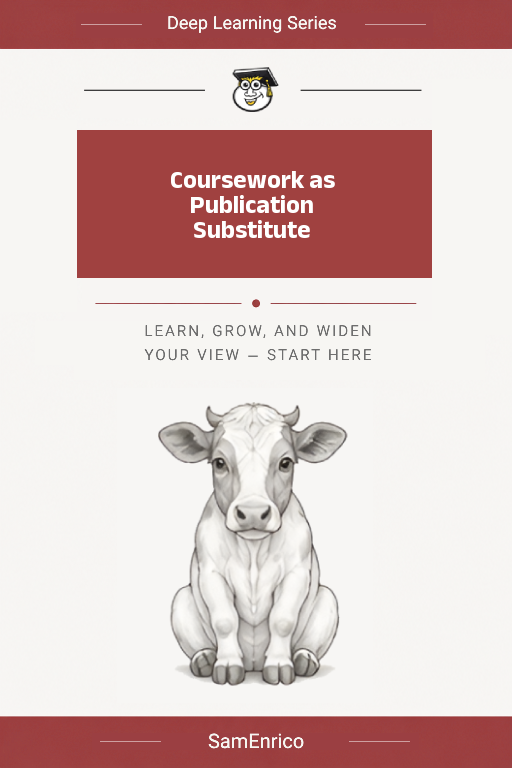
Non-FictionStudent's ShortcutCoursework Strategy
Coursework as Publication Substitute eBook
Highlight advanced seminar papers, literature revi
Highlight advanced seminar papers, literature reviews, and methodological assignments as evidence of scholarly writing.
Formats
Free sample
Chapter 1: The 40-Hour Ghost--It is a Thursday evening in late November, and you have just spent forty hours—two full workweeks—writing a seminar paper. You have pulled all-nighters. You have wrestled with Pro Quest at 2:00 a.m. You have rewritten the same paragraph eleven times, each time convinced that this version will be the one that finally says what you mean. You have sacrificed time with your partner, skipped your friend's birthday dinner, and ignored three separate text messages from your mother asking if you are still alive.You submit the paper at 11:57 p.m., three minutes before the deadline.
Your heart is racing. Your neck hurts from hunching over your laptop. You feel a strange mix of exhaustion and accomplishment, the peculiar high of having produced something that you believe, in this exhausted state, might actually matter.Three weeks later, your professor returns the paper. There is a grade on the first page—an A-minus, or maybe a B-plus, the difference between them feeling cosmically significant even though you cannot remember which is which. There are nine comments scattered across twenty pages.
"Good point." "Expand?" "Awkward phrasing." "See Smith (2019)." And then, at the bottom, a single paragraph of feedback that takes approximately ninety seconds to read.You glance at the comments. You look at the grade. You close the document.And then nothing happens.The paper sits on your hard drive. It sits in your university's learning management system, buried three clicks deep. It will never be read by anyone except you and that one professor.
It will never be cited. It will never appear on your CV. It will never help you get a job, a grant, or a tenure-track position. It will never matter to anyone outside the very small, very temporary transaction that produced it.You spent forty hours writing a ghost.This is not your fault.This is the system.The Disposable Assignment Economy Let us name the problem. Graduate education in the twenty-first century runs on what we will call the Disposable Assignment Economy.
Here is how it works: students produce intellectual labor in the form of papers, literature reviews, and research proposals. Professors evaluate that labor and assign a grade. The paper is then discarded—not literally thrown away, but professionally discarded. It never enters the scholarly conversation. It never becomes citable.
It never outlives the semester.This is a strange way to run a system that claims to be training the next generation of scholars.Consider any other professional training context. A medical resident does not perform forty hours of surgery only to have the patient disappear and the procedure notes thrown away. A law student does not write forty hours of briefs only to have the partner say "good job" and shred the documents. An architecture student does not design forty hours of blueprints only to have the professor say "nice concept" and recycle the paper. In every other profession, the work produced during training is either real work that matters or a simulation explicitly labeled as such.Graduate school does something stranger.
It treats student writing as simultaneously real and disposable. Real enough to spend forty hours on. Real enough to cause anxiety, exhaustion, and self-doubt. Real enough to matter to your GPA, your funding, your graduation timeline, and your sense of self-worth. But not real enough to enter the scholarly record.
Not real enough to be cited. Not real enough to count as evidence that you are, in fact, a scholar.This is the first and most important lie of graduate education: that you are not yet a real scholar, and that your writing is not yet real scholarship, but that you should keep doing it anyway.The Audience of One Problem Why does the Disposable Assignment Economy persist? The answer is simpler and more troubling than you might expect. It persists because the structure of graduate coursework trains students to write for an audience of one.Think about every paper you have written in graduate school. Who was your imagined reader?
If you are honest, you will admit that you were writing for a single person: the professor. You were trying to anticipate what that specific person wanted to see. Did Professor Jones like long block quotes or short paraphrases? Did Professor Smith prefer strong theoretical claims or careful empirical qualifications? Did Professor Chen deduct points for passive voice or for first-person pronouns?
You learned, often through trial and error, the secret preferences of each instructor. And then you wrote to satisfy those preferences.This is not a conspiracy. It is not even malicious. Professors are doing their jobs—reading student work carefully, providing feedback, assigning grades. The problem is not individual professors.
The problem is the structure. When you write for an audience of one, you learn to write defensively, compliance-oriented, and risk-averse. You learn to hedge your claims ("it seems possible that") because you do not want to make a strong assertion that the professor might disagree with. You learn to cite the readings the professor assigned, not the readings that would actually advance your argument. You learn to write what we will call student-ese: a tentative, passive, throat-clearing prose style that signals "I am a diligent student" rather than "I am a scholar with something to say."None of this prepares you for actual scholarly publishing.In the real scholarly world, you write for an audience of strangers.
You do not know who will read your work. You do not know their preferences, their pet theories, or their grading rubrics. You cannot anticipate their objections or tailor your claims to their idiosyncrasies. All you have is your argument, your evidence, and your voice. That is terrifying.
And graduate school does almost nothing to prepare you for that terror because graduate school trains you, relentlessly, to write for an audience of one.Consider the difference. When you write for a professor, you ask: "What does this person want to see?" When you write for an external audience, you ask: "What does this argument require?" The first question is about compliance. The second is about contribution. These are different cognitive tasks, different rhetorical modes, different ways of thinking about yourself as a writer. And the first one actively undermines the second.The Grading-Incentive Mismatch Here is an uncomfortable truth that no one tells you in orientation.
Grades are a terrible incentive system for producing good scholarly writing.Why? Because grades reward compliance, not contribution. You can get an A on a seminar paper that makes no original argument whatsoever, as long as you follow the instructions, cite the required readings, and demonstrate mastery of the course material. In fact, making a truly original argument is often riskier than playing it safe. An original argument might be wrong.
It might be underdeveloped. It might annoy the professor. The safest path to an A is to identify what the professor already believes and write a paper that confirms those beliefs using the sources the professor provided.This is not cynical. This is rational. You are a graduate student.
You need good grades to keep your funding, to stay in good standing, to graduate on time. You are making…
This is the end of the free sample. Get the eBook to keep going. Buy now
About this book
Details
- Author
- Mcdade Refugio
- Publisher
- SamEnrico
- Language
- English
- Genre
- Non-Fiction, Student's Shortcut, Coursework Strategy
- Released
- 2026-05-28
- Pages (approx.)
- 148
- Available as
- eBook, Audiobook

Read better in the ZLOADR app
Your eBooks on your phone or tablet. Sign in with your SamEnrico account and start reading.
More by Mcdade Refugio
 MBSR Beginners Eight Week CourseMcdade Refugio$11.99
 TRIZ Problem SolvingMcdade Refugio$11.99
 Survey Confidence Interval GenerationMcdade Refugio$11.99
 No Equipment HIIT WorkoutsMcdade Refugio$11.99
 OCD And Hair Pulling TrichotillomaniaMcdade Refugio$11.99
 Echoes from the Abyss: The Voyager Golden Record's Cosmic ConversationMcdade Refugio$11.99
 The Plague Hunters of Timbuktu: Africa's Forgotten Battle Against DiseaseMcdade Refugio$11.99
 Understanding Canine DistemperMcdade Refugio$17.99
 Slovak Master Degree GuideMcdade Refugio$12.99
 Forensic AccountingMcdade Refugio$11.99
 How to Become a Mixing-machine FeederMcdade Refugio$11.99
You may also like
 Hong Kong Handover 1997Dunn Johnnie$11.99
 Zumba For Postnatal Recovery CourseNeal Christian$11.99
 Zumba for BeginnersLadner Nikia$11.99
 YouTube Comment Mining GuideHumes Pandora$12.99
 Worry Box MeditationCarlin Rudy$11.99
 Workplace Stress MeditationNguyen Lynn$11.99
 Workplace Stress and Sleep RepairHawley Ivory$11.99
 Workplace Perfectionism CureDelaney Jeffry$11.99
 Workplace Injustice Anger GuideWallen Isabelle$11.99
 Work Addiction and Burnout LinkGreenwood Ester$11.99
 Women in Yoga and WellnessBeattie Galina$11.99
 Women in Stand Up ComedyChun Evangeline$11.99