
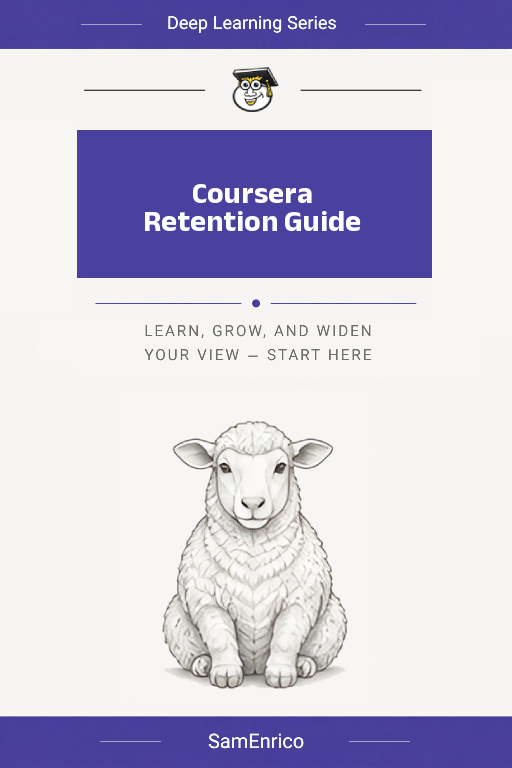
Non-FictionStrategic AtlasRetention Strategy
Coursera Retention Guide eBook
Analyze course progress, certificate completion, a
Analyze course progress, certificate completion, and learning reminders that drive subscriber renewal.
Formats
Free sample
Chapter 1: The Leaky Bucket--– You have just enrolled in a Coursera Specialization. The confirmation email lands in your inbox. You feel a surge of motivation—this is the course that will teach you data analysis, or project management, or artificial intelligence. You log in, watch the first video, maybe take a quick quiz. Then life happens.
A deadline at work. A sick child. The simple exhaustion of a Tuesday evening. By the end of the week, you have not opened the course again. By the end of the month, the emails from Coursera go unread.
By the end of the quarter, you have forgotten you ever enrolled. You are not lazy. You are not undisciplined. You are statistically normal.The data is brutal. Across thousands of MOOCs, nearly half of all learners disengage before completing the first few items in a course.
In some business management courses, up to 48.3% of learners disappear before making meaningful progress. The problem is not the quality of the content. It is not the price (many courses are free to audit). It is the gap between intention and action—a gap that every online learning platform struggles to bridge.This book is not about how to build a better MOOC. It is about how to keep learners on the platform long enough to complete one.
Drawing on best practices from Coursera's own platform data, evidence-led course design from the University of London, and retention strategies from customer engagement research, this 12-chapter framework addresses the entire learner lifecycle: from the first seven days through to certificate completion and subscriber renewal.The title "Coursera Retention Guide" is intentionally practical. This is not a theoretical treatise. It is a playbook for course designers, program managers, and platform strategists who need to move the needle on persistence, completion, and revenue retention. Each chapter identifies a specific point in the learner journey where disengagement is most likely and offers tested interventions to keep learners on track.Let us begin where most journeys end: the first seven days. If you can get a learner through the first week, you have already beaten the odds.The First Seven Days: Where Retention Battles Are Won or Lost The first week of a course is where retention battles are won or lost.
Research from the University of London's analysis of 16 high-enrollment MOOCs found that the sharpest drop-off occurs immediately after the first few items in the course. Learners arrive motivated but disoriented. They encounter dense material, confusing navigation, and insufficient guidance. Many leave within days, never to return.The solution is what the University of London team called a "frictionless entry point"—a redesigned onboarding experience that orients, motivates, and engages learners from the very first click. This chapter introduces four key interventions that belong exclusively in the first week.
(Important note: Scaffolding, which begins in week two, is covered in Chapter 2. The first seven days focus solely on onboarding and habit formation.)Intervention One: Standardized Onboarding Materials Every course should begin with a clear welcome module that answers three questions before the learner watches a single video: What will I achieve by completing this course? How is the course structured (weeks, videos, quizzes, projects)? What time commitment is required? This is not fluff.
It is a contract between learner and platform. Learners who understand what they are signing up for are more likely to follow through.A welcome module should include:A 2-3 minute orientation video from the instructor A written breakdown of weekly topics and estimated time per week A "first week survival guide" highlighting the three most important actions to take A clear statement of the certificate requirements (which quizzes, which projects, minimum passing score)The University of London team found that standardized onboarding reduced early drop-off by orienting learners before confusion could set in. When learners know what to expect, they are less likely to feel overwhelmed and abandon the course.Intervention Two: Scaffolded Early Activities The first quiz should not be the hardest. It should be achievable—a confidence-builder, not a gatekeeper. Early assessments should test basic comprehension, not application or synthesis.
Save the difficult questions for week three, after learners have built momentum.The University of London team found that scaffolding from the very first item significantly improved persistence. Learners who pass their first quiz are more likely to attempt the second. Learners who fail their first quiz are more likely to abandon the course entirely. This is not about lowering standards; it is about sequencing difficulty appropriately.Practical implementation:First quiz: 5 questions, multiple choice, covering only material from the first video Second quiz: 5-7 questions, mixing multiple choice and simple application Third quiz and beyond: Full-length assessments that challenge learners to synthesize Intervention Three: Immediate Cognitive Engagement Passive video watching is the enemy of retention. Learners who watch videos without interacting retain dramatically less than those who are prompted to reflect, apply, and test their understanding.
The first week is when learning habits are formed. If learners develop the habit of passive watching in week one, they will carry that habit through the entire course—and they will remember almost nothing.Immediate cognitive engagement means replacing "watch this video" with "watch this video, then answer this question" or "watch this video, then discuss with a peer." Coursera Coach, the platform's AI-powered learning assistant, enables structured Socratic exchanges around key concepts. In the University of London pilot, 79% of learners rated these dialogue activities as "very useful," and 42.5% reported being challenged to think in new ways.For courses without AI dialogue tools, low-tech alternatives include:Embedded multiple-choice checkpoints within videos A required discussion post after each video ("What is one question you have about this concept?")A one-sentence summary prompt ("In your own words, explain X")Intervention Four: Progress Nudges and Streak Rewards (Introduction)Behavioral psychology tells us that people hate breaking streaks. The same principle that keeps people returning to language learning apps and fitness trackers can keep learners returning to their courses. In-app progress nudges and streak rewards give learners a small dopamine hit for simply showing up.A streak reward might be as simple as a visual badge for logging in on consecutive days.
A progress nudge might be a notification that says "You've completed 2 of 5 videos this week—just 3 more to go!" These interventions are most powerful in the first week, when the habit of regular engagement is being formed.However, the full treatment of streak rewards and the loss-frame psychology that makes them effective belongs in Chapter 3, where we explore milestone psychology in depth. For now, know that streak rewards are part of the week-one toolkit, and we will return to them.The University of London Pilot: Evidence That Onboarding Works The University of London's redesign of their MOOC onboarding provides compelling evidence that these interventions drive retention. In one mathematics course, the redesign produced a 255% uplift in course completion. In a corporate strategy course, 99% of learners reached the final week.It is important to note that the 99% statistic reflects the combined effect of onboarding (Chapter 1) and scaffolding (Chapter 2). The University of London team implemented both sets of interventions simultaneously.
For the purposes of this book, we attribute the 99% figure to scaffolding (see Chapter 2) while acknowledging that onboarding…
This is the end of the free sample. Get the eBook to keep going. Buy now
About this book
Details
- Author
- Hayward Telma
- Publisher
- SamEnrico
- Language
- English
- Genre
- Non-Fiction, Strategic Atlas, Retention Strategy
- Released
- 2026-05-28
- Pages (approx.)
- 145
- Available as
- eBook, Audiobook

Read better in the ZLOADR app
Your eBooks on your phone or tablet. Sign in with your SamEnrico account and start reading.
More by Hayward Telma
 Body Scan For Insomnia ReliefHayward Telma$11.99
 Soil Contamination Garden GuideHayward Telma$11.99
 Partner Travel Without YouHayward Telma$11.99
 The Partner Difficult Conversation GuideHayward Telma$11.99
 The Cairo Banker's Folly: How a Victorian-Era Embezzler Almost Collapsed an EmpireHayward Telma$11.99
 Understanding PseudopapilledemaHayward Telma$17.99
 Retirement Plan Legal TrapHayward Telma$12.99
 Elm HarvestingHayward Telma$11.99
 How to Become a Spring CoilerHayward Telma$11.99
You may also like
 Hong Kong Handover 1997Dunn Johnnie$11.99
 Zumba For Postnatal Recovery CourseNeal Christian$11.99
 Zumba for BeginnersLadner Nikia$11.99
 YouTube Comment Mining GuideHumes Pandora$12.99
 Worry Box MeditationCarlin Rudy$11.99
 Workplace Stress MeditationNguyen Lynn$11.99
 Workplace Stress and Sleep RepairHawley Ivory$11.99
 Workplace Perfectionism CureDelaney Jeffry$11.99
 Workplace Injustice Anger GuideWallen Isabelle$11.99
 Work Addiction and Burnout LinkGreenwood Ester$11.99
 Women in Yoga and WellnessBeattie Galina$11.99
 Women in Stand Up ComedyChun Evangeline$11.99