
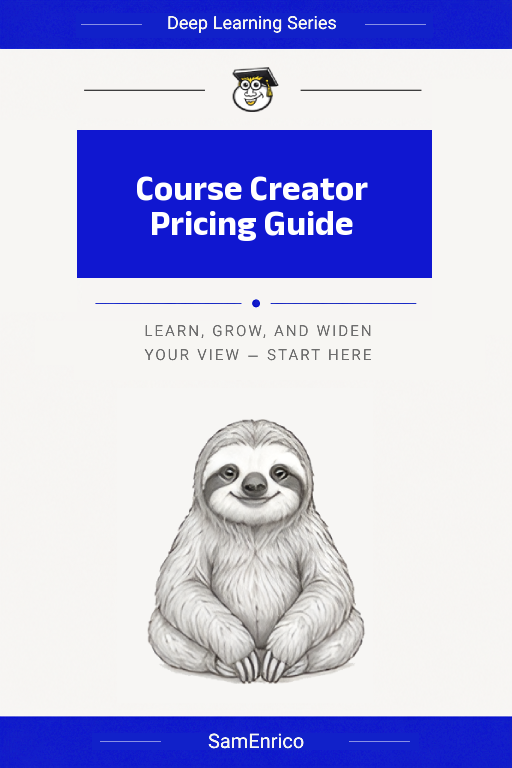
Non-FictionFirst 30 DaysCourse Pricing
Course Creator Pricing Guide eBook
Prices online courses, memberships, and digital pr
Prices online courses, memberships, and digital products confidently using launch pricing, tiered access, and payment plans.
Formats
Free sample
Chapter 1: The Imposter Syndrome Tax--–- You are overqualified to charge more than 97.Yes,you.Thecourseyoubuilttook200hours.Itcontains47videos,12downloadabletemplates,andaprivatecommunitythatyoumoderateyourselfonweekends.Youhavehelped14betastudentsgetresultsrangingfromlandingjobstolaunchingsidehustles.Andyet,whenyousitdowntosetaprice,yourcursorhoversover97. Yes, you. The course you built took 200 hours. It contains 47 videos, 12 downloadable templates, and a private community that you moderate yourself on weekends. You have helped 14 beta students get results ranging from landing jobs to launching side hustles.
And yet, when you sit down to set a price, your cursor hovers over 97.Yes,you.Thecourseyoubuilttook200hours.Itcontains47videos,12downloadabletemplates,andaprivatecommunitythatyoumoderateyourselfonweekends.Youhavehelped14betastudentsgetresultsrangingfromlandingjobstolaunchingsidehustles.Andyet,whenyousitdowntosetaprice,yourcursorhoversover97. Maybe $147 if you are feeling bold. Your stomach knots. What if nobody buys? What if someone leaves a one-star review saying you are overpriced?
What if your own mother laughs?Congratulations. You have just paid the Imposter Syndrome Tax.This tax is not collected by the government. It is collected by fear, disguised as humility. It is the difference between what your course is actually worth and what you have the courage to charge. For most course creators, that gap is not ten or twenty dollars.
It is often five hundred, one thousand, or even five thousand dollars per sale. Over a year, with a few hundred students, the Imposter Syndrome Tax can cost you a six-figure income. Not because your course is bad. Because you priced it from your calendar, not from the transformation it delivers.This chapter exists to make you uncomfortable. Not cruel-uncomfortable, but the kind of uncomfortable that happens when you realize you have been leaving money on the table and calling it "being reasonable." We are going to dismantle every false belief you hold about pricing.
We will replace those beliefs with a single framework that ties your price directly to the cost of your student's problem. And by the end of this chapter, you will have a specific number—not a range, not a guess, a number—that reflects what you should charge. Whether you use that number is up to you. But you will never again pretend that $97 is the "market rate."Let us begin with a story.The Accountant Who Lost $10,000 (And Almost Refused to Fix It)I once consulted with a certified public accountant named Sarah. She specialized in small business taxes.
She had created a self-paced video course showing restaurant owners how to legally deduct every expense from napkins to point-of-sale systems. The average restaurant owner in her city overpaid taxes by roughly $10,000 per year due to missed deductions. Sarah's course closed that gap completely.When I asked what she charged, she said, "$197.""Why $197?" I asked.She shrugged. "That's what other accounting courses cost on Udemy."Let me pause here. Sarah was not stupid.
She was not lazy. She was not greedy. She was suffering from a cognitive distortion that affects nearly every expert who creates digital products. She had anchored her price not to the value she created—saving restaurant owners $10,000 annually—but to the price of competitors who sold generic, non-specialized content.The market rate for a generic accounting course is indeed around $197. But Sarah was not selling a generic accounting course.
She was selling a restaurant-specific tax optimization system. The difference between those two things is the difference between a bandage and surgery. Both address pain, but only one solves the root cause.I asked Sarah a different question: "If a restaurant owner buys your course and saves 10,000thisyear,andthensavesanother10,000 this year, and then saves another 10,000thisyear,andthensavesanother10,000 next year, what is the two-year value of your course?"She paused. "Twenty thousand dollars.""And what would that restaurant owner have paid a local CPA for the same advice?""Probably five thousand dollars per year. So ten thousand total over two years.""Then why," I asked, "are you charging $197?"Sarah did not increase her price to 10,000overnight.Thatwouldhavebeenaleaptoofarforherpsychology.Butshedidincreaseitto10,000 overnight.
That would have been a leap too far for her psychology. But she did increase it to 10,000overnight.Thatwouldhavebeenaleaptoofarforherpsychology.Butshedidincreaseitto1,997. Within six months, she had sold 47 copies. Her revenue went from approximately 9,000(at9,000 (at 9,000(at197 per course) to nearly $94,000—from the same course, with the same videos, the same templates, and the same effort.The Imposter Syndrome Tax had cost Sarah $85,000. She had paid it willingly, believing she was being "reasonable."Why Smart People Charge Stupid Prices If you are reading this chapter, you are likely a smart person.
You have expertise. You have created something useful. And yet, like Sarah, you have probably defaulted to one of three dysfunctional pricing methods.The first is hourly rate pricing. You calculate how many hours you spent creating the course—say, 200 hours. You multiply by what you think your time is worth—say, 50perhour.Thatgivesyou50 per hour.
That gives you 50perhour.Thatgivesyou10,000. Then you panic and divide by 100 because "nobody will pay that." You end up at $100. This method fails because customers do not buy your hours. They buy the result. A surgeon can remove an appendix in forty-five minutes.
You do not pay for the forty-five minutes. You pay for not dying.The second is competitor-based pricing. You search "digital marketing course" on Google or Udemy. You see prices ranging from 49to49 to 49to997. You pick the middle—$297—and call it research.
This method fails because your competitors are also underpricing themselves. You are anchoring to anchors that are already wrong. It is like measuring your height with a broken ruler and then being surprised when you do not fit through the door.The third is cost-plus pricing. You add up your expenses: hosting (50/month),software(50/month), software (50/month),software(100/month), advertising (500/month).Youdividebyexpectedsales(50)andadda30500/month). You divide by expected sales (50) and add a 30% margin.
You land at 500/month).Youdividebyexpectedsales(50)andadda30150. This method fails because the customer does not care about your expenses. They care about their own pain. Nobody wakes up thinking, "I hope this course creator can cover their Kajabi bill."These three methods have one thing in common: they are entirely inward-facing. They look at you—your time, your competitors, your costs.
They do not look at the one person who actually matters: the student, sitting in their kitchen at 11:00 PM, frustrated, stuck, and desperate for a solution.The Transformation Economy (Spoiler: Information Is Now Free)Here is a truth that will either liberate you or terrify you: information is free. Everything you teach in your course is probably available somewhere on You Tube, Reddit, or a random blog from 2014. There are 500 million blog posts on Word Press alone. There are 3.7 million You Tube videos uploaded every single day. Your knowledge, by itself, is not rare.What is rare is transformation.Information is a list of ingredients.
Transformation is the cooked meal. Information is a gym membership. Transformation is the body that emerges after six months of discipline. Information is a PDF of tax codes. Transformation is the $10,000 refund check that arrives in the mail.When you charge for information, you compete with free.
You will lose. Someone, somewhere, will always be willing to give away what you know for nothing, because they monetize through ads, sponsorships, or selling your data. You cannot beat free.When you charge for transformation, you compete with nobody. Because transformation requires trust, structure, accountability, and a system. A You Tube…
This is the end of the free sample. Get the eBook to keep going. Buy now
About this book
Details
- Author
- Canales Roxann
- Publisher
- SamEnrico
- Language
- English
- Genre
- Non-Fiction, First 30 Days, Course Pricing
- Released
- 2026-05-29
- Pages (approx.)
- 137
- Available as
- eBook, Audiobook

Read better in the ZLOADR app
Your eBooks on your phone or tablet. Sign in with your SamEnrico account and start reading.
More by Canales Roxann
 Precedent Transaction DatabaseCanales Roxann$11.99
 NVC In Customer Support WorkbookCanales Roxann$11.99
 FTZ Growth OutlookCanales Roxann$11.99
 The Anapanasati Breath GuideCanales Roxann$11.99
 Loving Kindness For Sleep GuideCanales Roxann$11.99
 The Timbuktu Tally: Mathematicians of the Golden AgeCanales Roxann$11.99
 Tax Farming TaxCanales Roxann$11.99
 How to Start a Accounting Machine Business (Beginners Guide)Canales Roxann$11.99
 Understanding Sleepwalking DisorderCanales Roxann$17.99
 Middle East Sales Objections GuideCanales Roxann$12.99
You may also like
 Hong Kong Handover 1997Dunn Johnnie$11.99
 Zumba For Postnatal Recovery CourseNeal Christian$11.99
 Zumba for BeginnersLadner Nikia$11.99
 YouTube Comment Mining GuideHumes Pandora$12.99
 Worry Box MeditationCarlin Rudy$11.99
 Workplace Stress MeditationNguyen Lynn$11.99
 Workplace Stress and Sleep RepairHawley Ivory$11.99
 Workplace Perfectionism CureDelaney Jeffry$11.99
 Workplace Injustice Anger GuideWallen Isabelle$11.99
 Work Addiction and Burnout LinkGreenwood Ester$11.99
 Women in Yoga and WellnessBeattie Galina$11.99
 Women in Stand Up ComedyChun Evangeline$11.99