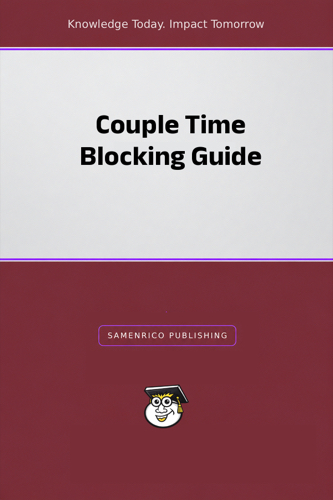
Couple Time Blocking Guide eBook
Schedule date nights and relationship check-ins as
Schedule date nights and relationship check-ins as calendar blocks.
Formats
Free sample
Chapter 1: The Couch Trap--–- The Friday night scene is always the same. You have survived five days of meetings, emails, carpools, deadlines, and the relentless hum of obligation. You are both vertical but barely conscious. You collapse onto the couch at 8:47 PM. Someone opens a laptop.
Someone else picks up a phone. A streaming service autoplays something you have already seen. Two hours later, you mumble “I’m tired” and walk to separate sides of the bed. And somewhere in the silence between brushing teeth and turning off the lamp, one of you thinks it: We never have time for each other anymore.The Most Expensive Lie You Believe Let me name something painful but true. That thought—“we never have time”—is not a fact.
It is a story. And it is the most expensive story your relationship will ever tell itself.Expensive in what currency? Not dollars. In resentment. In loneliness.
In the slow, quiet erosion of the thing that made you choose each other in the first place. The story of “no time” costs you the glances you used to exchange across a crowded room. It costs you the inside jokes that die from lack of repetition. It costs you the sex that shifts from anticipation to memory. And eventually, if you tell the story long enough, it costs you the relationship itself.I am not being dramatic.
I am being precise.The research on relationship dissolution is mercilessly clear. Couples do not usually break up because of one catastrophic event—an affair, a bankruptcy, a screaming fight. Those are the headlines. The actual cause of death is almost always something smaller, slower, and more mundane: drift. Two people slowly stop turning toward each other.
They stop scheduling each other into the white spaces of their calendars. They stop assuming that the other person’s face is worth looking at without a screen in the way. And then one day, they look up from their phones and realize they are roommates who share a mortgage and a last name but not a life.This book exists because that drift is not inevitable. It is reversible. But reversal requires that you first stop lying to yourself about the nature of the problem.The Myth of Spontaneity Here is the lie that keeps the couch trap in business: Real love should not have to be scheduled.Say it out loud.
Most of you have thought it at some point. There is a romantic fantasy buried deep in our culture—sold to us by movies, novels, and the curated social media feeds of couples who seem to float through life having unplanned picnics and spontaneous dance parties—that if you have to put something on a calendar, it is not authentic. Real connection just happens. Real intimacy flows naturally. The moment you block out “date night” from 7:00 to 9:30 PM on a Tuesday, you have killed the magic.This is nonsense.
And worse, it is dangerous nonsense.Spontaneity is not a sign of a healthy relationship. Spontaneity is a sign of an under-scheduled life. Think about the last time you actually had a spontaneous afternoon of lovemaking and long walks and uninterrupted conversation. I will tell you when it was: before you had children, or before you took that promotion, or before you started caring for aging parents, or before you bought the house that needs constant repair. Spontaneity is the luxury of people with surplus time.
If you are reading this book, you do not have surplus time. You have a surplus of obligations. And pretending otherwise is not romantic—it is denial.Consider the alternative framing. What if scheduling your partner into your calendar is not a sign of failure but a sign of respect? What if blocking out two hours for a date night is not killing magic but protecting it?
What if the most romantic thing you can say is not “Let’s see where the night takes us” but rather “I have protected Thursday from 7 to 9 PM. Nothing else gets that space. You do.”That shift in framing—from “scheduled love is fake love” to “scheduled love is prioritized love”—is the foundation of everything that follows in this book. But before we can build the system, we have to diagnose the disease.The Gottman Data: Turning Toward or Drifting Apart Let me introduce you to one of the most important research findings in the history of relationship science. Dr.
John Gottman and his colleagues at the University of Washington spent decades observing thousands of couples in a laboratory apartment they called the “Love Lab.” They wired couples to heart rate monitors, filmed every interaction, and tracked them over years to see who stayed together and who divorced.What they found was both simple and devastating. The difference between thriving couples and failing couples came down to one micro-behavior: bids for connection.A bid is any small attempt to get attention, affirmation, or affection from your partner. It can be verbal: “Hey, look at this funny video.” It can be nonverbal: a touch on the arm, a raised eyebrow, a sigh that invites inquiry. Bids happen dozens of times a day. Most of them last less than three seconds.When a bid is made, the partner has three possible responses:Turning toward – Acknowledging the bid with eye contact, a response, or a reciprocal gesture.
“Oh yeah, that is funny.” A return touch. A question back.Turning away – Ignoring the bid. Continuing to scroll. Walking past without responding. The silent acknowledgment that you heard but did not care enough to engage.Turning against – Responding with hostility.
“Why are you showing me that now? Can’t you see I’m busy?”Here is what Gottman found. Couples who stayed together and reported high relationship satisfaction turned toward each other’s bids 86 percent of the time. Couples who divorced turned toward each other only 33 percent of the time. That is not a small difference.
That is a chasm.And here is the part that should terrify you. Most couples who drift apart do not start with active hostility. They start with benign neglect. They turn away not because they are angry but because they are distracted. The phone is more interesting.
The email is more urgent. The show is more engaging. And after enough ignored bids, partners stop making them. Why reach for someone who never reaches back?The Couch Trap Is a Bid Graveyard Now let me show you how this applies to the Friday night scene I described at the beginning of this chapter.You are on the couch. You are both exhausted.
One of you makes a micro-bid. Maybe it is a hand reaching over. Maybe it is a question about the day. Maybe it is just a sigh that invites a “What’s wrong?”And the other partner—not maliciously, not cruelly, just distractedly—looks at the phone instead. Turns away.
The moment passes.Thirty seconds later, another bid. Turned away.This happens ten, fifteen, twenty times over the course of two hours. By the end of the night, the bidding partner has received a pile of tiny rejections. Not the kind that cause a fight.…
This is the end of the free sample. Get the eBook to keep going. Buy now
About this book
Details
- Author
- Stinson Beryl
- Publisher
- SamEnrico
- Language
- English
- Genre
- Non-Fiction, Self-Help, Relationship Management
- Released
- 2026-06-06
- Pages (approx.)
- 116
- Available as
- eBook, Audiobook

Read better in the ZLOADR app
Your eBooks on your phone or tablet. Sign in with your SamEnrico account and start reading.
More by Stinson Beryl
 Anger And Child's Breakup PainStinson Beryl$11.99
 Performance Pressure AngerStinson Beryl$11.99
 Pain Neuroscience for NursesStinson Beryl$11.99
 The Timbuktu Scholars: Love, Learning, and the Golden Age of African KnowledgeStinson Beryl$11.99
 The Last Broadcast: Titan's WhisperStinson Beryl$11.99
 Wildlife Photography (Scientific)Stinson Beryl$11.99
 Understanding Hyperoxaluria Type 1Stinson Beryl$17.99
 Voice Payment Authentication TechStinson Beryl$12.99
 One Page Portfolio Resume GuideStinson Beryl$12.99