
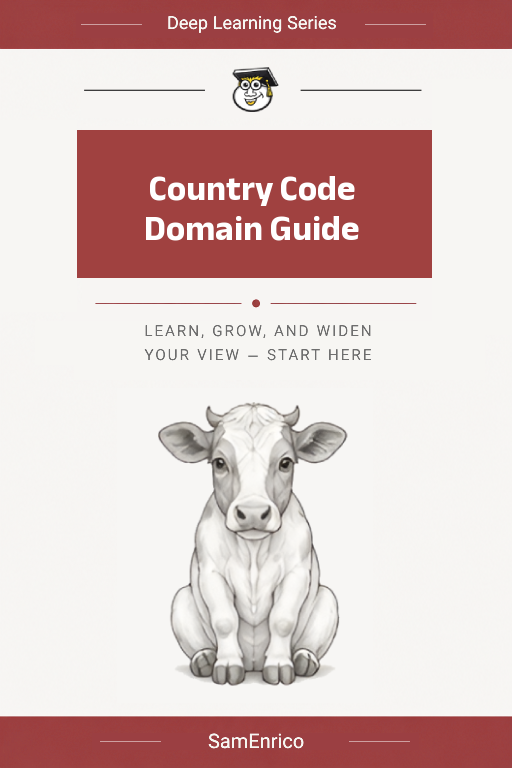
Country Code Domain Guide eBook
Understands differences between .africa (geoTLD),
Understands differences between .africa (geoTLD), .us (ccTLD), .eu (geoTLD) and generic TLDs like .com.
Formats
Free sample
Chapter 1: The Geography Advantage--“Why is my website invisible?”That is the question Maria Chen asked herself every morning for six months. She had launched “Maria’s Artisan Bakery” in Chicago with a flawless recipe for sourdough, a beautiful storefront on Clark Street, and a website she had paid $2,500 to build. Her domain was mariasartisanbakeryandcafe.com. It was long, awkward, and forgettable. But it was a .com, and everyone told her that .com was the only choice that mattered.Maria spent 500amonthon Google Ads,another500 a month on Google Ads, another 500amonthon Google Ads,another300 on SEO consultants, and an embarrassing amount of money on coffee for local food bloggers who never wrote about her.
Her website languished on page four of Google’s search results. Customers who loved her croissants would ask, “Do you have a website? I tried to find you, but I couldn’t remember the address.”She was not alone. Across the United States, Europe, and Africa, millions of small business owners, nonprofit founders, and entrepreneurs were trapped in the same psychological prison. They believed that a .com domain was the only legitimate choice for a serious business.
They believed that any other extension—.us, .eu, .africa, .london, .berlin—was somehow second-class, amateurish, or risky.They were wrong. And that mistake was costing them customers, credibility, and revenue every single day.The Domain You Choose is a Strategic Weapon This book will prove that the top-level domain (TLD) you choose is not a technical detail to be handled by your web developer. It is one of the most powerful strategic signals you can send to both search engines and human beings. The right TLD tells Google where you are located. It tells your customer that you belong.
It tells the world who you are, where you serve, and why you should be trusted.The wrong TLD does the opposite. It makes you invisible. It makes you forgettable. It makes you look like a global corporation pretending to be local, or a local business pretending to be something you are not.Maria eventually discovered the truth. A fellow baker at a farmers’ market mentioned that she had switched from a .com to a .us domain.
Within three months, her local search rankings had skyrocketed. Maria was skeptical—after all, how could changing the last three letters of a web address possibly matter more than all the SEO money she had spent?She decided to test it. She registered mariasbakery.us. The name was shorter, cleaner, and included the geographic signal of the United States. She redirected her old .com to the new domain, updated her Google Business Profile, and waited.Within six weeks, she appeared on page one for “bakery near me” and “best sourdough Chicago.” Organic traffic tripled.
Phone calls from local customers doubled. Her monthly advertising spend dropped by sixty percent.Maria had discovered what this book will teach you: geography is a competitive advantage.The .Com Monopoly: A Historical Accident To understand why geographic domains have become so powerful, you must first understand how the internet’s naming system evolved—and why the dominance of .com was never inevitable.In the early days of the commercial internet—roughly 1995 to 2005—there were relatively few top-level domains. You had .com (commercial), .org (organizations), .net (network infrastructure), .edu (education), and a handful of country-code domains like .us (United States), .uk (United Kingdom), and .de (Germany). Most of these cc TLDs were poorly managed, difficult to register, and associated with either government entities or amateur hobbyists.During this same period, Silicon Valley exploded. Amazon, Google, e Bay, and countless other billion-dollar companies all chose .com.
The media covered them obsessively. The public began to associate .com not just with commercial activity but with legitimacy itself. If a business didn’t have a .com, the thinking went, could it really be trusted?This was not rational. It was psychological. And it created what we call the .com Bias—the deep, often unconscious preference for .com domains over all others, even when the alternative domain is shorter, clearer, or more relevant.The .com Bias has persisted for three decades, reinforced by every movie that shows a .com website, every podcast that urges listeners to visit a .com address, and every marketing consultant who never bothered to learn about alternatives.But here is the truth that the .com industry does not want you to know: the .com namespace is saturated, expensive, and increasingly irrelevant for local and regional businesses.The Data That Changes Everything Let us examine the numbers.As of 2025, there are approximately 360 million registered domain names across all TLDs.
Of those, roughly 160 million are .com domains. That is a market share of about forty-four percent, not the sixty percent often cited in older reports. The share has been declining steadily for a decade.More importantly, the usable .com namespace is almost exhausted. A study by Domain Tools analyzed all two, three, four, five, and six-character .com domains. Their findings were stark:Every single two-character .com (like ab.com) has been registered since the 1990s.Every single three-character .com (like car.com) has been registered.Over ninety-eight percent of four-character .com domains are taken.Over eighty-five percent of five-character dictionary words in English are already registered as .com domains.What remains are either (a) long, awkward hyphenated names like the-best-bakery-in-chicago-illinois.com, or (b) premium domains listed on aftermarket platforms for five, six, or even seven figures.
The domain bread.com sold for over 500,000.Thedomain‘coffee.com‘soldforover500,000. The domain `coffee.com` sold for over 500,000.Thedomain‘coffee.com‘soldforover1 million.For a small business owner like Maria, buying a premium .com domain was never an option. Her budget was a few hundred dollars, not a few hundred thousand.This is the first principle of modern domain strategy: If you are not a global brand with a seven-figure marketing budget, you should think twice before fighting for a generic .com name.The 2012 ICANN Expansion: The Great Unlocking Everything changed in 2012 when the Internet Corporation for Assigned Names and Numbers (ICANN) made a decision that would reshape the internet’s geography.ICANN is not a corporation in the traditional sense. It is a non-profit, multi-stakeholder organization that coordinates the global domain name system. Its participants include governments, technical experts, businesses, civil society, and academics from around the world.
No single country controls ICANN, and no single company owns it.For years, non-US nations and communities had argued that the domain system was biased toward American commercial interests. Why, they asked, should a business in Kenya or Indonesia be forced to register a .com domain controlled by American registries? Why should a city like Berlin or London have no digital identity of its own?In response, ICANN opened a new application round for generic Top-Level Domains. The results were astonishing. Instead of adding a handful of new extensions, ICANN approved over 1,200 new TLDs.
These included:Geo TLDs representing continents: .africa, .asia Geo TLDs representing cities: .london, .nyc, .berlin, .tokyo Generic TLDs for industries: .bank, .insurance, .lawyer Brand TLDs for corporations: .google, .amazon, .microsoft This expansion broke the monopoly of legacy g TLDs. For the first time in internet history, a business could register a domain…
This is the end of the free sample. Get the eBook to keep going. Buy now
About this book
Details
- Author
- Braswell Stevie
- Publisher
- SamEnrico
- Language
- English
- Genre
- Non-Fiction, First 30 Days, ccTLD
- Released
- 2026-06-01
- Pages (approx.)
- 140
- Available as
- eBook, Audiobook

Read better in the ZLOADR app
Your eBooks on your phone or tablet. Sign in with your SamEnrico account and start reading.
More by Braswell Stevie
 The Income Based App Usage GuideBraswell Stevie$11.99
 Teen Affirmations HandbookBraswell Stevie$11.99
 ED Insurance GuideBraswell Stevie$11.99
 The Foster Home Locked PantryBraswell Stevie$11.99
 CBT For MDD HandbookBraswell Stevie$11.99
 The Last Stand of the Iron Lady: Thatcher’s Final TriumphBraswell Stevie$11.99
 The Breeder's Guide to Roman GeeseBraswell Stevie$11.99
 Fractional CTO for StartupsBraswell Stevie$12.99
 Parisite MiningBraswell Stevie$11.99
 How to Become a Oven TenderBraswell Stevie$11.99
You may also like
 Hong Kong Handover 1997Dunn Johnnie$11.99
 Zumba For Postnatal Recovery CourseNeal Christian$11.99
 Zumba for BeginnersLadner Nikia$11.99
 YouTube Comment Mining GuideHumes Pandora$12.99
 Worry Box MeditationCarlin Rudy$11.99
 Workplace Stress MeditationNguyen Lynn$11.99
 Workplace Stress and Sleep RepairHawley Ivory$11.99
 Workplace Perfectionism CureDelaney Jeffry$11.99
 Workplace Injustice Anger GuideWallen Isabelle$11.99
 Work Addiction and Burnout LinkGreenwood Ester$11.99
 Women in Yoga and WellnessBeattie Galina$11.99
 Women in Stand Up ComedyChun Evangeline$11.99