
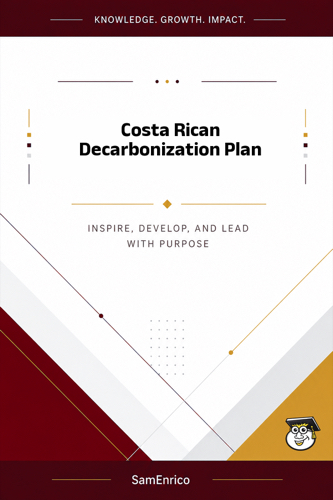
Non-FictionAnnual CheckupCentral American
Costa Rican Decarbonization Plan eBook
Details EV import tax reductions, solar net meteri
Details EV import tax reductions, solar net metering, and green building incentives.
Formats
Free sample
Chapter 1: The Green Paradox...–- On a humid morning in San José, a taxi driver named Carlos switches on his meter and merges into the capital's notorious traffic. Behind him, the exhaust of aging diesel buses forms a hazy curtain against the mountains. Ahead of him, a sleek electric sedan with green license plates glides silently past, its driver paying no attention to the city's driving restrictions. In this single moment, Carlos has unknowingly driven into the central contradiction of Costa Rica's climate story: a nation that lights its homes with nearly 100 percent renewable electricity still poisons its air with imported fossil fuels.This is the Green Paradox. Costa Rica has achieved what most countries only dream about—a national electricity grid powered almost entirely by water, wind, and geothermal heat.
Yet the same country that abolished its army in 1949 and planted peace as its national identity now finds itself fighting a different battle. The enemy is not a neighboring nation but its own transportation system, its buildings, its agriculture, and its waste. The war is decarbonization, and the terrain is far more complex than any military conflict.The numbers tell a troubling story. In 2024, Costa Rica generated approximately 98 percent of its electricity from renewable sources, a feat that places it among an elite group of nations alongside Norway, Paraguay, and Iceland. Hydroelectric dams scattered across the country's river systems provide the backbone, while wind turbines on mountain ridges and geothermal plants near active volcanoes fill the gaps when rainfall is scarce.
For anyone visiting from Europe or North America, where coal and natural gas still light millions of homes, this statistic feels almost unbelievable. How did a small Central American nation with a gross domestic product smaller than the city of Boston achieve what industrial giants could not?The answer lies in geography, history, and a peculiar kind of national stubbornness. Costa Rica sits on the Pacific Ring of Fire, which gives it abundant geothermal potential. Its mountainous interior creates ideal conditions for hydroelectric dams. Trade winds blowing across the Caribbean coast produce reliable wind power.
And decades of political stability, including the abolition of the military in 1949, freed up government budgets for environmental investments rather than tanks and fighter jets. The Payments for Environmental Services program, established in the 1990s, demonstrated early on that Costa Rica would pay its citizens to conserve forests—a radical idea at the time that has since been copied around the world.But here is the paradox that this chapter will unpack. Generating clean electricity is only the first twenty percent of decarbonization. The remaining eighty percent involves everything that happens after electricity leaves the power plant. It involves the cars people drive, the buses they ride, the trucks that deliver bananas to port, the factories that process coffee, the homes they cool with air conditioners, the offices they light with LEDs, and the landfills where they dump their waste.
All of these activities, in Costa Rica as elsewhere, still run primarily on fossil fuels.The transportation sector alone accounts for approximately 65 percent of Costa Rica's total emissions from energy use, a figure that has been climbing steadily since 2010 even as the electricity grid became cleaner. This is the dirty secret of renewable energy: you can have the greenest grid on the planet, but if you drive a gasoline car, take a diesel bus, and fly on kerosene-powered airplanes, your carbon footprint remains large. Costa Rica learned this lesson the hard way, watching its emissions rise through the 2010s despite its hydroelectric accomplishments.The Historical Roots of the Paradox To understand how Costa Rica arrived at this contradictory moment, we must go back to the 1970s, long before climate change entered the popular vocabulary. In 1974, the country created the National Park Service and began systematically protecting its extraordinary biodiversity. Unlike many developing nations that viewed conservation as a luxury for wealthy countries, Costa Rica made it a core part of national identity.
Ecotourism emerged as a major industry, drawing visitors from around the world who wanted to see monkeys in the canopy, turtles on the beach, and quetzals in the cloud forest.By the 1990s, the Payments for Environmental Services program formalized an arrangement that had been growing organically: the government paid landowners to maintain forest cover rather than clear it for cattle or crops. This program, funded by a fossil fuel tax and international donations, became a global model. It proved that environmental protection did not require sacrificing economic development. In fact, ecotourism revenues soon exceeded those from bananas and coffee combined, giving the country a powerful financial incentive to keep its forests standing.The electricity sector followed a similar trajectory. During the 1980s and 1990s, Costa Rica invested heavily in hydroelectric projects, most notably the Arenal Dam, which remains a symbol of the country's engineering ambitions.
When the global climate community began calling for renewable energy in the 2000s, Costa Rica could already claim a grid that was majority-clean. By 2015, the figure had reached 90 percent. By 2019, it touched 99 percent for several consecutive months.But while the grid was greening, the transportation system was moving in the opposite direction. Car ownership in Costa Rica grew rapidly during the same period, fueled by rising incomes, the elimination of import tariffs on used vehicles, and the expansion of road networks. Between 2000 and 2020, the number of registered vehicles nearly tripled, from approximately 800,000 to over 2.2 million.
Most of these were gasoline or diesel powered. Fuel consumption rose accordingly, and with it, emissions.This is the heart of the Green Paradox. Costa Rica solved the easy problem first—cleaning up its electricity grid—but the harder problems of transportation, buildings, industry, and waste have proven more stubborn. The country now faces a choice: declare victory based on its electricity achievements while emissions continue to climb, or confront the difficult political and economic trade offs required to decarbonize the rest of the economy.Why the Paradox Matters for the Rest of the World Costa Rica is not alone in facing this paradox. Across the globe, countries that have made rapid progress on renewable electricity are discovering that the next phase of decarbonization is far more difficult.
In Germany, the Energiewende (energy transition) succeeded in deploying wind and solar but struggled to reduce transportation emissions. In California, the grid has become significantly cleaner, yet traffic congestion and vehicle miles traveled continue to increase. In China, the world's largest manufacturer of solar panels and electric vehicles, coal plants still run at full capacity during peak demand.What makes Costa Rica's case particularly instructive is that it is a developing country, not a wealthy industrial nation. It does not have the financial resources of Germany or California. It cannot subsidize electric vehicles at the scale that Norway can, where EV adoption has exceeded 80 percent of new car sales.
It does not have the manufacturing base to produce its own solar panels or batteries. And it operates within the constraints of a small, open economy that depends on imported fuels and exported agricultural products.Yet Costa Rica has something that many wealthier countries lack: a proven track record of environmental leadership, a stable political system, and a population that broadly supports climate action.…
This is the end of the free sample. Get the eBook to keep going. Buy now
About this book
Details
- Author
- Tolliver Jessi
- Publisher
- SamEnrico
- Language
- English
- Genre
- Non-Fiction, Annual Checkup, Central American
- Released
- 2026-06-09
- Pages (approx.)
- 149
- Available as
- eBook, Audiobook

Read better in the ZLOADR app
Your eBooks on your phone or tablet. Sign in with your SamEnrico account and start reading.
More by Tolliver Jessi
 Self Esteem While Dating OnlineTolliver Jessi$11.99
 Individuation Dream Stages HandbookTolliver Jessi$11.99
 Weekly OKR Check In MethodTolliver Jessi$11.99
 The Vanishing of Lady JaneTolliver Jessi$11.99
 The Ghost in the Machine: How Russia Hacked the 2016 US ElectionTolliver Jessi$11.99
 Video Engagement Analytics GuideTolliver Jessi$12.99
 CTA Penalty And Enforcement HandbookTolliver Jessi$12.99
 Mattress CraftTolliver Jessi$11.99
 Understanding Ichthyosis Hystrix, Curth Macklin TypeTolliver Jessi$17.99
 How to Start a British Dental Association Business (Beginners Guide)Tolliver Jessi$11.99
You may also like
 Hong Kong Handover 1997Dunn Johnnie$11.99
 Zumba For Postnatal Recovery CourseNeal Christian$11.99
 Zumba for BeginnersLadner Nikia$11.99
 YouTube Comment Mining GuideHumes Pandora$12.99
 Worry Box MeditationCarlin Rudy$11.99
 Workplace Stress MeditationNguyen Lynn$11.99
 Workplace Stress and Sleep RepairHawley Ivory$11.99
 Workplace Perfectionism CureDelaney Jeffry$11.99
 Workplace Injustice Anger GuideWallen Isabelle$11.99
 Work Addiction and Burnout LinkGreenwood Ester$11.99
 Women in Yoga and WellnessBeattie Galina$11.99
 Women in Stand Up ComedyChun Evangeline$11.99