
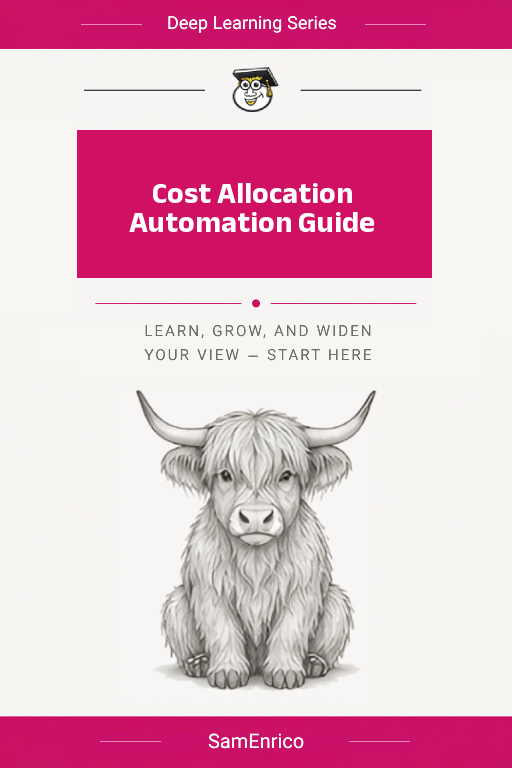
Non-FictionAI OperatorCost Accounting
Cost Allocation Automation Guide Audiobook
Implement AI workflows that automatically allocate
by Yost Cameron
Implement AI workflows that automatically allocate operational costs to departments or projects.
Formats
Free sample
Chapter 1: The Million-Dollar Blind Spot--–- The email arrived at 4:47 PM on a Friday. Maya Chen, CFO of a rapidly growing Saa S company, stared at the subject line: "Q3 Cloud Costs Exceed Forecast by $1.2M – Root Cause Unknown." Her stomach tightened. She had signed off on the quarterly budget just six weeks ago. How could they miss more than a million dollars?She scrolled through the attached spreadsheet. Forty-seven tabs.
Three different currencies. A cost allocation report that had been generated 54 days after the spending occurred. Somewhere in this mess was the answer to why her company's gross margins had dropped eight percentage points. But finding it would require her team of five analysts to spend the next two weeks manually tracing cloud resources, guessing at ownership, and reconciling invoices from a dozen different Saa S providers.By the time they had an answer, the quarter would be over. The damage would be done.
The CEO would be asking harder questions.Maya closed her laptop and thought: "There has to be another way."The Crisis That Finance Leaders Don't See Coming Maya's story is not hypothetical. It is a composite drawn from dozens of real-world conversations with financial controllers, chief financial officers, and operations directors who discovered, often painfully, that their cost allocation systems were failing. The problem is not that these leaders are incompetent. The problem is that the tools they inherited—spreadsheets, traditional enterprise resource planning modules, and manual review processes—were designed for a different era.That era was characterized by predictable, static costs. You bought servers.
You signed annual software licenses. You paid rent. Allocation was straightforward: assign each cost to a department based on a simple formula, review it quarterly, and move on.Today's cost landscape looks nothing like that.Modern operational spending is dynamic, consumption-based, and distributed across dozens of providers. A single product feature might use Amazon Web Services for compute, Open AI for language generation, Stripe for payments, and Snowflake for data storage. Each of these providers bills differently.
Each has different granularity. Each exports data in different formats with different column names and different latency windows.Traditional allocation methods—the spreadsheet templates your predecessor built, the rigid cost center structures in your enterprise resource planning system, the manual tagging processes that rely on engineers remembering to add metadata—are not just inefficient. They are actively misleading.This book exists because that reality is unsustainable.…
This is the end of the free sample. Get the Audiobook to keep going. Buy now
About this book
Details
- Author
- Yost Cameron
- Publisher
- SamEnrico
- Language
- English
- Genre
- Non-Fiction, AI Operator, Cost Accounting
- Released
- 2026-06-01
- Pages (approx.)
- 155
- Available as
- eBook, Audiobook

Listen in the VoxFlicks app
Audiobooks and audio dramas wherever you go. Sign in with your SamEnrico account and press play.
More by Yost Cameron
 Cognitive Reframing at WorkYost Cameron$11.99
 Confident Teen HandbookYost Cameron$11.99
 Ayurvedic Salt GuideYost Cameron$11.99
 Teen Self Esteem and EnvironmentalismYost Cameron$11.99
 South Korean Talent Globalization ForecastYost Cameron$11.99
 Grace in Motion: The Black Pioneers Who Defied Gravity and Defined BalletYost Cameron$11.99
 How to Start a Hobby in pet-sittingYost Cameron$11.99
 Volcanic Gas SamplingYost Cameron$11.99
 Understanding Microcephaly Brachydactyly KyphoscoliosisYost Cameron$17.99
 Ghana Ecommerce Logistics HubsYost Cameron$12.99
You may also like
 Hong Kong Handover 1997Dunn Johnnie$11.99
 Zumba For Postnatal Recovery CourseNeal Christian$11.99
 Zumba for BeginnersLadner Nikia$11.99
 YouTube Comment Mining GuideHumes Pandora$12.99
 Worry Box MeditationCarlin Rudy$11.99
 Workplace Stress MeditationNguyen Lynn$11.99
 Workplace Stress and Sleep RepairHawley Ivory$11.99
 Workplace Perfectionism CureDelaney Jeffry$11.99
 Workplace Injustice Anger GuideWallen Isabelle$11.99
 Work Addiction and Burnout LinkGreenwood Ester$11.99
 Women in Yoga and WellnessBeattie Galina$11.99
 Women in Stand Up ComedyChun Evangeline$11.99