
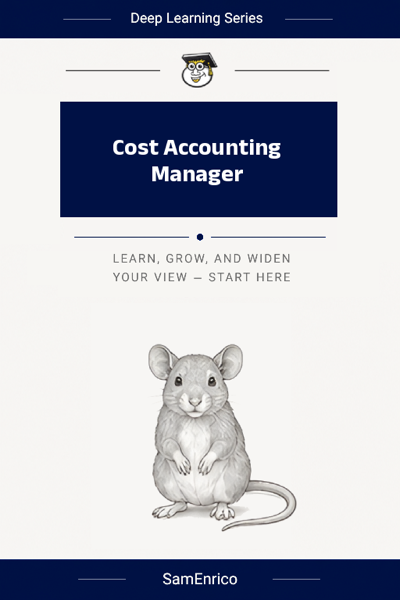
Non-FictionInformativeEducational
Cost Accounting Manager eBook
A Coursebook on Cost Accounting Manager
by Lea Gwenn
A Coursebook on Cost Accounting Manager
Formats
Free sample
Chapter 1: The Profit Detectives--–- The email arrived at 4:47 PM on a Friday, just as Sarah Chen was packing her bag. "Urgent: Q3 margins collapsed. CFO needs answers by Monday. Something is very wrong with our costs." Sarah, newly promoted to Cost Accounting Manager at a $500 million manufacturing firm, stared at her screen. She had inherited a costing system that hadn't been updated since the Clinton administration.
The previous manager had retired after thirty years, leaving behind three-ring binders, dusty spreadsheets, and a parting warning: "The numbers are lying to you, Sarah. They've been lying for years. I just didn't know how to fix it."That Friday evening email launched a six-month journey that would transform not only how the company measured costs but how it made every major decision. Sarah's story—fictional but drawn from dozens of real cost accounting managers the author has advised—illustrates the central thesis of this book: Cost accounting is not about counting beans. It is about detecting hidden truths, exposing silent profit leaks, and giving managers the ammunition they need to win in competitive markets.This chapter establishes your role as a Cost Accounting Manager.
You are not a bookkeeper. You are not a glorified data entry clerk. You are, in the most literal sense, a profit detective. Your tools are not magnifying glasses and fingerprint powder but cost drivers, variance analyses, and activity-based models. Your suspects are not criminals but outdated processes, misallocated overhead, and decisions made with bad information.
Your reward is not a conviction but a healthier income statement, a more competitive product portfolio, and a seat at the strategic table.If you came to this book expecting a dry recitation of accounting rules, close it now and return it to wherever you found it. This book is for managers who want to lead, not just report. It is for professionals who understand that cost data, when properly understood, is the single most powerful lever for improving profitability. And it is for those who are willing to challenge every assumption, question every allocation, and dig deeper than anyone else in the organization.Let us begin with the fundamental distinction that separates cost accounting from its more famous cousin.The Great Divorce: Cost Accounting vs. Financial Accounting Every business maintains two parallel universes of numbers.
The first universe, financial accounting, is the world of external reporting. It produces the income statements, balance sheets, and cash flow statements that go to investors, banks, regulators, and the Internal Revenue Service. Financial accounting follows strict rules—Generally Accepted Accounting Principles (GAAP) in the United States, International Financial Reporting Standards (IFRS) almost everywhere else. These rules prioritize consistency, verifiability, and comparability across companies. A dollar of inventory must be treated the same way by General Motors, Procter & Gamble, and a small family bakery, at least in theory.The second universe, cost accounting, operates under no such constraints.
Cost accounting is internal. Its reports never leave the building (or at least, they should not). Its rules are whatever helps managers make better decisions. It can invent new categories, change allocation methods monthly, and ignore GAAP entirely if doing so provides clearer insight. Financial accounting asks, "What happened?" Cost accounting asks, "What should happen next?"This distinction is not merely academic.
Consider inventory valuation. Under GAAP, a manufacturer must include direct materials, direct labor, and both variable and fixed manufacturing overhead in the cost of inventory. This is called absorption costing, and it is non-negotiable for external reporting. But for internal decision making, absorption costing can be disastrous because it hides the behavior of fixed costs. A manager who uses absorption costing to evaluate a special order might reject a profitable deal because the fixed overhead allocation makes the product look expensive, when in fact the fixed costs would exist regardless.Cost accounting liberates you from these constraints.
You can use variable costing (including only variable costs in product costs) for short-term decisions. You can allocate overhead based on activities rather than machine hours. You can treat depreciation as irrelevant for some decisions and critically important for others. The only test is whether the information improves decisions.Sarah Chen learned this lesson painfully. Her predecessor had built a costing system designed entirely for external reporting.
Every product received a share of overhead based on direct labor hours. But Sarah's factory had automated heavily over the previous decade. Direct labor had fallen to less than five percent of total cost. Using labor hours to allocate overhead was like using a sundial to time a rocket launch. The numbers were not just imprecise; they were actively misleading.
Products that consumed large amounts of machine time, setup time, and engineering support appeared artificially cheap because they used little direct labor. Products that were simple and labor-intensive appeared artificially expensive.The result? The company had been systematically overpricing its simple products and underpricing its complex ones. Competitors were eating their lunch on the simple products while customers complained about high prices on specialty items. The sales team had no idea why they kept losing bids.
The CFO was convinced the problem was on the revenue side. Sarah discovered it was on the cost side.The Five-Step Decision Framework That Will Structure Your Career Throughout this book, we will return to a single decision-making framework. It appears in every chapter, applied to different problems, but the core remains constant. Memorize it. Internalize it.
Teach it to your team.Step One: Identify the Problem or Opportunity Most organizations are excellent at identifying symptoms and terrible at identifying root causes. "Our margins are falling" is not a problem; it is a symptom. The problem might be rising material costs, an outdated pricing model, a shift in product mix toward lower-margin items, or a competitor's aggressive new strategy. Your first job as a Cost Accounting Manager is to push past the obvious and articulate the real decision to be made.Sarah's company thought the problem was "our costs are too high." But after two weeks of investigation, she reframed it: "Our cost allocation system is distorting product costs, causing us to misprice products and misallocate marketing resources." The framing determined the solution. If costs were simply too high, the answer would be across-the-board cuts.
But the real answer was more subtle: fix the allocation system, then reprioritize the product portfolio.Step Two: Gather Relevant Information Relevance is the most important word in cost accounting. Information is relevant if it differs between alternatives and if it pertains to the future. Past costs, no matter how large, are irrelevant if they cannot be changed. (Appendix A provides a full treatment of sunk costs and relevance.)In practice, gathering relevant information means distinguishing between:Costs that will change based on the decision (relevant)Costs that will remain the same regardless (irrelevant)Revenues that will differ between alternatives (relevant)Revenues that will be identical (irrelevant)Sarah's investigation revealed that the company spent $2 million annually on setups, quality inspections, and engineering change orders. Under the old system, these costs were allocated based on direct labor hours, which meant simple high-volume products absorbed most of them.
But in reality, complex low-volume products caused most of these activities. The relevant information was not the total overhead pool…
This is the end of the free sample. Get the eBook to keep going. Buy now
About this book
Details
- Author
- Lea Gwenn
- Publisher
- SamEnrico
- Language
- English
- Genre
- Non-Fiction, Informative, Educational
- Released
- 2026-06-02
- Pages (approx.)
- 149
- Available as
- eBook, Audiobook

Read better in the ZLOADR app
Your eBooks on your phone or tablet. Sign in with your SamEnrico account and start reading.
More by Lea Gwenn
 Parenting Stress JournalLea Gwenn$11.99
 Pattern Recognition in MathLea Gwenn$11.99
 The Mindful Morning Routine GuideLea Gwenn$11.99
 Growth Hormone Heart HealthLea Gwenn$11.99
 Steel and Steam: The Titans of the Industrial AgeLea Gwenn$11.99
 How to Start a Argon Business (Beginners Guide)Lea Gwenn$11.99
 Portuguese Product Listings for Brazilian Dropshipping SuccessLea Gwenn$12.99
 How to Produce Brake FluidLea Gwenn$11.99
You may also like
 Hong Kong Handover 1997Dunn Johnnie$11.99
 Zumba For Postnatal Recovery CourseNeal Christian$11.99
 Zumba for BeginnersLadner Nikia$11.99
 YouTube Comment Mining GuideHumes Pandora$12.99
 Worry Box MeditationCarlin Rudy$11.99
 Workplace Stress MeditationNguyen Lynn$11.99
 Workplace Stress and Sleep RepairHawley Ivory$11.99
 Workplace Perfectionism CureDelaney Jeffry$11.99
 Workplace Injustice Anger GuideWallen Isabelle$11.99
 Work Addiction and Burnout LinkGreenwood Ester$11.99
 Women in Yoga and WellnessBeattie Galina$11.99
 Women in Stand Up ComedyChun Evangeline$11.99