
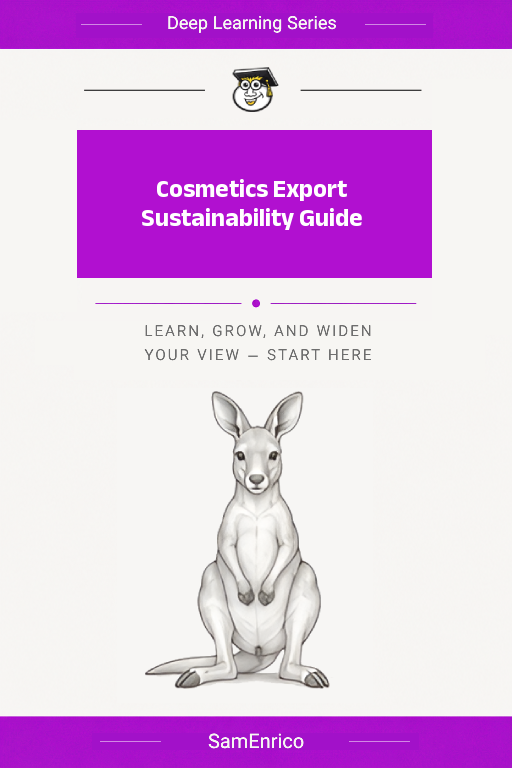
Non-FictionBusiness BriefCosmetics Compliance
Cosmetics Export Sustainability Guide eBook
Navigates COSMOS, Natrue, Leaping Bunny, and cruel
by Duvall An
Navigates COSMOS, Natrue, Leaping Bunny, and cruelty-free certifications for cosmetic exporters targeting EU and US markets.
Formats
Free sample
Chapter 1: The Three Doors--–- Every cosmetics exporter eventually faces a moment of truth. It usually arrives in the form of an email from a buyer, a customs rejection notice, or a whispered warning from a competitor who learned the hard way. The message is always the same: your labels say “natural,” “cruelty-free,” and “sustainable,” but without a certification logo next to those words, they might as well be written in disappearing ink.This chapter is not an overview. It is not a gentle introduction. It is the moment you choose which door to walk through—because in the world of cosmetics exports to the European Union and the United States, there is no hallway that serves all three destinations at once.
You must choose your primary market, and that choice dictates your first certification. Get it wrong, and you will spend six months and thirty thousand dollars pursuing a credential that opens the wrong doors.The three doors are deceptively simple. Door One leads to the European Union, where natural and organic certifications from COSMOS and NATRUE are the price of admission to retailers like DM, Boots, and Douglas. Door Two leads to the United States, where Leaping Bunny cruelty-free certification is non-negotiable for clean beauty retailers like Credo, Sephora, and Ulta. Door Three is the trap door—the brand that tries to pursue all three certifications simultaneously without a strategy, and ends up with none.This chapter will help you identify which door is yours, why the other doors are not wrong but simply different, and how to avoid the most expensive mistake in the certification game: guessing.The Email That Changes Everything Let us begin with a story.
It is a composite of three real brands, anonymized to protect the survivors, but every detail happened to someone.A cosmetics founder in Seoul spent eighteen months developing a line of face oils and serums. The formulations were exquisite: cold-pressed organic camellia seed oil, fermented rice water extract, traditional Korean herbal infusions. The packaging was minimalist glass with bamboo caps. The brand story was authentic, rooted in generations of family skincare knowledge.The founder translated the website into English and German, hired a logistics partner in Rotterdam, and landed a meeting with a buyer from a major German drugstore chain. The buyer loved the products.
The samples were approved. The order was substantial: five hundred thousand euros for an initial test across fifty stores.Then came the email."We require COSMOS Organic certification for all skincare products in the natural beauty category. Please provide your certificate number and organic percentage breakdown per SKU within ten business days."The founder had never heard of COSMOS. The packaging said "natural" and "organic ingredients." But there was no logo. No certificate.
No audit trail. The buyer could not wait. The order was rescinded. The containers were already booked. The brand spent six months pivoting to a lower-margin Amazon strategy and never recovered.This book exists so that email never happens to you.The Three Doors Explained Each certification door corresponds to a distinct market reality.
Understanding these realities requires abandoning the notion that one certification is objectively better than another. COSMOS is not "better" than Leaping Bunny. NATRUE is not "stricter" in any universally comparable way. Each certification solves a different problem for a different customer.Door One: The European Union – Natural and Organic First The European Union is the most mature market for natural and organic cosmetics. German consumers, in particular, have been conditioned over decades to look for specific certification logos.
The BDIH logo (now integrated into COSMOS) has been on shelves since 2001. The Soil Association logo since 2002. These logos are not marketing embellishments; they are purchase triggers.When a German shopper picks up a moisturizer in DM or Rossmann, they scan for the COSMOS Organic logo. If it is not there, they assume the product is conventional. They may still buy it, but they will pay less—often forty to sixty percent less—than they would for a certified organic product.
The certification signals that the product meets a standard they already understand.COSMOS emerged in 2017 as a unification of five European standards: BDIH (Germany), Ecocert (France), Soil Association (UK), ICEA (Italy), and Cosmébio (France). These organizations had been certifying natural and organic cosmetics independently, sometimes with conflicting requirements. COSMOS created a single standard that all five certifiers enforce. A COSMOS certificate from Ecocert in France is identical to a COSMOS certificate from Soil Association in the UK.The COSMOS standard has two main pathways:COSMOS Natural: Requires that all ingredients be of natural origin, with a small allowance (up to two percent) for synthetic ingredients only where unavoidable, such as certain preservatives that have no natural alternative. There is no organic percentage requirement.
This pathway is suitable for products that cannot meet organic thresholds due to formulation constraints, such as products high in water or mineral content.COSMOS Organic: Requires that at least twenty percent of the total formula weight (excluding water and minerals) consist of organically grown agricultural ingredients. Additionally, at least ninety-five percent of all physically processed agro-ingredients (PPAI) in the formula must be organic. The organic threshold is calculated on the weight of countable ingredients only, a distinction that trips up even experienced formulators and is covered in detail in Chapter 5.NATRUE offers an alternative with a different philosophy. Where COSMOS focuses on the percentage of organic content, NATRUE focuses on the purity of natural origin. NATRUE bans several categories of ingredients that COSMOS permits in limited quantities, including ethoxylated compounds (PEGs, sodium laureth sulfate) and petroleum-derived ingredients (mineral oil, paraffin).
NATRUE also requires that natural ingredients undergo minimal processing, with a shorter list of allowed green chemistry methods.NATRUE has three tiers:Natural: One hundred percent natural origin, excluding water and minerals. This is the entry tier for brands that want to avoid synthetic ingredients but cannot yet source high percentages of organic agricultural materials.Natural with Organic Portion: At least seventy percent of agricultural ingredients must be organic. This tier is roughly comparable to COSMOS Organic, though the calculation methods differ.Organic: At least ninety-five percent of agricultural ingredients must be organic. This is the strictest tier and the most difficult to achieve.For EU market entry, the most common requirement from retailers is COSMOS Organic or NATRUE Tier 2 or 3. DM, Rossmann, Boots, Douglas, and Sephora France all require one of these certifications for placement in their natural beauty sections.
Products without certification go to conventional shelves, where they compete on price rather than values.Door Two: The United States – Cruelty-Free First The United States market operates on a different logic. American consumers care about natural and organic ingredients, but they care more about animal testing. The cruelty-free claim has become a baseline expectation for the clean beauty segment, and retailers have responded by making Leaping Bunny certification a requirement.Credo, the largest dedicated clean beauty retailer in the United States, requires Leaping Bunny certification for all brands on its shelves. Sephora's "Clean + Planet Positive" program requires Leaping Bunny as a minimum. Ulta's "Conscious Beauty" program requires cruelty-free certification, with Leaping Bunny being the most widely accepted.Why Leaping Bunny and not the…
This is the end of the free sample. Get the eBook to keep going. Buy now
About this book
Details
- Author
- Duvall An
- Publisher
- SamEnrico
- Language
- English
- Genre
- Non-Fiction, Business Brief, Cosmetics Compliance
- Released
- 2026-05-30
- Pages (approx.)
- 149
- Available as
- eBook, Audiobook

Read better in the ZLOADR app
Your eBooks on your phone or tablet. Sign in with your SamEnrico account and start reading.
More by Duvall An
 Side Hustle Imposter SyndromeDuvall An$11.99
 High Dose Buprenorphine GuideDuvall An$11.99
 Evergreen Content StrategyDuvall An$11.99
 The Sugar and Inflammation LinkDuvall An$11.99
 The Last Broadcast: The Day the Internet Almost DiedDuvall An$11.99
 Understanding Prieto–badia–mulas SyndromeDuvall An$17.99
 A Beginners Guide to Foosball (Volume 1)Duvall An$11.99
 GA4 Server Side Tagging GuideDuvall An$12.99
 Concept ArtistDuvall An$11.99
You may also like
 Hong Kong Handover 1997Dunn Johnnie$11.99
 Zumba For Postnatal Recovery CourseNeal Christian$11.99
 Zumba for BeginnersLadner Nikia$11.99
 YouTube Comment Mining GuideHumes Pandora$12.99
 Worry Box MeditationCarlin Rudy$11.99
 Workplace Stress MeditationNguyen Lynn$11.99
 Workplace Stress and Sleep RepairHawley Ivory$11.99
 Workplace Perfectionism CureDelaney Jeffry$11.99
 Workplace Injustice Anger GuideWallen Isabelle$11.99
 Work Addiction and Burnout LinkGreenwood Ester$11.99
 Women in Yoga and WellnessBeattie Galina$11.99
 Women in Stand Up ComedyChun Evangeline$11.99