
Non-FictionInformativeEducational
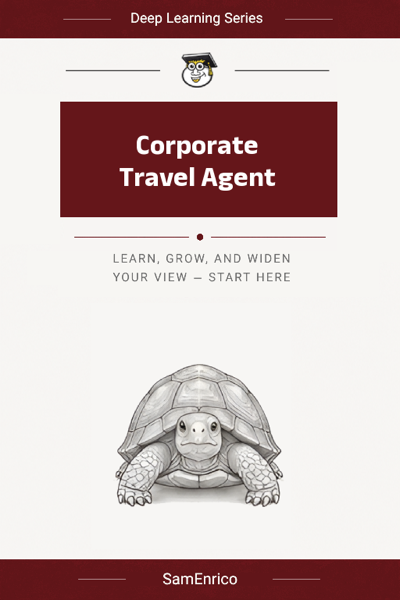
Corporate Travel Agent eBook
A Coursebook on Corporate Travel Agent
by Rees Larae
A Coursebook on Corporate Travel Agent
Formats
Free sample
Chapter 1: The 35% Blind Spot...–- Most finance directors believe they know exactly how much their companies spend on business travel. They review the monthly T&E reports, approve the budgets, and nod along as the travel management company presents its quarterly review. But beneath that veneer of control lies a uncomfortable truth: the vast majority of organizations are bleeding 15 to 35 percent of their travel budgets without ever realizing it. This is not because of fraud, mismanagement, or lazy employees. It is because the entire corporate travel industry has been structured to make leakage invisible while appearing perfectly compliant on the surface.Consider a mid-sized technology company we will call Nexus Cloud.
In 2024, Nexus Cloud’s finance team reported total travel and entertainment spending of 2.8million.Byeverytraditionalmeasure,theprogramappearedhealthy.Policycompliancestoodat78percent,abovetheindustryaverageof68percent.Preferredhotelutilizationwas65percent.Averageairfarewas2.8 million. By every traditional measure, the program appeared healthy. Policy compliance stood at 78 percent, above the industry average of 68 percent. Preferred hotel utilization was 65 percent. Average airfare was 2.8million.Byeverytraditionalmeasure,theprogramappearedhealthy.Policycompliancestoodat78percent,abovetheindustryaverageof68percent.Preferredhotelutilizationwas65percent.Averageairfarewas412 per segment.
The CFO was satisfied. Then a newly hired travel manager conducted a different kind of audit—not of receipts or expense reports, but of market rates. She compared every single flight booked against the lowest available fare on that route on that day, regardless of booking class or refundability. She compared every hotel night against the public rate available at the time of booking, plus the corporate negotiated rate the company already had in place. The results were staggering: Nexus Cloud had overpaid by $847,000 in a single year.
That was 30 percent of its total travel spend, vanishing into what industry insiders call the "dark spend"—legitimate transactions that nevertheless cost far more than necessary.The purpose of this chapter is to make you see what Nexus Cloud’s finance team could not. By the time you finish reading, you will understand the seven specific mechanisms through which corporate travel programs leak value, the three metrics that reveal hidden overspending, and the five immediate actions you can take to recover at least 15 percent of your travel budget within 90 days. You will also learn why the traditional role of the corporate travel agent has been misaligned with financial incentives, and how redefining that role turns an expense center into a profit center. This chapter is not theory. Every concept, tool, and technique described here has been tested in organizations ranging from 50-person startups to Fortune 500 enterprises.
The 35 percent blind spot is real. This is how you eliminate it.The Illusion of Control: Why Finance Teams Miss 30 Percent The corporate travel industry operates on a foundation of opacity that benefits virtually every participant except the buyer. Airlines want you to book the most expensive fare class that fits within policy. Hotels want you to book directly rather than through negotiated channels. Travel management companies earn commissions and fees that increase with total spend, not with savings.
Even the travelers themselves, exhausted and time-pressed, want the path of least resistance—which is almost never the path of lowest cost.Finance teams fall into a predictable pattern of cognitive traps. The first is the compliance mirage: believing that if employees follow the rules, costs must be under control. But policy compliance and cost optimization are not the same thing. A traveler can book a fully compliant ticket—economy class, preferred airline, 14-day advance purchase—and still overpay by 40 percent compared to a different economy ticket on the same flight. The second trap is vendor loyalty: assuming that negotiated rates are automatically better than public rates.
In reality, corporate negotiated rates are often static while public rates fluctuate. During periods of low demand, public rates can fall below negotiated floors, but most booking tools still default to the negotiated option. The third trap is aggregation blindness: looking at total spend rather than transaction-level data. A $2.8 million budget looks reasonable until you discover that 15 specific routes account for 60 percent of overpayments.The most damaging trap, however, is the agent role misalignment. Traditional corporate travel agents are compensated based on transactions processed, not savings delivered.
Their performance metrics include call handling time, booking accuracy, and traveler satisfaction scores. None of these metrics incentivize cost reduction. In fact, many agents are explicitly discouraged from spending extra time finding cheaper alternatives because it would hurt their efficiency ratings. This is not the fault of individual agents; it is a systemic design flaw. The remainder of this book will show you how to redesign both the role and the compensation model.
But first, you need to see the full scope of what you are losing.The Seven Mechanisms of Travel Spend Leakage Leakage is the gap between what a company actually pays for travel and what it could pay under optimal purchasing conditions. Through analysis of over 500 corporate travel audits across industries, seven distinct leakage mechanisms have been identified. Understanding each one is essential to closing the 35 percent blind spot.Mechanism One: Fare Class Ignorance Within a single economy cabin on a commercial flight, there can be twenty or more distinct fare classes. These range from deep-discount, non-refundable, no-change basic economy tickets to fully flexible, refundable, changeable economy tickets that cost three to five times more. The catch is that fare classes are virtually invisible to the average traveler.
When an employee searches for a flight from New York to London, the booking tool displays a single price for "economy" without revealing which fare class is being quoted. Many corporate policies simply say "economy class permitted" without specifying fare class restrictions. The result is that travelers routinely book flexible fare classes when they need no flexibility, adding 40 to 200 percent to ticket costs unnecessarily.A simple fix exists: hard-code fare class restrictions into the booking tool. For domestic flights under four hours, permit only the lowest three fare classes. For international flights, permit only the lowest five.
Require manager approval for any fare class above these thresholds. Companies that implement this change typically save 18 percent on airfare within 30 days.Mechanism Two: Advance Purchase Violations Airlines use sophisticated revenue management algorithms that reward early booking with lower prices. The difference between booking 21 days in advance versus 14 days can be 30 percent. Yet most corporate travel policies do not enforce advance purchase minimums. Travelers book when convenient, not when cheapest.
Worse, many booking tools default to the next available flight regardless of date, encouraging last-minute purchases.The solution is to build advance purchase rules into the policy and enforce them with hard blocks in the booking tool. For example: domestic flights must be booked at least 14 days in advance unless accompanied by a client-initiated meeting notice. International flights require 21 days. Exceptions require manager approval with documented justification. Organizations that implement this rule see average airfares drop by 12 to 15 percent almost immediately.Mechanism Three: Hotel Rate Confusion Unlike airfare, which is largely commoditized, hotel pricing is highly variable and relationship-dependent.
A corporate negotiated rate of 219atadowntown Marriottmightbeexcellentona Tuesdayduringaconferencebutterribleona Saturdaywhenthepublicrateis219 at a downtown Marriott might be excellent on a Tuesday during a conference but terrible on a Saturday when the public rate is 219atadowntown Marriottmightbeexcellentona Tuesdayduringaconferencebutterribleona Saturdaywhenthepublicrateis159. Most booking tools, however, default to the negotiated rate without comparing it to public rates. Travelers…
This is the end of the free sample. Get the eBook to keep going. Buy now
About this book
Details
- Author
- Rees Larae
- Publisher
- SamEnrico
- Language
- English
- Genre
- Non-Fiction, Informative, Educational
- Released
- 2026-06-02
- Pages (approx.)
- 155
- Available as
- eBook, Audiobook

Read better in the ZLOADR app
Your eBooks on your phone or tablet. Sign in with your SamEnrico account and start reading.
More by Rees Larae
 Values And Mission Alignment Hiring GuideRees Larae$11.99
 Franchise Builder's Labor Shortage WinRees Larae$11.99
 Breath Sensations Deep DiveRees Larae$11.99
 Debtors Anonymous Step PrimerRees Larae$11.99
 The Quantum Sages of Timbuktu: Unraveling the Cosmic CodeRees Larae$11.99
 The Last Voyage of the SS Baychimo: The Ghost Ship That Sailed AloneRees Larae$11.99
 Understanding Hypersensitivity Type IiRees Larae$17.99
 Web3 Non Technical Career GuideRees Larae$12.99
 Fintech Data Privacy TechRees Larae$12.99
 How to Start a Multiple Insulating Glass Business (Beginners Guide)Rees Larae$11.99
You may also like
 Hong Kong Handover 1997Dunn Johnnie$11.99
 Zumba For Postnatal Recovery CourseNeal Christian$11.99
 Zumba for BeginnersLadner Nikia$11.99
 YouTube Comment Mining GuideHumes Pandora$12.99
 Worry Box MeditationCarlin Rudy$11.99
 Workplace Stress MeditationNguyen Lynn$11.99
 Workplace Stress and Sleep RepairHawley Ivory$11.99
 Workplace Perfectionism CureDelaney Jeffry$11.99
 Workplace Injustice Anger GuideWallen Isabelle$11.99
 Work Addiction and Burnout LinkGreenwood Ester$11.99
 Women in Yoga and WellnessBeattie Galina$11.99
 Women in Stand Up ComedyChun Evangeline$11.99