
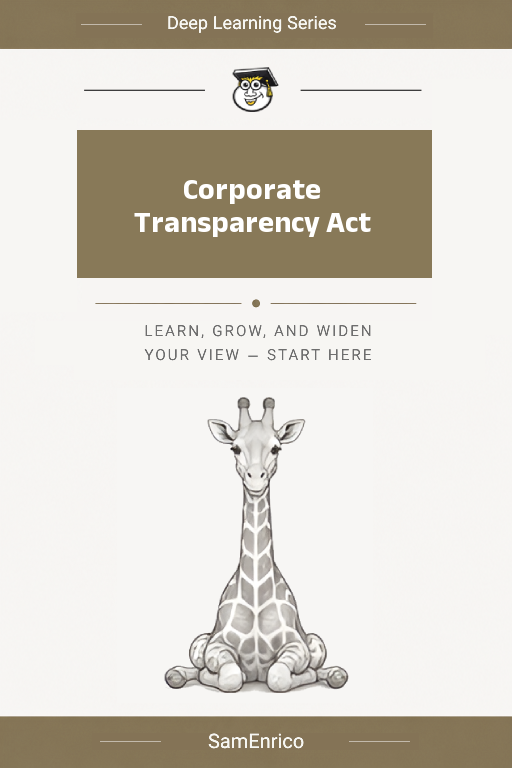
Non-FictionAnnual CheckupCTA ComplianceBOI Filing
Corporate Transparency Act eBook
File BOI reports for all LLCs and corporations by
File BOI reports for all LLCs and corporations by January 1 deadline.
Formats
Free sample
Chapter 1: The Privacy Funeral...–- On a cloudy Tuesday morning in April 2021, a single paragraph buried on page 1,642 of the 2,212-page National Defense Authorization Act quietly did what no law had done in over two centuries: it ended the era of anonymous business ownership in the United States. The paragraph was unremarkable in its prose, dense with the kind of legislative jargon that usually signals nothing more than bureaucratic housekeeping. But inside that paragraph—tucked between provisions about military base construction and cybersecurity protocols—lay the Corporate Transparency Act, a piece of legislation that would eventually force millions of business owners to decide between transparency and federal penalties. And almost no one noticed.The silence that followed the CTA's passage was not accidental. The law received minimal media coverage.
Business associations issued cautious, muted statements. Law firms buried the news in client alerts that most entrepreneurs deleted without reading. Even the U.S. Treasury Department, tasked with implementing the law, moved slowly, releasing proposed rules months behind schedule and final rules years after the fact. For the better part of three years, the CTA existed in a strange purgatory—legally enacted but practically invisible, a ticking clock that most business owners refused to hear.That clock now reads 11:55.
And this chapter is your wake-up call.The Question That Changed Everything To understand why the Corporate Transparency Act exists, you have to first understand a simple question that law enforcement has been asking for decades: Who actually owns this company?It sounds like a straightforward question. In most countries, it is. But in the United States, for most of the nation's history, the answer has been frustratingly opaque. You can form an LLC in Delaware, Wyoming, or New Mexico without ever disclosing the name of a single human being. You can create a corporation in Nevada using nothing more than a mail forwarding address and the signature of a registered agent who has never met you.
You can stack these entities like nesting dolls—an LLC owning a corporation owning a trust owning another LLC—until the trail of ownership becomes a labyrinth that even forensic accountants struggle to navigate.This was not an accident of poor drafting. The United States deliberately designed its business formation system to prioritize privacy. Unlike much of Europe, where corporate registries have long required the disclosure of ultimate beneficial owners, American states competed for incorporation revenue by offering the strongest privacy protections. Delaware, which hosts more than 1.8 million business entities—more than its human population—built its incorporation franchise on speed, efficiency, and confidentiality. Wyoming pioneered the anonymous LLC.
Nevada marketed itself as a "corporate fortress" where owners could operate without fear of disclosure.For legitimate business owners, this privacy was a feature, not a bug. It protected them from competitors, from nuisance lawsuits, from public scrutiny of their personal wealth. But for criminals, it was an invitation. The same privacy that protected a family business from a rival also protected a drug trafficker from federal agents. The same opacity that allowed a real estate investor to buy property discreetly also allowed a foreign oligarch to launder money through shell companies.By 2020, the scale of the problem had become impossible to ignore.The Loophole That Became a Highway The Financial Crimes Enforcement Network, or Fin CEN—the obscure bureau within the U.S.
Treasury Department that would become the central character of this story—had been tracking the abuse of anonymous companies for years. Their data painted a disturbing picture.Between 2010 and 2020, federal prosecutors identified over 10,000 suspicious transactions routed through U.S. shell companies. The patterns were remarkably consistent: a foreign national would wire funds to a Delaware LLC, which would then transfer the money to a second LLC in Wyoming, which would then purchase real estate, luxury goods, or financial assets. The original source of the funds—often drug proceeds, fraud schemes, or bribes—was effectively laundered through layers of anonymous entities.
Law enforcement could identify the LLCs but could not identify the humans behind them without subpoenas that crossed international borders and took months to execute.The Panama Papers leak of 2016 exposed this machinery to global scrutiny. Those 11.5 million documents showed how wealthy individuals, including politicians accused of corruption, used U.S. shell companies to hide assets. The leak did not reveal a single illegal act by the U.S. companies themselves—most were perfectly legal entities.
What it revealed was the use of those entities as veils. And the world reacted with outrage, but the outrage was directed primarily at Panama, not at Delaware or Wyoming or Nevada. The United States had, by design or neglect, become one of the world's most attractive jurisdictions for anonymous corporate formation.The Financial Action Task Force, an intergovernmental body that sets global anti-money laundering standards, took notice. In multiple reports, it criticized the United States for failing to require beneficial ownership disclosure. By 2020, the United States and North Korea were virtually the only major jurisdictions that did not require companies to report their true owners to a central registry.
The comparison was embarrassing, and it put American banks at risk of being cut off from international financial networks.Something had to change.The Legislative Backstory: How a Transparency Law Hid in Plain Sight The Corporate Transparency Act did not emerge from a single legislative push. It was the product of years of incremental advocacy, bipartisan negotiation, and strategic timing. The key players were an unlikely coalition: Democratic Senator Sheldon Whitehouse of Rhode Island, Republican Senator Mike Rounds of South Dakota, and a group of anti-corruption activists who had spent years documenting the abuse of anonymous companies.Their first attempt to pass beneficial ownership legislation came in 2019, when the bipartisan ILLICIT Cash Act (a title that creatively acronymed "Illicit Laundering and Illegal Currency Investigation, Tracking, and Cash") stalled in committee. The bill was too aggressive for some Republicans, too weak for some Democrats, and too obscure for most members of Congress who had never heard of beneficial ownership as an issue.The strategy shifted. Instead of passing a standalone bill, the advocates decided to attach the CTA to must-pass legislation.
The National Defense Authorization Act, the annual bill that funds the military, was the perfect vehicle. It was massive—over 2,000 pages—and it had to pass. No senator wanted to explain a vote against defense funding because of an obscure transparency provision.The negotiations were tense. Opponents of the CTA, including some business associations and privacy advocates, argued that the law would burden small businesses without meaningfully reducing crime. They pointed out that criminals would simply lie on their disclosure forms or find other ways to hide ownership.
The advocates countered that even imperfect disclosure would raise the cost of anonymous shell companies, forcing criminals toward less convenient jurisdictions.The compromise that emerged was classic legislative horse-trading. The threshold for reporting was set at 25 percent ownership—above that, you had to disclose; below that, only if you exercised "substantial control" over the company. A large operating company exemption was included to spare genuine businesses from redundant reporting. Financial institutions, already heavily regulated, were exempted entirely. And the penalties were structured to punish willful violations while offering a…
This is the end of the free sample. Get the eBook to keep going. Buy now
About this book
Details
- Author
- Draper Chasidy
- Publisher
- SamEnrico
- Language
- English
- Genre
- Non-Fiction, Annual Checkup, CTA Compliance, BOI Filing
- Released
- 2026-05-30
- Pages (approx.)
- 149
- Available as
- eBook, Audiobook

Read better in the ZLOADR app
Your eBooks on your phone or tablet. Sign in with your SamEnrico account and start reading.
More by Draper Chasidy
 First Tetrad: Breathing with BodyDraper Chasidy$11.99
 Construction Site Stress SafetyDraper Chasidy$11.99
 Imposter Exercise AntidoteDraper Chasidy$11.99
 Sleep for Exam PreparationDraper Chasidy$11.99
 LTC Insurance For 60s GuideDraper Chasidy$11.99
 Famous TM PractitionersDraper Chasidy$11.99
 The Sexual Addiction Recovery WorkbookDraper Chasidy$11.99
 Narcissistic Parent SurvivorDraper Chasidy$11.99
 The Microscopic Revolution: Robert Hooke and the Hidden World of CellsDraper Chasidy$11.99
 Bubble Burst: The Unseen Fall of Lehman Brothers' Subprime EmpireDraper Chasidy$11.99
 The Edison Effect: Lighting the WorldDraper Chasidy$11.99
 The Dancer's Guide to DrobushkiDraper Chasidy$11.99
You may also like
 Hong Kong Handover 1997Dunn Johnnie$11.99
 Zumba For Postnatal Recovery CourseNeal Christian$11.99
 Zumba for BeginnersLadner Nikia$11.99
 YouTube Comment Mining GuideHumes Pandora$12.99
 Worry Box MeditationCarlin Rudy$11.99
 Workplace Stress MeditationNguyen Lynn$11.99
 Workplace Stress and Sleep RepairHawley Ivory$11.99
 Workplace Perfectionism CureDelaney Jeffry$11.99
 Workplace Injustice Anger GuideWallen Isabelle$11.99
 Work Addiction and Burnout LinkGreenwood Ester$11.99
 Women in Yoga and WellnessBeattie Galina$11.99
 Women in Stand Up ComedyChun Evangeline$11.99