
Non-FictionInformativeEducational
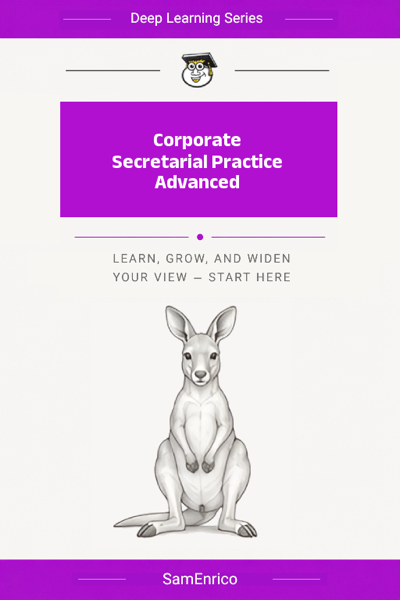
Corporate Secretarial Practice Advanced eBook
A Coursebook on Corporate Secretarial Practice Adv
A Coursebook on Corporate Secretarial Practice Advanced
Formats
Free sample
Chapter 1: The Four Faces...--–- The boardroom on the 34th floor smelled of polished mahogany and expensive coffee, but Sarah Chen, Group Company Secretary of a FTSE 250 financial services firm, noticed neither. Her eyes were fixed on the CEO, who had just proposed a related party transaction that would push the company to the very edge of regulatory tolerance. Three independent directors shifted uncomfortably. The CFO studied his shoes. The CEO, impatient, asked for a vote.Sarah had thirty seconds to decide which version of herself to become.
If she played the Governance Architect, she would note the procedural deficiency and raise it after the meeting – safe, professional, but potentially too late. If she played the Conscience, she would speak now, challenging the CEO in front of the entire board – courageous, but risking her career. If she played the Mediator, she would find a compromise, perhaps deferring the vote to a special committee – diplomatic, but possibly evading the core issue. If she played the Guardian, she would invoke the Code of Conduct and demand a formal conflicts check – legally correct, but relationship-destroying.She chose none of them. Instead, she realised something that would become the central thesis of this book: the modern Company Secretary does not have a single face.
The modern Company Secretary wears all four faces – just not at the same time. The art is knowing which face to wear, when to wear it, and – equally important – when to remove it.This chapter dismantles the outdated perception of the Company Secretary (CS) as a mere minute-taker or filing clerk. It traces the historical evolution of the role from the 19th century to the present day, introduces the Four Faces framework that resolves the conceptual inconsistencies found in earlier governance literature, and provides a practical methodology for situational role selection. By the end of this chapter, you will understand not only what the modern CS does, but how to be one – navigating the competing demands of compliance, counsel, conscience, and crisis.The Historical Arc: From Clerk to Architect To understand where the CS is going, we must first understand where the role has been. The company secretary – originally called the "secretary" of a joint-stock company – emerged in the early 19th century as a purely administrative function.
The first formal recognition came in 1844 with the Joint Stock Companies Act (UK), which required every registered company to have a secretary who maintained the register of members and filed annual returns. This was a clerical role, requiring penmanship, accuracy, and little else.The Industrial Revolution accelerated the proliferation of joint-stock companies, and with it, the secretary's responsibilities expanded to include minute-taking at board meetings, maintaining statutory books, and handling correspondence with shareholders. A good secretary was invisible – efficient, accurate, and never noticed. A great secretary was even more invisible, because invisibility meant nothing had gone wrong.The first major shift occurred in 1948, when the UK Companies Act formally recognized the company secretary as an officer of the company, carrying potential criminal liability for default. Suddenly, the role had teeth – but also risk.
Secretaries could no longer hide behind the board; they were personally accountable for filings, registers, and notices. This legal elevation spread across Commonwealth jurisdictions and influenced corporate law worldwide.The second, more dramatic shift came in the wake of the Enron and World Com collapses (2001-2002) and the subsequent Sarbanes-Oxley Act (2002). These events revealed that governance failures were not administrative errors but existential threats. The board needed someone who understood not just the letter of the law but its spirit – someone who could anticipate regulatory shifts, design processes that prevented misconduct, and speak truth to power without fear. The company secretary, uniquely positioned at the intersection of board, management, and shareholders, became that someone.The third shift is happening now.
Environmental, Social, and Governance (ESG) reporting, digital transformation, cybersecurity, and stakeholder capitalism have expanded the CS's remit beyond traditional compliance into strategy, risk, and sustainability. The modern CS is no longer a back-office functionary but a strategic partner to the board – the "Governance Architect" who designs the systems that make good governance possible.Yet this evolution has created confusion. Different texts describe the CS as a "conscience," a "mediator," a "guardian," or an "architect" – without explaining when each role applies. This chapter resolves that confusion with a unified framework.The Four Faces of the Modern Company Secretary The Four Faces framework acknowledges that the CS performs multiple, sometimes contradictory functions. The framework is not a typology of different types of CSs – it is a situational model for a single CS to apply different faces in different contexts.Face One: The Governance Architect When to wear: During periods of regulatory change, annual planning, policy design, and process improvement.
Also when the board is considering new structures (committees, delegations, charters) or entering new jurisdictions.Core activities: Designing board processes, drafting Terms of Reference for committees, creating compliance calendars, mapping regulatory requirements to internal controls, anticipating future regulatory trends, embedding governance into strategic decisions.Mindset: Forward-looking, systemic, process-oriented. The Architect asks: "What systems prevent problems before they occur?"Risk of overuse: The Architect can become detached from operational reality, designing beautiful processes that no one follows. Architects may also neglect the human dimension – relationships, trust, and culture – which cannot be designed away.Example: When the EU's Corporate Sustainability Reporting Directive (CSRD) was announced, the CS of a multinational manufacturer did not wait for regulators to provide guidance. She formed a cross-functional working group, mapped existing disclosures against the proposed requirements, and presented the board with a three-year implementation roadmap. She was wearing the Architect face.Face Two: The Conscience of the Board When to wear: During board discussions where ethical issues arise, when directors appear to be overlooking risks, when groupthink is evident, or when the board is considering actions that may harm stakeholders.Core activities: Challenging assumptions, asking difficult questions, escalating red flags, reminding directors of their fiduciary duties, protecting minority shareholder interests, maintaining confidentiality while ensuring concerns are recorded.Mindset: Courageous, principled, uncomfortable.
The Conscience asks: "Are we doing the right thing, not just the legal thing?"Risk of overuse: The Conscience can become the board's scold – ignored, resented, and eventually excluded. Conscience without credibility is merely noise. The CS must choose battles carefully, speaking only when the issue truly matters.Example: A board was preparing to approve executive bonuses despite missing several compliance targets. The CS asked: "If these bonuses were disclosed in the annual report tomorrow, would any shareholder call for your resignation?" The room fell silent. The bonuses were deferred pending a review.
The CS wore the Conscience face for precisely thirty seconds – but those thirty seconds saved the board from a shareholder revolt.Face Three: The Mediator When to wear: During disputes between the board and management, between executive and independent directors, between the Chair and the CEO, or between the company and shareholders. Also during succession planning, compensation negotiations, and board evaluations.Core activities: Facilitating difficult conversations, finding common ground, proposing compromise solutions, maintaining relationships while resolving conflicts, documenting agreements without assigning blame.Mindset: Diplomatic, patient, neutral. The Mediator asks: "What outcome allows all parties to continue working together?"Risk of overuse: The Mediator can become the board's…
This is the end of the free sample. Get the eBook to keep going. Buy now
About this book
Details
- Author
- Moreau Melodee
- Publisher
- SamEnrico
- Language
- English
- Genre
- Non-Fiction, Informative, Educational
- Released
- 2026-06-02
- Pages (approx.)
- 146
- Available as
- eBook, Audiobook

Read better in the ZLOADR app
Your eBooks on your phone or tablet. Sign in with your SamEnrico account and start reading.
More by Moreau Melodee
 Trotsky Ice AxeMoreau Melodee$11.99
 Extracurricular LogisticsMoreau Melodee$11.99
 Engineer Imposter SyndromeMoreau Melodee$11.99
 Contract Abstraction Certification PrepMoreau Melodee$11.99
 Constipation Success StoriesMoreau Melodee$11.99
 Sacred Dance Leadership GuideMoreau Melodee$11.99
 The Reformation Printing PressMoreau Melodee$11.99
 Listening to Trauma SurvivorsMoreau Melodee$11.99
 SEC DOJ FCPA Case LogMoreau Melodee$11.99
 The Great Conundrum: The Math Behind the Lost City of ZMoreau Melodee$11.99
 The Art of War: Nguyen Si Kha’s Brushstrokes of ResistanceMoreau Melodee$11.99
 Frozen Fire: The Arctic Volcano Hunters of 1912Moreau Melodee$11.99
You may also like
 Hong Kong Handover 1997Dunn Johnnie$11.99
 Zumba For Postnatal Recovery CourseNeal Christian$11.99
 Zumba for BeginnersLadner Nikia$11.99
 YouTube Comment Mining GuideHumes Pandora$12.99
 Worry Box MeditationCarlin Rudy$11.99
 Workplace Stress MeditationNguyen Lynn$11.99
 Workplace Stress and Sleep RepairHawley Ivory$11.99
 Workplace Perfectionism CureDelaney Jeffry$11.99
 Workplace Injustice Anger GuideWallen Isabelle$11.99
 Work Addiction and Burnout LinkGreenwood Ester$11.99
 Women in Yoga and WellnessBeattie Galina$11.99
 Women in Stand Up ComedyChun Evangeline$11.99