
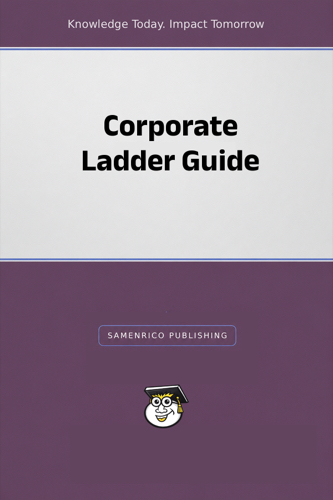
Non-FictionNon-Obvious CareerCorporate
Corporate Ladder Guide eBook
Climb management ranks in large organizations with
Climb management ranks in large organizations with structured promotion paths.
Formats
Free sample
Chapter 1: The Six Silent Rules--–- The first time Sarah Jenkins cried in an office bathroom, she told herself it was a fluke. The second time, she blamed exhaustion. The third time—three days after learning she had been passed over for a promotion she had worked 1,200 overtime hours to earn—she finally admitted the truth: she had been playing the wrong game by the wrong rules for her entire career.Sarah was a senior manager at a mid-sized manufacturing firm. Her performance reviews were flawless. Her projects came in under budget and ahead of schedule.
Her team loved her. And yet, when the director position opened—the one her boss had explicitly told her she was "in line for"—the job went to a peer with half her experience, weaker results, and a reputation for spending more time in the executive conference room than at his own desk.The feedback she received was maddeningly vague. "It was a close call." "You're doing everything right." "Keep doing what you're doing, and your time will come." Sarah had heard these phrases before. She would hear them again. And like millions of mid-level managers across every industry, she would internalize the message as try harder—when the real message was play differently.This book exists because Sarah's story is not the exception.
It is the rule.Over the past decade, the corporate ladder has been fundamentally redesigned. The old model—show up, work hard, stay loyal, wait your turn—has been quietly dismantled. In its place, a new system has emerged: ambiguous, performance-driven, and governed by a set of unwritten rules that no one teaches you, no one discusses openly, and yet everyone in leadership uses to make promotion decisions.These six rules determine who rises and who stalls. They are not listed in any employee handbook. They will never appear on a performance review form.
Your boss will almost certainly never articulate them to you directly. And yet, every time a promotion committee sits down to decide between two qualified candidates, they apply these six rules instinctively, often without even realizing it.This chapter reveals those six rules for the first time. It also introduces the central operating system of this book: The CEO Framework—a complete mental and tactical shift from being a passive employee to becoming the active, strategic CEO of your own career. By the end of this chapter, you will understand exactly why Sarah lost her promotion and, more importantly, what you must do to ensure you never lose yours.The Death of the Predictable Career Path To understand why the six rules matter, you must first understand what they replaced.Fifty years ago, the corporate career was a conveyor belt. You joined a company after college, learned a trade, accepted annual cost-of-living raises, and waited for the person above you to retire or die.
Promotions were based primarily on two factors: tenure and the absence of major mistakes. The system was predictable, slow, and deeply hierarchical.That world is gone.The average tenure of a CEO has fallen from ten years in 1990 to less than five years today. Corporate restructurings that once happened once a decade now happen every eighteen to twenty-four months. The "org chart" that was once a stable document now changes so frequently that many companies have stopped printing them altogether.In this new environment, tenure is not an asset—it is often a liability. Longevity can signal stagnation.
Loyalty can signal lack of options. And waiting your turn is a guarantee that you will never take a turn at all, because the person ahead of you is also waiting, and the person ahead of them, and the entire line is frozen while the market shifts beneath everyone's feet.Consider the data. According to longitudinal studies of corporate promotion patterns, managers who are promoted to director do so after an average of 4.2 years in their current role—but the standard deviation is enormous. Some are promoted in eighteen months. Others wait a decade.
What separates these two groups is not performance metrics, which are often statistically identical. It is something else entirely: the degree to which they demonstrate the six unwritten rules.But here is the catch. Because the rules are unwritten, most managers do not even know they are being evaluated on them. They continue to pour energy into the written rules—hitting KPIs, completing tasks on time, staying out of trouble—while remaining completely invisible to the executives who hold their futures. This is the central tragedy of the modern corporate career: you can do everything you were told to do and still fail, because you were told the wrong things.The CEO Framework: Your New Operating System Before we examine the six rules, we must change how you think about your career entirely.Most employees operate under what I call the Passive Model.
The Passive Model sounds like this: If I work hard, someone will notice. If I deliver results, someone will reward me. If I am loyal, someone will reciprocate. The Passive Model outsources your career trajectory to other people—your boss, HR, the promotion committee—and assumes that fairness and visibility are built into the system.They are not.The CEO Framework replaces the Passive Model with an active, strategic, and ownership-based approach. It is built on a simple premise: you are the CEO of a one-person corporation called "You, Inc." Your skills are your product.
Your relationships are your distribution channels. Your time is your capital. And your promotion is not a reward—it is a transaction in which an investor (your employer) decides to allocate more resources to your division because you have proven that the return will exceed the investment.This framework is not a metaphor. It is a practical operating system with four components that will appear throughout this book:Component One: The CEO Mindset. You stop waiting and start initiating.
You stop asking permission and start creating opportunities. You stop treating your boss as a parent and start treating them as a customer or an investor—someone whose needs you must understand and exceed.Component Two: The Strategic Audit. Every quarter, you conduct a formal review of You, Inc. What are your assets? What are your liabilities?
Which of the six rules are you demonstrating? Which are you neglecting? Where is the market (your industry) moving, and are your skills moving with it?Component Three: The Stakeholder Map. You identify every person who can affect the share price of You, Inc.—not just your boss, but your boss's peers, your skip-level leader, influential stakeholders in other functions, and the gatekeepers who control access to decision-makers. You then manage those relationships with the same discipline a CEO manages a board of directors.Component Four: The Weekly Self-Audit.
Every Friday afternoon, you spend fifteen minutes answering three questions: (1) Which of the six rules did I demonstrate this week? (2) Where did I leave value on the table? (3) Who did I influence, and who influenced me? This audit is your single most powerful tool for turning the CEO Framework from an idea into a habit.Throughout the rest of this chapter and the eleven that…
This is the end of the free sample. Get the eBook to keep going. Buy now
About this book
Details
- Author
- Lafferty Joaquin
- Publisher
- SamEnrico
- Language
- English
- Genre
- Non-Fiction, Non-Obvious Career, Corporate
- Released
- 2026-06-10
- Pages (approx.)
- 137
- Available as
- eBook, Audiobook

Read better in the ZLOADR app
Your eBooks on your phone or tablet. Sign in with your SamEnrico account and start reading.
More by Lafferty Joaquin
 Meditation For ScrupulosityLafferty Joaquin$11.99
 Self Esteem for Caregiver SeniorsLafferty Joaquin$11.99
 Military Family Reunified After DeploymentLafferty Joaquin$11.99
 Recovery After Sexual AssaultLafferty Joaquin$11.99
 The Police Negotiator CaptiveLafferty Joaquin$11.99
 Zach King MagicLafferty Joaquin$11.99
 Wendy Kopp TeachLafferty Joaquin$11.99
 Pixel Pioneers: How a Japanese Journalist Uncovered the Birth of GamingLafferty Joaquin$11.99
 The Dragon Emperor's Last Trial: A Knight's Quest in the Jade CourtLafferty Joaquin$11.99
 How to Start a Public Baths Business (Beginners Guide)Lafferty Joaquin$11.99
 Compensation Strategy and Executive PayLafferty Joaquin$11.99
 Post Launch Review One Page GuideLafferty Joaquin$12.99
You may also like
 Hong Kong Handover 1997Dunn Johnnie$11.99
 Zumba For Postnatal Recovery CourseNeal Christian$11.99
 Zumba for BeginnersLadner Nikia$11.99
 YouTube Comment Mining GuideHumes Pandora$12.99
 Worry Box MeditationCarlin Rudy$11.99
 Workplace Stress MeditationNguyen Lynn$11.99
 Workplace Stress and Sleep RepairHawley Ivory$11.99
 Workplace Perfectionism CureDelaney Jeffry$11.99
 Workplace Injustice Anger GuideWallen Isabelle$11.99
 Work Addiction and Burnout LinkGreenwood Ester$11.99
 Women in Yoga and WellnessBeattie Galina$11.99
 Women in Stand Up ComedyChun Evangeline$11.99