
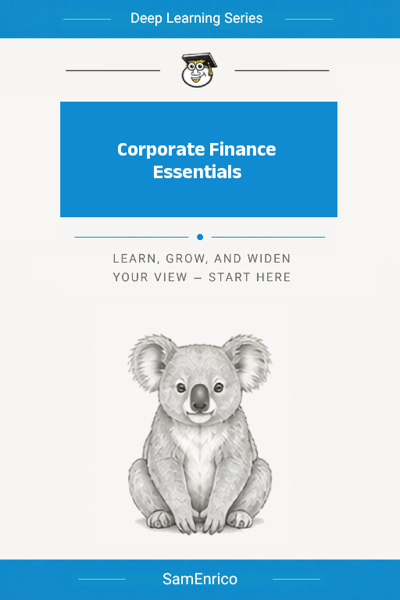
Non-FictionInformativeEducational
Corporate Finance Essentials eBook
A Coursebook on Corporate Finance Essentials
by Engle Bailey
A Coursebook on Corporate Finance Essentials
Formats
Free sample
Chapter 1: The Ownership Trap...--–- Imagine you wake up tomorrow as the CEO of a company you’ve never seen. You don’t know its products. You don’t know its customers. But you do know one thing: every single decision you make today will either create or destroy wealth for thousands of people who have entrusted their money to you. No pressure.This is not a hypothetical nightmare.
It is the daily reality of every financial manager. And the single most important insight of corporate finance—the one that separates those who build lasting value from those who preside over slow-motion train wrecks—is that most managers get the fundamental question wrong from the very beginning.They ask: How do I make my company more profitable?They should ask: Whose money am I managing, and what do they actually want?The difference between these two questions is the difference between a captain who knows the destination and a captain who simply enjoys steering. Both may move the ship. Only one arrives.This chapter reveals the hidden trap that destroys more corporate value than bad markets, worse competitors, or even fraud. It is the trap of forgetting who owns the company.
And once you see it, you will never look at a quarterly earnings report, a CEO bonus, or a stock price the same way again.The Three Decisions That Define a Financial Manager Before we can understand what goes wrong, we must first understand what financial managers are supposed to do. Corporate finance, stripped of its jargon and spreadsheets, answers exactly three questions. Every decision, no matter how complex, is a variation of one of these three.Decision One: What long-term assets should we buy?This is called capital budgeting. A factory. A patent.
A fleet of delivery trucks. A software platform. Any asset that will generate cash for more than one year falls into this category. The question seems simple: buy things that make money. But the devil, as always, is in the timing, the risk, and the alternatives you didn't choose.Should Amazon build more warehouses in rural America or invest in drone delivery technology?
Should a pharmaceutical company spend $2 billion on a cancer drug that might fail or $500 million on five smaller projects with lower potential but higher probability of success? These are capital budgeting decisions. They are the most important decisions a company makes because they determine what the company will become.By the time you finish this book, you will know how to answer this question with precision using a tool called Net Present Value (Chapter 7). You will know how to forecast the cash flows (Chapter 8) and how to discount them for risk (Chapters 9 and 10). For now, simply recognize that every asset purchase is a bet on the future.
Some bets pay off. Most do not. The difference between great financial managers and average ones is not that they predict the future perfectly—no one does. It is that they systematically evaluate bets instead of gambling.Decision Two: How should we pay for these assets?This is called capital structure. Should you use your own money (equity) or borrow money (debt)?
Should you sell shares to the public or take a loan from a bank? Should you raise $100 million from ten venture capitalists or $100 million from a thousand anonymous shareholders?This question is older than modern finance. In fact, the Medici bank in 15th-century Florence struggled with the same capital structure decisions that trouble Silicon Valley startups today. Borrowing amplifies your returns when things go well—but it amplifies your losses when things go badly. Selling equity dilutes your control but gives you partners who share the risk.Here is the counterintuitive truth that surprises most new students of finance: the way you pay for an asset affects the asset's risk, not its inherent value.
A coffee shop is still a coffee shop whether you bought it with cash or with a loan. But the returns to you as the owner change dramatically depending on how much you borrowed.We will spend all of Chapter 11 on this question. You will learn why some companies borrow heavily (airlines, utilities, real estate) while others use almost no debt (tech startups, pharmaceutical R&D). You will learn the elegant Modigliani-Miller theorem, which won a Nobel Prize for showing that capital structure shouldn't matter—and then you will learn the three real-world frictions that make it matter enormously.Decision Three: How do we manage day-to-day cash flow?This is called working capital management. It is the least glamorous of the three decisions and the one that destroys more companies than any other.
Working capital is the money tied up in the ordinary operations of a business: inventory sitting on shelves, unpaid customer invoices, and the cash buffer needed to pay suppliers before customers pay you.A company can be profitable on paper and still go bankrupt. How? It runs out of cash. You have probably seen this happen. A restaurant is fully booked every night (profitable!) but cannot make rent because its largest corporate client pays invoices on 120-day terms (cash problem!).
A manufacturer lands a huge order (profitable!) but must buy raw materials before receiving payment from the customer (cash problem!). A construction company wins a billion-dollar government contract (profitable!) but must finance payroll for six months before the first payment arrives (cash problem!).Working capital management is the art of keeping enough cash flowing to survive until tomorrow while not leaving so much cash idle that you starve your growth opportunities. We will return to this in Chapter 3 when we analyze liquidity ratios and again in Chapter 8 when we build cash flow forecasts.For now, remember these three questions. They are the entire domain of corporate finance. A financial manager who answers them well creates enormous value.
A financial manager who answers them poorly destroys value, often catastrophically. And the most common reason for answering them poorly is not lack of intelligence or effort. It is a failure to understand the first principle: whose money is this anyway?The Goal That Everyone Gets Wrong Ask a group of business students what a company should maximize, and you will hear a chorus of answers: profits, revenue, market share, growth, customer satisfaction, employee happiness, innovation, sustainability.These are all good things. But they are not the ultimate goal. They are means to an end.The ultimate goal of corporate finance is singular and precise: maximize the value of the enterprise.Wait.
Not shareholder value? Not stock price? Not profits?Let me explain the distinction because it matters enormously—and because most textbooks get it wrong, leading to the inconsistency that plagues otherwise excellent books.When we say "enterprise value," we mean the total value of the company to all providers of capital: both debt holders and equity holders. Enterprise value = Market value of equity + Market value of debt – Cash.Why include debt? Because a company that borrows $1 billion and then burns it on bad investments destroys value for both shareholders and creditors.
A focus only on shareholder value might celebrate a leveraged buyout that transfers wealth from creditors to shareholders. A focus on enterprise value forces managers…
This is the end of the free sample. Get the eBook to keep going. Buy now
About this book
Details
- Author
- Engle Bailey
- Publisher
- SamEnrico
- Language
- English
- Genre
- Non-Fiction, Informative, Educational
- Released
- 2026-06-02
- Pages (approx.)
- 149
- Available as
- eBook, Audiobook

Read better in the ZLOADR app
Your eBooks on your phone or tablet. Sign in with your SamEnrico account and start reading.
More by Engle Bailey
 Chronic Illness and Self WorthEngle Bailey$11.99
 Domestic Worker Reunited With KidsEngle Bailey$11.99
 Career Pacing GuideEngle Bailey$11.99
 Meditation For Tinnitus AnxietyEngle Bailey$11.99
 The Journalist CapturedEngle Bailey$11.99
 Paul Farmer PartnersEngle Bailey$11.99
 Healing The Inner Child GuideEngle Bailey$11.99
 Whales and Leverage: The Liquidation MachineEngle Bailey$11.99
 The Dragon’s Hoard: A Knight’s Bargain with the Beast of the Black ForestEngle Bailey$11.99
 Freya’s Golden Tears: The Love That Shattered AsgardEngle Bailey$11.99
 The Mineral Guide to BertranditeEngle Bailey$11.99
 How to Start a Adventure Playground Business (Beginners Guide)Engle Bailey$11.99
You may also like
 Hong Kong Handover 1997Dunn Johnnie$11.99
 Zumba For Postnatal Recovery CourseNeal Christian$11.99
 Zumba for BeginnersLadner Nikia$11.99
 YouTube Comment Mining GuideHumes Pandora$12.99
 Worry Box MeditationCarlin Rudy$11.99
 Workplace Stress MeditationNguyen Lynn$11.99
 Workplace Stress and Sleep RepairHawley Ivory$11.99
 Workplace Perfectionism CureDelaney Jeffry$11.99
 Workplace Injustice Anger GuideWallen Isabelle$11.99
 Work Addiction and Burnout LinkGreenwood Ester$11.99
 Women in Yoga and WellnessBeattie Galina$11.99
 Women in Stand Up ComedyChun Evangeline$11.99