
Non-FictionBiographyTragic Child Stars
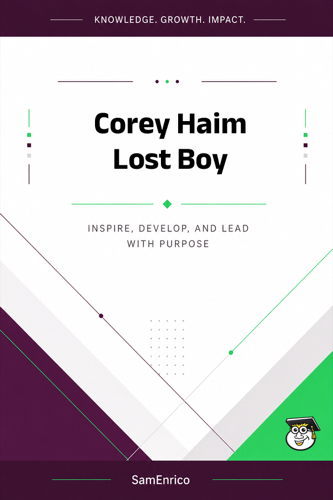
Corey Haim Lost Boy eBook
Fall victim to the dark side of 80s child stardom
by Cohn Polly
Fall victim to the dark side of 80s child stardom and addiction.
Formats
Free sample
Chapter 1: The Silver Bullet...--–- The boy who learned to cry for money was born on a cold December morning in 1971, in a Toronto hospital that has since been demolished. Corey Ian Haim arrived six weeks early, lungs underdeveloped, screaming before he took his first breath. The nurses called him a fighter. His mother, Judy, called him a burden. His father, Bernie, called him an accident.This is not a story about drugs.
Not really. Drugs are the symptom, not the disease. The disease is a system that looks at a fourteen-year-old boy, sees his pain, and asks: How much can we sell that for? The disease is a mother who chooses a paycheck over protection. The disease is a city called Hollywood, which has never met a child it couldn't break.Corey Haim was born with two strikes against him: he was sensitive, and he was poor.
Not starving poor, but Canadian poor—the kind of poor where your father sells real estate in a bad market and your mother works as a data entry clerk because the family needs two incomes to afford a three-bedroom house in a neighborhood that isn't embarrassing. The Haims lived at 3 Invermay Avenue in Toronto’s Bathurst Manor, a middle-class Jewish enclave where the lawns were small and the mortgages were large. Bernie Haim was a tall, handsome man with a salesman's smile and a gambler's luck—which is to say, he had neither. Judy Haim was a thin, sharp-faced woman who measured her life in efficiency. She did not hug her son.
She scheduled him.The Unwanted Child Corey was an only child, a status that sounds privileged until you understand that being an only child in a cold marriage means you are the battlefield. Bernie and Judy fought constantly—about money, about his drinking, about her nagging, about the fact that they had a son neither of them seemed to want. Young Corey learned early that the safest place was in his bedroom, door closed, headphones on, watching television. He was asthmatic, sickly, prone to croup and bronchitis. He missed so much school that teachers forgot his name.
He had no friends his own age because he was never well enough to go outside.What he had was an imagination. And a television.The television became his babysitter, his teacher, his lover. He watched everything—sitcoms, dramas, late-night movies, commercials. He would reenact scenes in his bedroom mirror, trying on different voices, different faces. When he was seven, his grandmother took him to see a touring production of Annie.
He sat in the dark, transfixed, and when the orphans sang "It's a Hard Knock Life," he turned to his grandmother and whispered: "I can do that."She laughed. He did not.The First Audition At age ten, Corey heard about an open casting call for a commercial. He begged his mother to take him. Judy, who saw everything in terms of return on investment, calculated the cost of gas, parking, and her time against the potential payout. She agreed—but only because the audition was near a grocery store she needed to visit anyway.The audition was held in a cramped community center basement.
Fifty kids, all taller, healthier, better dressed. Corey wore hand-me-down jeans and a t-shirt with a small hole near the collar. The casting director asked each child to read a simple line: "Mom, I want the red one." Most kids shouted it. Some whispered it. One boy cried on command.Corey watched the crying boy get called back for a second audition.
He filed that information away.When it was his turn, he did not cry. Instead, he looked at the casting director—a bored woman in her forties—and said the line as if he were asking his own mother for something he knew he would never receive. "Mom, I want the red one." His voice cracked on the word red. His eyes dropped to the floor. He looked like a child who had already been told no a thousand times.The casting director stopped scrolling through her phone."Read it again," she said.He did.
This time, he added a single tear. He had practiced in the mirror.He booked the commercial. He earned $3,200. For a ten-year-old in 1982, that was a fortune. For Judy Haim, it was proof of concept.The Mother Who Quit Judy quit her job as a computer systems analyst the day Corey's first residual check arrived.
She announced to Bernie that she would now be Corey's full-time manager. Bernie, who had lost another real estate deal that week, shrugged and opened a beer.This was the moment the trajectory changed.In any functional family, a mother becoming a child's manager is a conflict of interest. In the Haim household, it was a disaster scripted from the start. Judy had no experience in entertainment. She had no contacts, no negotiation skills, no understanding of child labor laws.
What she had was a belief that her son was a product and she was the CEO.She drove Corey to every audition within a hundred-mile radius. She bought him headshots with money she took from their joint savings account. She made him practice crying in the car. "More tears," she would say. "They want to see real tears."Corey learned to produce tears on command.
He learned to access a deep well of sadness—his parents' fighting, his loneliness, the asthma attacks that left him gasping on the floor—and turn it into a performance. He discovered that when he cried on stage, adults gave him things. Attention. Praise. Money.He also discovered that when he cried at home, his mother told him to stop being dramatic.So he learned the difference.
The performance was for strangers. The real pain was private.Firstborn: The Education of a Child Actor In 1984, twelve-year-old Corey auditioned for the film Firstborn, a drama about a teenage boy (played by Christopher Collet) who must protect his younger brother (Corey) from their mother's dangerous new boyfriend (Peter Weller). The director, Michael Apted, was known for his documentary 7 Up series—a man who understood childhood as a fragile, fleeting thing.Corey did not get the role because he was the best actor. He got the role because he was the most real. During his audition, he read a scene where his character discovers that his mother's boyfriend has been stealing from the family.
The script called for him to cry. Corey cried. But then, after the scene ended, he kept crying. He could not stop. Apted watched him for a full minute, tears running down the boy's face, and said: "That's not acting.
That's memory."He hired him immediately.On set, Corey learned his first lesson about Hollywood: the camera is not your friend. It is a confessional. It sees everything—the fear behind your eyes, the tremor in your hands, the way you flinch when an adult raises their voice. The camera does not judge. But the camera also does not protect.Firstborn was Corey's introduction to professional filmmaking.
He worked twelve-hour days, sometimes longer. He was tutored for three hours each morning, then released to the set where…
This is the end of the free sample. Get the eBook to keep going. Buy now
About this book
Details
- Author
- Cohn Polly
- Publisher
- SamEnrico
- Language
- English
- Genre
- Non-Fiction, Biography, Tragic Child Stars
- Released
- 2026-06-08
- Pages (approx.)
- 142
- Available as
- eBook, Audiobook

Read better in the ZLOADR app
Your eBooks on your phone or tablet. Sign in with your SamEnrico account and start reading.
More by Cohn Polly
 Memory Palace For Business PresentationsCohn Polly$11.99
 Reconstruction of Excited Delirium DeathsCohn Polly$11.99
 Justice For Anthony HintonCohn Polly$11.99
 Widow Identity ReconstructionCohn Polly$11.99
 Earnings Test Breakeven GuideCohn Polly$11.99
 Pomodoro for Project ManagersCohn Polly$11.99
 NSAID GuideCohn Polly$11.99
 Cannae: Hannibal's Perfect TrapCohn Polly$11.99
 The Angel of Bethnal Green: Dr. Thomas Neill Cream’s Poisonous LegacyCohn Polly$11.99
 Corn: Sweet Corn, Dent Corn & Flint Corn Harvesting GuideCohn Polly$11.99
 How to Produce Postage MetersCohn Polly$11.99
 Research Proposal Peer Review WorkbookCohn Polly$12.99
You may also like
 Hong Kong Handover 1997Dunn Johnnie$11.99
 Zumba For Postnatal Recovery CourseNeal Christian$11.99
 Zumba for BeginnersLadner Nikia$11.99
 YouTube Comment Mining GuideHumes Pandora$12.99
 Worry Box MeditationCarlin Rudy$11.99
 Workplace Stress MeditationNguyen Lynn$11.99
 Workplace Stress and Sleep RepairHawley Ivory$11.99
 Workplace Perfectionism CureDelaney Jeffry$11.99
 Workplace Injustice Anger GuideWallen Isabelle$11.99
 Work Addiction and Burnout LinkGreenwood Ester$11.99
 Women in Yoga and WellnessBeattie Galina$11.99
 Women in Stand Up ComedyChun Evangeline$11.99