
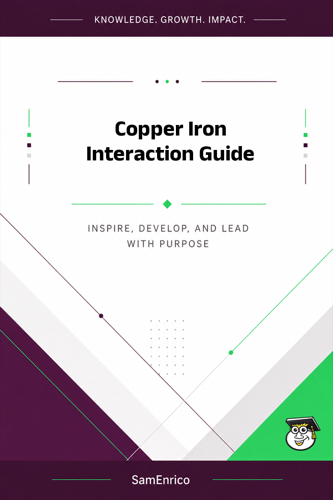
Non-FictionHealth & WellnessMineral Interactions
Copper Iron Interaction Guide eBook
Balances these minerals for blood health.
Balances these minerals for blood health.
Formats
Free sample
Chapter 1: The Iron Trap--When Sarah, a 34-year-old yoga instructor and mother of two, walked into her doctor’s office for the seventh time in eighteen months, she carried a list of seventeen symptoms on her phone. Chronic fatigue that no amount of sleep could touch. Restless legs that kept her awake until 3 a.m., pacing her living room while her husband slept. Hair falling out in clumps when she showered. Bruises on her thighs that appeared from no remembered injury.
Hands and feet so cold that she wore wool socks to bed in July.Her doctor reviewed her bloodwork from the previous week. “Your hemoglobin is a little low,” he said, turning the screen toward her. “You’re anemic. I’m going to prescribe iron supplements. Take one tablet daily with food.”Sarah felt a wave of relief.
Finally, a diagnosis. Finally, a solution. She filled the prescription that afternoon and took her first iron pill with dinner.Eight weeks later, she returned for a follow-up. Her hemoglobin had barely budged. Her ferritin—the protein that stores iron—had climbed from 50 to 180, well above the normal range.
And she felt worse. The fatigue was now bone-deep. The restless legs had intensified. She had developed a new symptom: a strange, dull ache in her joints, particularly her fingers and hips.Her doctor increased the iron dose.This is not an uncommon story. In fact, it is a story repeated millions of times every year in doctors’ offices across North America and Europe.
Patients present with fatigue, low energy, and a constellation of vague but debilitating symptoms. Bloodwork shows low hemoglobin or low-normal ranges. The diagnosis is iron deficiency anemia. The treatment is iron supplementation. And for a significant percentage of these patients, the treatment either does not work or actively makes them worse.The question that no one is asking—the question that this entire book exists to answer—is a simple one: What if the problem was never a lack of iron?The Great Iron Misconception Iron is essential.
Let me state that clearly at the outset. Without iron, your red blood cells cannot carry oxygen. Your mitochondria cannot produce energy. Your brain cannot synthesize certain neurotransmitters. Iron deficiency, in its true form, is a serious medical condition that requires treatment.But here is the uncomfortable truth that the past decade of nutritional science has forced us to confront: True iron deficiency is far less common than most people believe.
What is common—epidemically common—is something called iron dysregulation. And the difference between these two conditions is the difference between treating the right problem and accidentally making the wrong one much, much worse.Consider the following statistics. According to data from the National Health and Nutrition Examination Survey (NHANES), approximately 10-15% of women of childbearing age in the United States have iron deficiency as defined by low ferritin. But when researchers look at the broader population, a different picture emerges. Up to 40% of patients with chronic fatigue syndrome have normal or high ferritin but low hemoglobin.
Up to 30% of patients diagnosed with iron deficiency anemia do not respond to iron supplementation. And among patients with inflammatory conditions—autoimmune disease, chronic infections, metabolic syndrome—the rates of functional iron deficiency (where iron is present but inaccessible) approach 60-70%.What these numbers tell us is that the simple model of iron deficiency—low iron equals low energy equals take more iron—is not just incomplete. It is dangerously wrong for a large subset of the very people it claims to help.The Iron Epidemic: How We Got Here To understand how we arrived at this situation, we need to travel back in time to the mid-twentieth century. In the 1940s and 1950s, public health officials noticed that a significant percentage of the population, particularly women and children, had low iron stores. The response was a massive, well-intentioned campaign to fortify the food supply with iron.
Flour, breakfast cereals, pasta, and infant formula were all enriched with synthetic iron compounds. By the 1970s, iron fortification was standard practice across the developed world.The campaign succeeded in reducing the rates of severe iron deficiency anemia. But it also created an unintended consequence: the normalization of high iron intake across the entire population, regardless of individual need. The average person today consumes significantly more iron than their ancestors did a century ago. And while the body has sophisticated mechanisms for eliminating excess water-soluble vitamins, it has almost no mechanism for eliminating excess iron.Iron is not like vitamin C, which is flushed out in urine when consumed in excess.
Iron is a heavy metal that the body holds onto tenaciously. The only significant way humans lose iron is through bleeding (menstruation, childbirth, injury, or blood donation) or through the normal shedding of intestinal cells. This means that for the average person who is not regularly losing blood, iron accumulates over time.By itself, this accumulation might not be a problem. After all, the body has storage proteins—ferritin and hemosiderin—that can safely sequester excess iron. But these storage systems depend on a complex regulatory apparatus that requires, among other things, adequate copper.
And copper is where the entire model begins to break down.The Hidden Crisis: Iron That Cannot Be Used Imagine that your body is a construction site. Iron is the raw material—the bricks and steel beams needed to build red blood cells and power your mitochondria. But raw materials are useless without workers to carry them to where they are needed. In your body, those workers are copper-dependent enzymes, chief among them a protein called ceruloplasmin.Ceruloplasmin is the foreman of the construction site. Its job is to take iron out of storage (ferritin), oxidize it from its reactive, dangerous form (Fe²⁺) to its transportable, safe form (Fe³⁺), and then hand it off to another protein called transferrin, which delivers it to the bone marrow for red blood cell production.When copper is deficient, ceruloplasmin cannot do its job.
The foreman is absent. Iron remains locked in storage, even as the construction site (your bone marrow) is desperate for materials. Your ferritin levels may be normal or even high—the warehouse is full of bricks—but the building (your red blood cells) remains unfinished. This is functional iron deficiency. And it is the single most misdiagnosed condition in modern primary care.Consider Sarah again.
Her ferritin climbed from 50 to 180 on iron supplements because her body, lacking adequate copper, could not use the iron she was consuming. Instead of being incorporated into red blood cells, the supplemental iron was shunted directly into ferritin storage. Her ferritin rose, her hemoglobin remained low, and the free iron circulating in her bloodstream caused oxidative damage that produced her new joint pain.Her doctor increased the iron dose. The problem was never a lack of iron. The problem was a lack of copper.The Synthetic Iron Problem Not all iron is created equal.
This is a distinction that almost no doctor makes and almost no patient understands, yet it is absolutely central to resolving the iron-copper puzzle.Iron in food exists in two forms: heme iron and non-heme iron. Heme iron comes from animal sources—red meat…
This is the end of the free sample. Get the eBook to keep going. Buy now
About this book
Details
- Author
- Honeycutt Foster
- Publisher
- SamEnrico
- Language
- English
- Genre
- Non-Fiction, Health & Wellness, Mineral Interactions
- Released
- 2026-06-11
- Pages (approx.)
- 130
- Available as
- eBook, Audiobook

Read better in the ZLOADR app
Your eBooks on your phone or tablet. Sign in with your SamEnrico account and start reading.
More by Honeycutt Foster
 Gacy Forensic OdontologyHoneycutt Foster$11.99
 Brain Healthy Diet MINDHoneycutt Foster$11.99
 Noncash Property Donation GuideHoneycutt Foster$11.99
 Baby Boomer vs Gen Z CookingHoneycutt Foster$11.99
 Ramirez San Francisco CrimesHoneycutt Foster$11.99
 Financial Rewards Quit SmokingHoneycutt Foster$11.99
 Gambling Debt Repayment PlanHoneycutt Foster$11.99
 The Outback Pioneers: Taming the Red ContinentHoneycutt Foster$11.99
 The Oxford Inklings: Guardians of Myth and ModernityHoneycutt Foster$11.99
 Understanding QuadrantanopiaHoneycutt Foster$11.99
 How to Produce Soldering IronsHoneycutt Foster$11.99
 A Collector's Handbook to the Colt GalantHoneycutt Foster$11.99
You may also like
 Hong Kong Handover 1997Dunn Johnnie$11.99
 Zumba For Postnatal Recovery CourseNeal Christian$11.99
 Zumba for BeginnersLadner Nikia$11.99
 YouTube Comment Mining GuideHumes Pandora$12.99
 Worry Box MeditationCarlin Rudy$11.99
 Workplace Stress MeditationNguyen Lynn$11.99
 Workplace Stress and Sleep RepairHawley Ivory$11.99
 Workplace Perfectionism CureDelaney Jeffry$11.99
 Workplace Injustice Anger GuideWallen Isabelle$11.99
 Work Addiction and Burnout LinkGreenwood Ester$11.99
 Women in Yoga and WellnessBeattie Galina$11.99
 Women in Stand Up ComedyChun Evangeline$11.99