
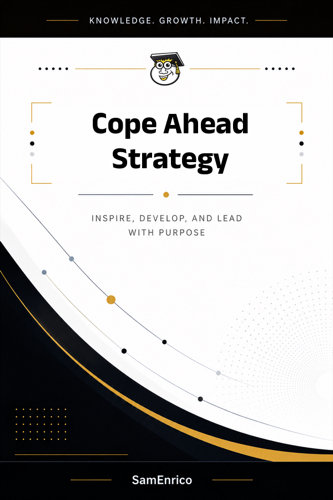
Non-FictionSelf-HelpPreparation
Cope Ahead Strategy eBook
Rehearse emotionally difficult situations before t
Rehearse emotionally difficult situations before they happen to reduce distress.
Formats
Free sample
Chapter 1: The Prediction Trap--–- Every night at 11:47 p.m., without fail, your brain runs a simulation. You are not conscious of it. You did not choose it. But while you lie in bed staring at the ceiling or scrolling your phone or tossing a pillow for the tenth time, your mind is doing something remarkable and terrible: it is predicting the future.–- It is not predicting the weather or the stock market or who will win the election. It is predicting something far more personal.
Your brain is asking a single question: What will happen tomorrow when I face that thing I am dreading? And then, because your brain is a pattern-matching machine built for survival, it answers that question using the only data it has—your past pain, your previous failures, your oldest fears.–- This is the Prediction Trap. And if you are reading this book, you have fallen into it hundreds or thousands of times.–- Consider a woman named Priya. Priya is a thirty-four-year-old marketing manager who has been asked to present quarterly results to her company’s executive team. She has ten days to prepare.
She knows the material. She has done similar presentations before. But every evening, as she sits down to work on her slides, a familiar sensation arrives: a tightness in her chest, a slight tremor in her hands, a voice in her head that says, You are going to mess this up. They are going to see right through you. Everyone will know you do not belong here.–- Priya is not experiencing fear.
Fear is what you feel when a car swerves into your lane or when you hear a crash in the dark. Fear has an object. It is a response to an immediate threat. What Priya is experiencing is something different, something more insidious, something that affects nearly every person who has ever worried about a conversation, a test, a date, a review, or a difficult decision. She is experiencing anticipatory distress.–- Anticipatory distress is the anxiety, dread, or panic that arises before a situation occurs.
It is the mind’s attempt to prepare for a future that has not yet arrived. And here is the paradox that sits at the heart of this entire book: the very mechanism that evolved to protect you—your ability to imagine what might happen next—has become one of the greatest sources of suffering in modern life.The Evolutionary Mismatch–- To understand why your brain torments you with predictions of disaster, you need to go back about two hundred thousand years. Imagine you are an early human living on the savanna. You hear a rustle in the grass. Your brain has a fraction of a second to answer a life-or-death question: Is that a lion or just the wind?
If you guess lion and you are wrong, you waste energy running from nothing. If you guess wind and you are wrong, you are eaten. Your brain is wired to treat uncertainty as danger. Better to run from a hundred false alarms than to ignore one real threat.–- This is called the negativity bias, and it is not a flaw in your brain. It is a feature that kept your ancestors alive long enough to have children.
Your brain is not trying to make you miserable. It is trying to keep you safe. The problem is that you no longer live on the savanna. The rustles in your grass are rarely lions. They are emails, performance reviews, text messages, voicemails, social gatherings, family dinners, and difficult conversations.
These are not threats to your life. They are threats to your ego. But your brain cannot tell the difference.–- So it runs the same ancient program. It scans for danger. It predicts the worst.
It prepares your body for fight or flight. Your heart rate increases. Your breathing becomes shallow. Your muscles tense. Your digestive system slows down.
This is the stress response, also known as the sympathetic nervous system activating. And here is the cruel twist: all of this happens in response to something that has not happened yet and may never happen.–- Priya’s presentation is nine days away. Her body is reacting as if she is being chased by a predator right now. This is the Prediction Trap. You are not responding to reality.
You are responding to your brain’s prediction of reality. And because your brain is wired to avoid danger, it consistently overestimates the likelihood of bad outcomes and underestimates your ability to handle them.The Neural Coupling Discovery–- In the late 1990s, neuroscientists made a discovery that changed how we understand anxiety. Using functional magnetic resonance imaging (f MRI), they asked research participants to perform two tasks. First, they asked them to actually move their fingers in a specific sequence. Second, they asked them to imagine moving their fingers in the exact same sequence, without actually moving.
The results were astonishing. The same regions of the brain activated in both conditions—the premotor cortex, the supplementary motor area, and the cerebellum. The brain could not fully distinguish between a real action and a vividly imagined one.–- This phenomenon is called neural coupling. The neurons that fire when you do something also fire when you imagine doing it. This is why athletes use mental rehearsal before competitions.
This is why musicians practice pieces in their heads when they cannot access an instrument. Your brain treats imagination as a form of practice.–- Now consider what this means for the Prediction Trap. When you lie in bed at night imagining your presentation going horribly wrong—the awkward silence, the confused faces, the critical question you cannot answer—your brain is not just thinking. It is practicing. It is strengthening the neural pathways associated with panic, shame, and helplessness.
You are rehearsing catastrophe. And because the brain cannot tell the difference between a vividly imagined catastrophe and a real one, you are training yourself to be more afraid.–- This is the dark side of neural coupling. If you rehearse failure, you become better at failing. If you rehearse panic, you become better at panicking. If you rehearse rejection, you become more sensitive to rejection.
Your brain is a learning machine, and it learns whatever you practice—whether you intend to practice it or not.–- But here is the same discovery turned toward hope. If your brain cannot distinguish between a vividly imagined catastrophe and a real one, it also cannot distinguish between a vividly imagined coping response and a real one. If you rehearse staying calm, you become better at staying calm. If you rehearse breathing through discomfort, you become better at breathing. If you rehearse a specific script for a difficult conversation, you become more likely to follow that script when the conversation actually happens.
The same mechanism that wires you for panic can wire you for resilience.–- The only difference is intention. Panic rehearses itself automatically. Coping requires deliberate practice.Productive Worry versus Unproductive Rumination–- Not all thinking about the future is harmful. In fact, some thinking about the future is essential for survival and success. The trick…
This is the end of the free sample. Get the eBook to keep going. Buy now
About this book
Details
- Author
- Geiger Catherina
- Publisher
- SamEnrico
- Language
- English
- Genre
- Non-Fiction, Self-Help, Preparation
- Released
- 2026-06-10
- Pages (approx.)
- 141
- Available as
- eBook, Audiobook

Read better in the ZLOADR app
Your eBooks on your phone or tablet. Sign in with your SamEnrico account and start reading.
More by Geiger Catherina
 Trauma Surgeon Resilience WorkbookGeiger Catherina$11.99
 Middle Manager Self EsteemGeiger Catherina$11.99
 The Waco Independent ReviewGeiger Catherina$11.99
 The Anapanasati Beginner GuideGeiger Catherina$11.99
 Amun The Hidden OneGeiger Catherina$11.99
 Therapy For BurnoutGeiger Catherina$11.99
 Pressure Suit Failure DrillsGeiger Catherina$11.99
 Cooking Recipe PalaceGeiger Catherina$11.99
 The Iron Titans: How Railroads United a ContinentGeiger Catherina$11.99
 The Silent Guardians: Swiss Precision in the ShadowsGeiger Catherina$11.99
 The Crown and the Kingmaker: How Queen Elizabeth II and Margaret Thatcher Reshaped a NationGeiger Catherina$11.99
 The Dancer's Guide to Bardo ChhamGeiger Catherina$11.99
You may also like
 Hong Kong Handover 1997Dunn Johnnie$11.99
 Zumba For Postnatal Recovery CourseNeal Christian$11.99
 Zumba for BeginnersLadner Nikia$11.99
 YouTube Comment Mining GuideHumes Pandora$12.99
 Worry Box MeditationCarlin Rudy$11.99
 Workplace Stress MeditationNguyen Lynn$11.99
 Workplace Stress and Sleep RepairHawley Ivory$11.99
 Workplace Perfectionism CureDelaney Jeffry$11.99
 Workplace Injustice Anger GuideWallen Isabelle$11.99
 Work Addiction and Burnout LinkGreenwood Ester$11.99
 Women in Yoga and WellnessBeattie Galina$11.99
 Women in Stand Up ComedyChun Evangeline$11.99