
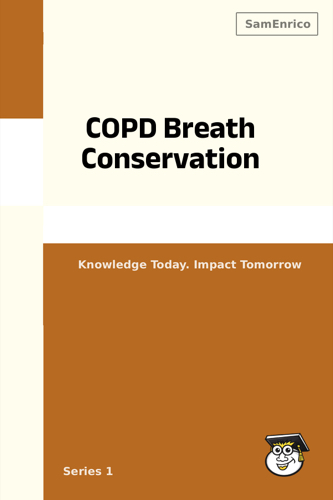
COPD Breath Conservation eBook
Practice energy-efficient breathing for chronic lu
Practice energy-efficient breathing for chronic lung conditions.
Formats
Free sample
Chapter 1: The Morning That Changed Everything--–- The fear started not with a gasp, but with a simple walk to the bathroom. That is where this story begins for most of us. For me, it was a Tuesday. Nothing remarkable about the date. No storm, no warning, no dramatic collapse.
Just twenty-two feet of hallway that suddenly felt like twenty-two miles.I woke up at 6:47 AM, same as always. My lungs felt heavy, the way they had for years. I swung my legs over the side of the bed and sat up, waiting for the dizziness to pass. On a good day, that took about fifteen seconds. On a bad day, I didn't stand up at all.
This Tuesday was somewhere in between. I stood. I took three steps toward the bathroom. And then my chest locked.Not a sharp pain. Not a heart-attack feeling.
Something worse. Something quieter. It was as if someone had reached inside my ribcage and started squeezing, slowly, persistently, like they were wringing out a wet towel. My neck muscles jumped. My shoulders rose toward my ears.
I tried to take a breath, but the air felt thick, syrupy, useless. I grabbed the doorframe. My knuckles went white. And then the voice in my head started whispering the words we all know too well: This is it. You can't do this anymore.
You're not going to make it.I made it. Of course I made it. I always made it. But that morning, standing in the hallway in my bathrobe at 6:48 AM, I understood something for the first time: I wasn't living. I was surviving.
And surviving, I was learning, is not the same thing as living.The Conversation We Don't Have If you are reading this book, you already know the feeling I just described. You have stood in your own hallway, or your kitchen, or your driveway, wondering if your lungs would ever forgive you for the simple act of moving. You have cancelled plans because the walk from the parking lot to the restaurant seemed insurmountable. You have sat down in the shower. You have pretended you weren't winded during a phone call so the person on the other end wouldn't worry.
You have become an expert at hiding.Here is what no one told you, and what this book exists to say: The instinct to stop moving when you feel breathless is the single most destructive habit you have.Let me repeat that, because it sounds wrong. It sounds like the opposite of what every doctor, every nurse, every well-meaning family member has ever told you. When you can't breathe, the natural response is to freeze. To rest. To wait.
To hope it passes. That instinct kept our ancestors alive when they heard a predator in the bushes. But for the person with COPD, that same instinct is a trap. A beautiful, reasonable, devastating trap.The trap has a name. It is called the Dyspnea Cycle, and understanding it is the difference between slowly shrinking your life to the size of a single chair and reclaiming the activities that make you who you are.The Dyspnea Cycle: A Quiet Devastation Let me draw you a picture.
Imagine a circle with four stations.Station One: Breathlessness. You attempt an activity—walking to the mailbox, carrying a laundry basket, climbing three stairs. Your lungs protest. You feel the familiar tightness, the panic, the desperate need for air. Your breathing rate spikes to thirty breaths per minute.
Your accessory muscles scream. You stop.Station Two: Inactivity. You decide, reasonably, that you should rest. You sit down. You tell yourself you will try again later.
But later becomes tomorrow, and tomorrow becomes next week. You begin to avoid the trigger activity altogether. You ask your spouse to get the mail. You let the laundry pile up. You use the downstairs bathroom even though the upstairs one is closer to the bedroom.Station Three: Deconditioning.
Here is where the body plays a cruel trick. Muscles that are not used atrophy. They shrink. They weaken. Your legs, your core, and most critically your diaphragm—the dome-shaped muscle beneath your lungs that does seventy percent of the work of breathing—begin to lose strength.
Your heart becomes less efficient at delivering oxygen. Your mitochondria (the tiny power plants inside your cells) become less dense.Station Four: Increased Breathlessness. Now you try the same activity again. But because you have lost muscle mass and diaphragmatic strength, the activity feels harder than it used to. You become breathless more quickly, more intensely, with less exertion.
You panic. You stop. You rest. And the cycle begins again.This is not a moral failure. This is not laziness.
This is physiology. Your body has learned, through perfectly logical reinforcement, that moving leads to suffering, and therefore avoiding movement is the correct strategy. Your brain has wired a fear response. Your muscles have adapted to rest. You have become, through no fault of your own, a prisoner of your own survival instincts.The Energy Bank: A New Way to Think Here is the metaphor I want you to carry with you through every chapter of this book.
It is not original to me, but it is the most useful tool I have found for understanding what is happening inside your body.Imagine that every morning, you wake up with a certain number of energy coins in your bank account. Let's say you start with one hundred coins. Every activity you perform costs a certain number of coins. Brushing your teeth costs two coins. Taking a shower costs eight coins.
Cooking a simple meal costs twelve coins. Walking to the end of the driveway and back costs fifteen coins.Here is the problem: people with COPD have a smaller energy bank than healthy people. Your bank account might start with only sixty coins. But the activities still cost the same number. So you run out faster.
You hit zero by 11:00 AM. You crash. You spend the rest of the day recovering.The goal of this book is not to give you more coins. That is impossible. The damage to your lungs is real.
The airway obstruction is real. The air trapping is real. No breathing exercise will reverse emphysema or cure chronic bronchitis. If anyone promises you that, close the book and walk away.The goal of this book is to teach you how to spend fewer coins on the same activities. To make brushing your teeth cost one coin instead of two.
To make showering cost four coins instead of eight. To make walking to the mailbox cost seven coins instead of fifteen. You cannot increase your deposit. But you can absolutely reduce your withdrawal.How? By changing how you breathe, how you move, how you position your body, and how you organize your day.
That is what breath conservation means. It is not about breathing less. It is about breathing smarter.Dangerous vs. Expected Breathlessness Before we go any further, I need to draw a line. A hard line.
A line that could save your life.Not all breathlessness is the same. There is dangerous breathlessness, which requires immediate medical attention. And there…
This is the end of the free sample. Get the eBook to keep going. Buy now
About this book
Details
- Author
- Jacob Antoine
- Publisher
- SamEnrico
- Language
- English
- Genre
- Non-Fiction, Self-Help
- Released
- 2026-06-10
- Pages (approx.)
- 154
- Available as
- eBook, Audiobook

Read better in the ZLOADR app
Your eBooks on your phone or tablet. Sign in with your SamEnrico account and start reading.
More by Jacob Antoine
 Joyful Creativity Through GratitudeJacob Antoine$11.99
 Couples Therapy Low CostJacob Antoine$11.99
 The Stress First Apology MethodJacob Antoine$11.99
 Jimmy John Liautaud FreakyJacob Antoine$11.99
 The Self ForgivenessJacob Antoine$11.99
 Infant Choking RescueJacob Antoine$11.99
 Leukemia at SeaJacob Antoine$11.99
 Jimmy Kimmel UnmaskedJacob Antoine$11.99
 The Ballad of Ibn Battuta: The Unstoppable African ExplorerJacob Antoine$11.99
 Pulp Fiction: The Wild, Untamed Birth of Beat LiteratureJacob Antoine$11.99
 The Lost Chronicles of Gonzalo Pizarro: The Amazon’s Forgotten ConquestJacob Antoine$11.99
 Growing HypoestesJacob Antoine$11.99
You may also like
 Hong Kong Handover 1997Dunn Johnnie$11.99
 Zumba For Postnatal Recovery CourseNeal Christian$11.99
 Zumba for BeginnersLadner Nikia$11.99
 YouTube Comment Mining GuideHumes Pandora$12.99
 Worry Box MeditationCarlin Rudy$11.99
 Workplace Stress MeditationNguyen Lynn$11.99
 Workplace Stress and Sleep RepairHawley Ivory$11.99
 Workplace Perfectionism CureDelaney Jeffry$11.99
 Workplace Injustice Anger GuideWallen Isabelle$11.99
 Work Addiction and Burnout LinkGreenwood Ester$11.99
 Women in Yoga and WellnessBeattie Galina$11.99
 Women in Stand Up ComedyChun Evangeline$11.99