
Non-FictionBusiness BriefCertification
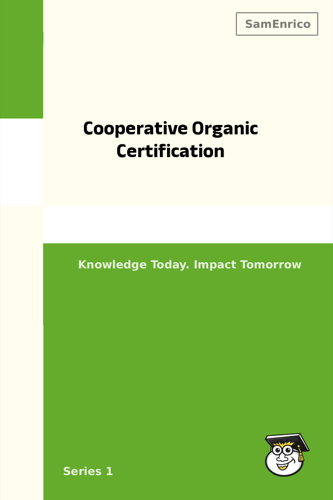
Cooperative Organic Certification eBook
Meet standards for international organic markets a
Meet standards for international organic markets as a group.
Formats
Free sample
Chapter 1: Beyond the Individual...--–- The smallholder farmer in rural Tanzania knelt in her cassava field, her hands dark with soil, and listened as the export buyer explained organic certification. She needed to pay $2,000 for an inspector to visit her two-hectare farm. Her annual income from cassava was $500. The math was impossible. She stood up, brushed off her knees, and walked away from the organic market before she had ever truly entered it.
This scene repeats itself millions of times across the developing world—not because farmers lack the skill or will to farm organically, but because the certification system was designed for industrial agriculture, not for the smallholder who feeds the world.For decades, organic certification has operated on an individual model. A single farm, regardless of size, pays the same fixed fees: an application fee, an annual inspection fee, the inspector’s travel costs (airfare, hotel, meals, ground transportation), and often a royalty fee based on sales. For a 1,000-hectare grain estate in Germany or a 500-hectare almond orchard in California, these fees represent a manageable business expense, often less than one percent of revenue. For the 475 million smallholder farmers worldwide who cultivate less than two hectares each, these same fees represent an insurmountable barrier. The result is a profound market failure: the farmers who are most likely to already practice organic methods—because they cannot afford synthetic inputs—are systematically excluded from the premium prices that organic certification commands.This chapter dismantles the assumption that individual certification is the only path to organic markets.
It introduces an alternative model that has been quietly proving itself for three decades: group certification through a cooperative or producer organization. Under this model, the cooperative becomes the certified entity, and individual farmers become members of an internal control system. The external certifier audits the cooperative’s system, not each farmer individually. The cost per farmer drops from thousands of dollars to as little as twenty dollars. The Tanzanian cassava farmer who could not afford $2,000 can afford $20.
More importantly, she can afford it as part of a collective that shares not only costs but also knowledge, infrastructure, and market power.The chapter proceeds in three parts. First, it diagnoses the structural economics of certification, showing exactly why individual certification fails for smallholders and why that failure is not an accident but a design feature of a system built for large farms. Second, it introduces the group certification model, explaining how producer organizations and cooperatives function as certified entities and how the internal control system replaces individual inspections with collective accountability. Third, it provides a comparative analysis of the three major international organic standards—the EU Organic Regulation, the USDA National Organic Program, and the Japanese Agricultural Standard—demonstrating that all three explicitly permit group certification and that a well-designed internal control system is universally recognized across all major markets. The chapter concludes with a decision framework to help farmer organizations assess whether group certification is the right path for their specific context.The Economic Impossibility of Individual Certification The fixed-cost structure of organic certification is the single greatest barrier to smallholder participation.
To understand why, we must examine each component of certification cost and how it scales—or, more precisely, how it fails to scale.Application fees typically range from $500 to $1,500 per certification. This fee covers the certifier’s administrative costs of reviewing the application, assigning an inspector, and opening a file. Whether the applicant is a single farmer with one hectare or a cooperative with ten thousand hectares, the application fee is identical. The certifier performs the same administrative steps regardless of the applicant’s size. From the certifier’s perspective, this is rational: each client requires a file, a contract, and a record-keeping system.
From the smallholder’s perspective, it is irrational: the application fee alone can exceed an entire year’s income.Annual inspection fees range from $1,000 to $4,000 per inspection. This fee compensates the inspector for their time on-site, typically one to three days depending on the complexity of the operation. A single large farm with a centralized packing facility, a single warehouse, and a single set of records can be inspected in two days. A group of five hundred smallholder farms, each with its own plot, its own storage, and its own records, would require weeks of inspection time—unless that group implements an internal control system that allows the external inspector to audit the system rather than each farm. The annual inspection fee is not inherently unreasonable; it reflects the real cost of sending a trained professional to a farm.
But that cost is the same for a one-hectare farm and a one-thousand-hectare farm, which means the cost per hectare or per unit of production is catastrophically higher for the smallholder.Travel costs are often the largest and most unpredictable expense in certification. The certifier’s inspector must physically visit the farm or cooperative. For smallholders in remote rural areas—precisely where organic agriculture is most common—travel costs can include international flights, domestic flights, several days of hired car and driver, hotel accommodations, and per diem meals. It is not uncommon for travel costs to exceed the inspection fee itself. A single inspection of a cooperative in rural Uganda might require the inspector to fly from Nairobi to Entebbe, drive five hours to the cooperative’s office, stay two nights in a local hotel, and then reverse the journey.
Total travel cost: $2,000 or more. For an individual smallholder, this is impossible. For a cooperative with a thousand members, spread across two hundred members, it becomes $2 per farmer.Royalty fees are a percentage of organic sales, typically 0.5 to 1.5 percent. Unlike fixed fees, royalty fees scale with revenue. A smallholder earning $500 per year from organic sales would pay $2.50 to $7.50 in royalties—affordable.
But royalty fees are only charged on organic sales, and the smallholder cannot reach organic sales without first paying the application, inspection, and travel fees. Royalty fees are therefore not the barrier; they are the toll at the end of a road that most smallholders cannot afford to enter.The per-farmer cost calculation reveals the brutal mathematics. A single farmer seeking individual certification might pay: $1,000 application fee, $2,000 annual inspection fee, $1,500 travel costs, and $500 in miscellaneous administrative costs, for a total of $5,000 in the first year and $4,000 in subsequent years. For a farmer earning $500 annually, certification costs ten times their annual income. This is not a business decision; it is an impossibility.
The same farmer participating in a cooperative with five hundred members might pay: the cooperative’s total certification costs of $6,000 ($1,000 application, $2,000 inspection, $1,500 travel, $500 admin, plus $1,000 for the internal control system) divided by five hundred members, for a per-farmer cost of $12. This is the power of group certification.The Group Certification Model Group certification is not a loophole or a lower standard. It is a formally recognized certification model under all major organic regulations, designed specifically for smallholder producers who would otherwise be excluded from organic markets. The model rests on three foundational principles: collective certification, internal control, and shared liability.Collective certification means that the legal entity—the cooperative, the producer organization, the association—holds the organic certificate, not the individual farmers.…
This is the end of the free sample. Get the eBook to keep going. Buy now
About this book
Details
- Author
- Conklin Oralia
- Publisher
- SamEnrico
- Language
- English
- Genre
- Non-Fiction, Business Brief, Certification
- Released
- 2026-06-08
- Pages (approx.)
- 144
- Available as
- eBook, Audiobook

Read better in the ZLOADR app
Your eBooks on your phone or tablet. Sign in with your SamEnrico account and start reading.
More by Conklin Oralia
 Road Rage Safety ProtocolConklin Oralia$11.99
 Sediment Coring Around WrecksConklin Oralia$11.99
 Psychotic Depression Explained GuideConklin Oralia$11.99
 Pomodoro for Learning New SoftwareConklin Oralia$11.99
 The Shadow Scribes: Unmasking Australia’s First Crime WritersConklin Oralia$11.99
 Understanding Oral Facial DyskinesiaConklin Oralia$17.99
 How to Become a Shale Planer Operator HelperConklin Oralia$11.99
 Portfolio vs Diploma DebateConklin Oralia$12.99
 Bank of America SWOTConklin Oralia$12.99
 Paid Social Media ManagerConklin Oralia$11.99
You may also like
 Hong Kong Handover 1997Dunn Johnnie$11.99
 Zumba For Postnatal Recovery CourseNeal Christian$11.99
 Zumba for BeginnersLadner Nikia$11.99
 YouTube Comment Mining GuideHumes Pandora$12.99
 Worry Box MeditationCarlin Rudy$11.99
 Workplace Stress MeditationNguyen Lynn$11.99
 Workplace Stress and Sleep RepairHawley Ivory$11.99
 Workplace Perfectionism CureDelaney Jeffry$11.99
 Workplace Injustice Anger GuideWallen Isabelle$11.99
 Work Addiction and Burnout LinkGreenwood Ester$11.99
 Women in Yoga and WellnessBeattie Galina$11.99
 Women in Stand Up ComedyChun Evangeline$11.99