
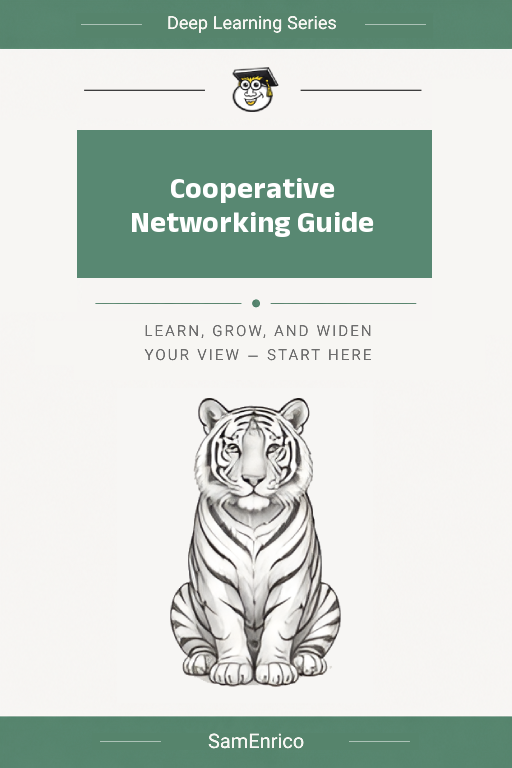
Non-FictionBusiness BriefCooperative Networks
Cooperative Networking Guide eBook
Build federations, apex bodies, and partnerships a
Build federations, apex bodies, and partnerships among cooperatives for shared services and collective bargaining.
Formats
Free sample
Chapter 1: The Graveyard of Lonely Co-ops--The Weathered Hands Farm Co-op had ninety-three days of cash left. It was a Tuesday in late October, and the rain had turned the access road to mud. Susan Okonkwo, the co-op’s general manager, sat at her kitchen table with three spreadsheets open on a laptop that was older than her youngest child. The numbers were not ambiguous. They were terminal.Weathered Hands was a good co-op.
Ten small-scale vegetable farmers, two beekeepers, and a flower grower, all women, all first-generation farmers, all deeply committed to soil health and living wages. Their vegetables were beautiful. Their customers loved them. Their largest wholesale account—a regional grocery chain with thirty-seven stores—had just demanded a 15 percent price cut, effective in sixty days, or they would drop the co-op entirely and source from a single industrial farm in California.Susan had tried everything. She called the bank: no additional credit.
She called the Small Business Development Center: they sent a PDF on social media marketing. She called four other small farm co-ops within a hundred miles, just to commiserate. And that call—the one made out of desperation, not strategy—changed everything.“We’re in the same boat,” said Maria from Red Clay Co-op. “They squeezed us too.”“Us three,” said James from Harvest Together.“Four,” said Priya from Common Roots.By the end of that week, seven co-ops had agreed to a single, simple experiment: they would buy their potting soil together. Just potting soil.
Nothing else. No legal entity, no complicated governance, no shared staff. Seven co-op managers on a group text message, one supplier, one quote: twenty-two percent lower than any of them could get alone.Within ninety days, Weathered Hands not only survived—they raised their price to the grocery chain by 8 percent. Because now they were not one co-op. They were seven.
And seven co-ops bargaining together look very different to a buyer than one co-op begging alone.This book is the playbook they wished they had before that desperate Tuesday phone call.--The Problem That No One Wants to Name Isolated cooperatives are dying. Not all of them, not all at once, but steadily and predictably, like small grocers in the age of Walmart or independent bookstores before Amazon. The data is not kind. According to a longitudinal study of cooperative failure rates published in the Journal of Co-operative Studies, independent, non-federated co-ops have a failure rate three times higher within their first decade than co-ops that belong to a formal federation or apex body. The reason is not better management or more committed members.
The reason is scale.Consider the math. A single food co-op with 3millioninannualrevenuepaysabookkeeper3 million in annual revenue pays a bookkeeper 3millioninannualrevenuepaysabookkeeper50,000, an HR consultant 20,000,andapart−time ITperson20,000, and a part-time IT person 20,000,andapart−time ITperson30,000. That is 100,000inoverheadbeforetheyhavesoldasinglecarrot.Tenco−ops,eachdoingthesamething,collectivelyspend100,000 in overhead before they have sold a single carrot. Ten co-ops, each doing the same thing, collectively spend 100,000inoverheadbeforetheyhavesoldasinglecarrot.Tenco−ops,eachdoingthesamething,collectivelyspend1 million on the same functions, duplicated ten times. A federation of those ten co-ops, with a shared service center, can do all of that work for 400,000—a60percentreduction.That400,000—a 60 percent reduction.
That 400,000—a60percentreduction.That600,000 in savings is not abstract. It is the difference between staying open and locking the doors.But the problem is worse than overhead. The problem is market power—or the lack of it. A single worker co-op negotiating with a hospital system for a cleaning contract has no leverage. The hospital knows the co-op has no alternative buyer.
Ten worker co-ops, acting together, can walk away. A single farm co-op selling to a grocery chain accepts whatever price the chain offers. Twenty farm co-ops, acting together, can set a floor.This is not theory. This is the story of every successful cooperative sector in the world. The reason dairy farmers in Wisconsin have survived decades of consolidation is not because they are better farmers.
It is because they belong to Land O’Lakes, a cooperative of cooperatives that processes and markets their milk. The reason credit unions still exist alongside JPMorgan Chase is not because they offer better interest rates. It is because they belong to corporate credit unions and shared branching networks that give them the scale of a national bank while keeping local governance.The cooperatives that survive are the ones that learn to act like a single entity when facing the market, while remaining autonomous in their communities. This is the central tension of cooperative networking. And this book is a roadmap for navigating it.--The Sixth Principle Is Not a Suggestion In 1844, the Rochdale Pioneers—twenty-eight weavers and artisans in a small English town—wrote down the principles that would define the cooperative movement for the next 180 years.
The sixth principle, added later but now universally accepted, is this: Cooperation among cooperatives.For most of cooperative history, this principle has been interpreted as a nice ideal. Be friendly to other co-ops. Share best practices. Send a delegate to the annual federation meeting. These are not bad things, but they are not survival strategies.
They are the cooperative equivalent of exchanging business cards at a networking event while your company burns down.The argument of this book is that the sixth principle is not a suggestion. It is an existential mandate. The investor-owned economy has spent fifty years consolidating into giants—Walmart, Amazon, Uber, Cargill, Monsanto, Bank of America. These entities did not achieve their scale through better products or more committed workers. They achieved it through networks: supply chains, distribution hubs, data integrations, and bargaining power.Cooperatives have the same tools available.
But they have been slow to use them, partly out of a deep and admirable commitment to local autonomy, and partly out of simple lack of knowledge. Most co-op board members have never seen a shared service agreement. Most co-op managers do not know the difference between a secondary cooperative and a mutual guarantee society. Most co-op organizers have never been told that collective bargaining among non-agricultural co-ops is not only legal but actively protected under the rule of reason.This book fills that gap. It is not a theoretical treatise on cooperative economics.
It is a practical, chapter-by-chapter guide to building the networks that will keep your co-op alive. Each chapter ends with a concrete Monday Morning Action—something you can do tomorrow, not next year.--What This Book Covers (and What It Does Not)This book is organized into five parts, each addressing a critical dimension of cooperative networking.Part I: The Strategic Case for Connection (Chapters 1–3) establishes why networking is not optional, how to envision the right network for your specific problem, and how to choose the right depth of integration without overcommitting too fast. Chapter 2 introduces the Four Nets framework and the Which Service First? decision matrix. Chapter 3 presents the Integration Ladder, a five-rung framework for matching your problem to your level of commitment.Part II: Antitrust & Legal Design (Chapters 4–6) addresses the legal and governance foundations.
Chapter 4—placed before legal structures for a reason—explains the antitrust rules that govern collective bargaining and introduces the Legal Risk Heatmap. Chapter 5 walks through the three primary…
This is the end of the free sample. Get the eBook to keep going. Buy now
About this book
Details
- Author
- Keaton Briana
- Publisher
- SamEnrico
- Language
- English
- Genre
- Non-Fiction, Business Brief, Cooperative Networks
- Released
- 2026-06-01
- Pages (approx.)
- 154
- Available as
- eBook, Audiobook

Read better in the ZLOADR app
Your eBooks on your phone or tablet. Sign in with your SamEnrico account and start reading.
More by Keaton Briana
 Insomnia and ForgetfulnessKeaton Briana$11.99
 Strategic Group Map PrimerKeaton Briana$11.99
 Navigating Racist CommentsKeaton Briana$11.99
 Influenza Vaccine Deadly RaceKeaton Briana$11.99
 Digital Planner Product Photos WorkbookKeaton Briana$11.99
 The Last Flight of the Concorde: When Supersonic Travel DiedKeaton Briana$11.99
 Operation Deep Freeze: Antarctica’s Cold War for MarsKeaton Briana$11.99
 Understanding Childhood Pustular PsoriasisKeaton Briana$17.99
 Change Management Global CommsKeaton Briana$12.99
 Ice Cream Sundae Bar AttendantKeaton Briana$11.99
 How to Start a Audio/visual Cassettes (retail) Business (Beginners Guide)Keaton Briana$11.99
You may also like
 Hong Kong Handover 1997Dunn Johnnie$11.99
 Zumba For Postnatal Recovery CourseNeal Christian$11.99
 Zumba for BeginnersLadner Nikia$11.99
 YouTube Comment Mining GuideHumes Pandora$12.99
 Worry Box MeditationCarlin Rudy$11.99
 Workplace Stress MeditationNguyen Lynn$11.99
 Workplace Stress and Sleep RepairHawley Ivory$11.99
 Workplace Perfectionism CureDelaney Jeffry$11.99
 Workplace Injustice Anger GuideWallen Isabelle$11.99
 Work Addiction and Burnout LinkGreenwood Ester$11.99
 Women in Yoga and WellnessBeattie Galina$11.99
 Women in Stand Up ComedyChun Evangeline$11.99