
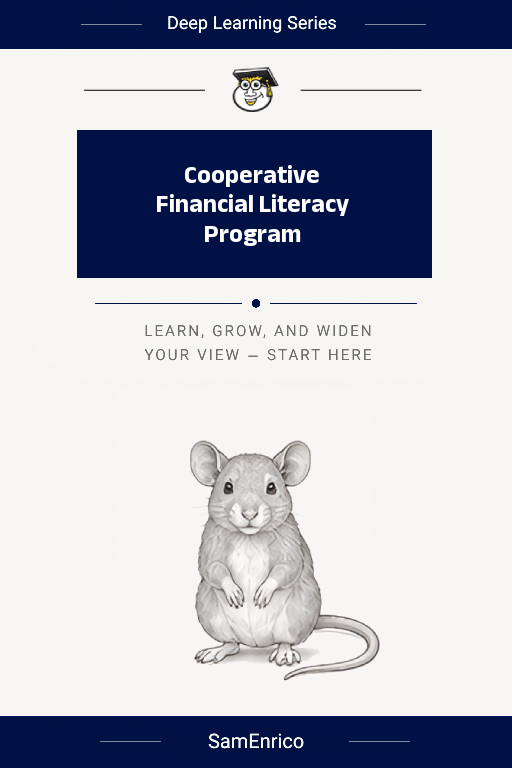
Cooperative Financial Literacy Program eBook
Provide member training on budgeting, saving, and
by Mosley Maren
Provide member training on budgeting, saving, and borrowing, reducing defaults and strengthening cooperative financial health.
Formats
Free sample
Chapter 1: The Owner’s Secret...--The first time Maria walked into a bank, she was nineteen years old, holding a crisp fifty-dollar bill she had saved from three months of braiding hair in her neighborhood. She wanted to open a savings account. The banker looked at her over his glasses, glanced at her worn sandals, and asked if she had a minimum balance of two hundred dollars. She did not. He handed her a brochure and said, “Come back when you have more.”Maria did come back.
She saved for another year. She returned with three hundred dollars. This time, the banker smiled, opened her account, and took her money. Six months later, Maria’s sewing machine broke. She needed two hundred dollars to repair it.
She went back to the bank and asked for a loan. The banker looked at her account—three hundred dollars in savings—and said no. She had no collateral. She had no credit history. She had no job with a formal paycheck.
She was, in the language of banking, “unbankable.”Maria borrowed the money from a loan shark instead. He charged her ten percent per week. By the time she repaid the loan, she had paid almost double the original amount. She closed her bank account, withdrew her three hundred dollars, and never went back.Six years later, Maria joined a cooperative. She deposited five dollars per week.
After ninety days, she applied for a two hundred dollar loan to buy fabric in bulk. The loan committee approved her within a week. She repaid on time. Six months later, she borrowed four hundred dollars. She bought a second sewing machine and hired an assistant.
Two years later, Maria owned a small shop. She had never borrowed from a bank again.Maria’s story is not unusual. It is the story of millions of people around the world who have been failed by traditional banking. But more importantly, it is the story of a fundamental truth that most people never learn: banks lend to people who already have money. Cooperatives lend to people who follow a system.
That system is what this book will teach you.The question that opens this chapter—the question that should haunt every person who has ever been turned away from a bank—is simple: why do banks always seem to lend money to people who do not actually need it? The answer reveals everything that is wrong with traditional finance and everything that is right about cooperatives.Banks require collateral. Collateral is an asset that the bank can take if you fail to repay your loan. A house. A car.
A piece of land. A savings account with a large balance. If you already own these things, the bank knows it can lend you money safely because it can seize your assets if you default. If you do not own these things, the bank will not lend to you. This is not cruelty.
It is the mathematical logic of banking. Banks exist to make a profit for their shareholders. They do not exist to lift people out of poverty. They do not exist to take risks on human potential. They exist to earn a return on capital.Cooperatives operate on a different logic entirely.
A cooperative is owned by its members. There are no distant shareholders demanding quarterly profits. When a cooperative earns money, that money is returned to the members as dividends. When a cooperative lends money, it is lending its own members’ savings to other members. The cooperative does not need collateral in the same way a bank does because the cooperative has something more valuable than collateral: data.Your weekly savings deposits are not just money.
They are data. Every time you deposit five dollars, ten dollars, or twenty dollars into your cooperative account, you are sending a signal to the loan committee. You are saying: I am consistent. I am reliable. I prioritize this obligation.
I show up every week. After ninety days of consistent deposits, you have sent ninety signals. The loan committee looks at those signals and makes a decision. Not based on what you own. Based on what you do.The Fundamental Mistake Most Members Make Here is the mistake that almost every new member makes.
They join a cooperative, but they continue to think like a bank customer. They view their weekly savings deposit as a fee. They see the money leaving their pocket and feel a small loss. They ask themselves: what am I getting for this? They do not see the deposit as an investment in their own borrowing power.
They do not see it as a vote of confidence in themselves.This mindset is the root of financial struggle. As long as you think like a customer, you will be treated like a customer. Customers pay fees. Customers have no power. Customers wait in line and take whatever terms they are given.
Owners behave differently. Owners understand that their weekly deposit is not a cost. It is a key. It unlocks the door to credit. It unlocks the door to larger loans, better terms, and eventually, financial freedom.Consider two members who join the same cooperative on the same day.
Member A deposits ten dollars every week for ninety days. She never misses a week. She treats the deposit as her most important bill. After ninety days, she applies for a five hundred dollar loan. The loan committee sees her perfect record and approves her within twenty-four hours.
Member B deposits ten dollars most weeks, but misses four weeks in the ninety-day period. When she applies for a five hundred dollar loan, the loan committee hesitates. They approve her for only two hundred dollars, at a slightly higher interest rate. The same cooperative. The same day.
The same request. Different outcomes. Why? Because Member A proved herself. Member B did not.This is the Owner’s Secret, and it is the single most important idea in this entire book: Banks lend based on what you have.
Cooperatives lend based on what you do.The Three Pillars of the Cooperative System Every cooperative operates on three pillars. You cannot understand your role as a member until you understand these pillars.Pillar One: Shared Ownership. When you join a cooperative, you purchase shares. Those shares make you an owner. You have a vote in electing the board of directors.
You have a voice in setting policies. You receive a share of the profits at the end of the year. This is not symbolic. It is legal and financial. You are not a customer.
You are an owner.Pillar Two: Shared Savings. Every member saves. The cooperative pools those savings and lends them to other members. When you save, you are not just building your own buffer. You are providing the capital that allows your neighbor to borrow.
When you borrow, you are not just taking money. You are using the savings of your fellow members. This mutual dependence creates accountability. You cannot borrow if others do not save. Others cannot borrow if you do not save.Pillar Three: Shared Risk.
When a member defaults on a loan, everyone loses. The cooperative loses capital. Dividends decrease. Interest rates may rise. Your…
This is the end of the free sample. Get the eBook to keep going. Buy now
About this book
Details
- Author
- Mosley Maren
- Publisher
- SamEnrico
- Language
- English
- Genre
- Non-Fiction, Business Brief
- Released
- 2026-06-01
- Pages (approx.)
- 143
- Available as
- eBook, Audiobook

Read better in the ZLOADR app
Your eBooks on your phone or tablet. Sign in with your SamEnrico account and start reading.
More by Mosley Maren
 Debt Collection Agent Stress GuideMosley Maren$11.99
 Ukrainian Family Reunited After InvasionMosley Maren$11.99
 Research Proposal Qualitative Methods GuideMosley Maren$11.99
 Sector for ParentsMosley Maren$11.99
 Producer Surplus MaximizationMosley Maren$11.99
 Induction Script TechniquesMosley Maren$11.99
 Death Valley Zero TraceMosley Maren$11.99
 Boxing Ring Focus HypnosisMosley Maren$11.99
 The Unstoppable Rise of Yulimar Rojas: From Humble Beginnings to Olympic GloryMosley Maren$11.99
 The Golden Quill of Sappho: A Voice Lost to TimeMosley Maren$11.99
 The Mineral Guide to BruciteMosley Maren$11.99
 How to Become a Buckshot-swage OperatorMosley Maren$11.99
You may also like
 Hong Kong Handover 1997Dunn Johnnie$11.99
 Zumba For Postnatal Recovery CourseNeal Christian$11.99
 Zumba for BeginnersLadner Nikia$11.99
 YouTube Comment Mining GuideHumes Pandora$12.99
 Worry Box MeditationCarlin Rudy$11.99
 Workplace Stress MeditationNguyen Lynn$11.99
 Workplace Stress and Sleep RepairHawley Ivory$11.99
 Workplace Perfectionism CureDelaney Jeffry$11.99
 Workplace Injustice Anger GuideWallen Isabelle$11.99
 Work Addiction and Burnout LinkGreenwood Ester$11.99
 Women in Yoga and WellnessBeattie Galina$11.99
 Women in Stand Up ComedyChun Evangeline$11.99