
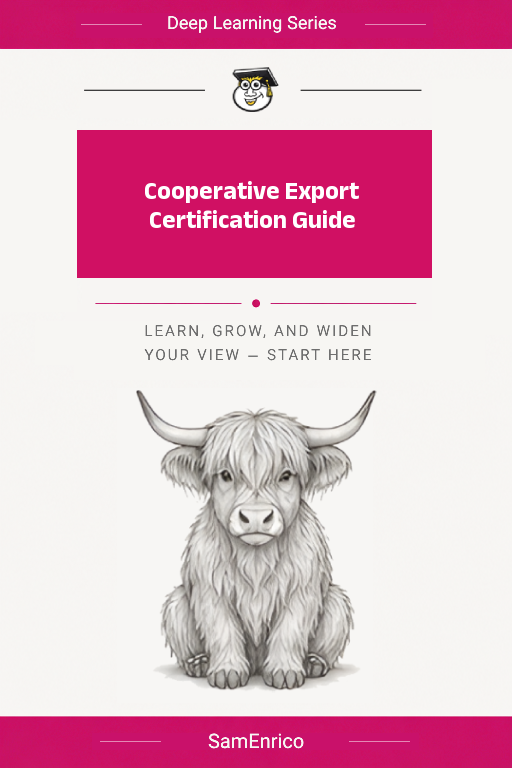
Cooperative Export Certification Guide eBook
Obtain Fairtrade, Organic, or Rainforest Alliance
Obtain Fairtrade, Organic, or Rainforest Alliance certification for cooperative exports, meeting international buyer requirements.
Formats
Free sample
Chapter 1: The Certification Cliff--–- The container ship had been sitting at the Port of Rotterdam for eleven days. Inside its hold sat forty metric tons of specialty-grade coffee from a smallholder cooperative in northern Peru—beans that had been grown with painstaking care, hand-sorted twice, and shipped with a valid organic certificate issued just four months earlier. The buyer, a well-known German roasting house, had already paid a 30% deposit. The cooperative's manager, a woman named Elena who had spent eighteen months preparing for this moment, received the email on a Thursday afternoon. The subject line read: "Urgent: Shipment Rejected – Certification Non-Compliant."The reason was not contaminated beans, nor failed lab tests, nor child labor violations.
The reason was a single missing polygon boundary on a mapping platform that did not exist when the cooperative first prepared its application. The buyer's new EU due diligence software had flagged the shipment because the cooperative could not prove, with geospatial certainty, that none of its 1,200 member farms had been deforested after December 31, 2020. The certificate was real. The product was clean. The paperwork was in order.
But the certification, as a market access tool, had just failed.Elena's cooperative lost €168,000 on that shipment. The buyer found a certified supplier in Brazil within ten days. The cooperative's container was eventually sold at a 40% discount to a conventional trader who stripped the organic labels and poured the beans into bulk bags. The certification itself was never revoked. It simply became worthless because the rules had changed while the cooperative was still playing the old game.This is not a cautionary tale.
It is the new normal.The Great Misunderstanding For the past twenty years, agricultural cooperatives in the Global South have been taught a simple equation: certification equals premium equals market access. Fairtrade meant a guaranteed minimum price and a social premium. Organic meant higher prices from health-conscious consumers. Rainforest Alliance meant environmental credibility and access to sustainability-focused buyers. And for two decades, this equation worked reasonably well.
Flawed, yes. Imperfect, certainly. But functional.That era ended on January 1, 2025.The European Union's Deforestation Regulation (EUDR) came into full force on that date, fundamentally altering the legal status of certification. Suddenly, certification was no longer a marketing tool—it became a legal defense mechanism. Buyers were no longer asking "Is this product certified?" They were asking "Can this certification prove, to the satisfaction of EU regulators, that this product did not come from deforested land and did not violate human rights laws?" For many cooperatives, the answer was no.This chapter dismantles the outdated understanding of certification and replaces it with a framework suited to the new regulatory reality.
You will learn why the old approach to certification—treating it as a box to be checked—is now actively dangerous. You will understand how the 2025 regulatory shocks have transformed certification from a nice-to-have into a must-have, but also into a much more demanding and precise instrument. And you will see, through data and case studies, exactly what happens to cooperatives that fail to make this transition.The Regulatory Earthquake of 2025Three pieces of legislation have fundamentally reshaped the certification landscape. Understanding each one is not optional. It is the difference between shipping your product and watching it rot on a dock.The EU Deforestation Regulation (EUDR)The EUDR is the most consequential piece of supply chain legislation in a generation.
It requires any operator placing specified commodities—including coffee, cocoa, palm oil, soy, beef, rubber, and wood—onto the EU market to prove that their products are "deforestation-free." The cutoff date is December 31, 2020. Any product grown on land that was deforested after that date is illegal to sell in the EU, regardless of its certification status.The regulation requires what is known as "geo-location" data. For every plot of land that produced a certified product, the operator must provide polygon mapping—not just a point on a map, but the actual boundaries of the farm. These polygons must be submitted to the EU's central information system. The regulation also requires due diligence statements that trace the product from farm to first point of entry into the EU, including supply chain mapping that identifies every actor.What makes the EUDR particularly challenging for cooperatives is that it does not recognize certification as a substitute for due diligence.
A product can carry the Rainforest Alliance seal, the Fairtrade mark, and the EU Organic logo—and still be non-compliant with the EUDR if the deforestation proof is missing. Certification schemes are scrambling to align their standards with the regulation, but as of 2025, the burden of proof remains squarely on the operator.For a cooperative, this means that your certificate is only as valuable as your ability to back it up with geospatial data. If you cannot draw a polygon around every member's farm and prove that the land was forested on December 31, 2020, your certification will not open EU markets. Period.The German Supply Chain Due Diligence Act (Lk SG)Germany's Act on Corporate Due Diligence in Supply Chains, which became fully effective in 2023 with enforcement ramping up through 2025, applies to companies with more than 1,000 employees operating in Germany. It requires these companies to identify, prevent, and remedy human rights and environmental risks in their supply chains.
Covered risks include child labor, forced labor, unsafe working conditions, discrimination, and environmental harm including water pollution and greenhouse gas emissions.The critical innovation of the Lk SG is its enforcement mechanism. The German Federal Office of Economic Affairs and Export Control (BAFA) can impose fines of up to 2% of a company's annual global turnover for violations. It can also exclude companies from public procurement contracts for up to three years. This creates a powerful incentive for buyers to demand evidence of compliance from their suppliers—including cooperatives.While the Lk SG does not mandate specific certifications, it has created a market where certification is the most efficient way for buyers to demonstrate compliance. A cooperative without recognized certification is now effectively invisible to major German buyers.
But a cooperative with certification that does not specifically address the Lk SG risk categories—child labor monitoring, grievance mechanisms, environmental protection—is nearly as invisible.The EU Organic Regulation 2018/848 – Full Enforcement The EU Organic Regulation was adopted in 2018, but its most stringent provisions were phased in over several years. By January 2025, the regulation is fully enforced with no further transitional grace periods. The most consequential changes for cooperatives are the group certification rules. Under the new regime, organic group certification is limited to a maximum of 2,000 members. Cooperatives that exceed this cap must either split into legal subgroups or transition to individual certification for each member—which is economically impossible for most smallholders.The regulation also mandates precise audit percentages that have caused enormous confusion.
Here is the correct breakdown, which will be explored in depth in Chapter 3: the cooperative must internally audit 5% of its members annually. The external certification body must inspect a sample of at least 5% of members. From that external sample, 5% must receive laboratory testing for prohibited substances. This means that for a 1,000-member cooperative, 50 members are internally audited each year, 50 receive external inspections, and 2…
This is the end of the free sample. Get the eBook to keep going. Buy now
About this book
Details
- Author
- Greenfield Josef
- Publisher
- SamEnrico
- Language
- English
- Genre
- Non-Fiction, Business Brief
- Released
- 2026-05-29
- Pages (approx.)
- 137
- Available as
- eBook, Audiobook

Read better in the ZLOADR app
Your eBooks on your phone or tablet. Sign in with your SamEnrico account and start reading.
More by Greenfield Josef
 Sector Interview PreparationGreenfield Josef$11.99
 Indian Family Reunification JourneyGreenfield Josef$11.99
 Research Proposal Peer Review WorkshopGreenfield Josef$11.99
 Rent Control AnalysisGreenfield Josef$11.99
 Self Esteem for Aging ArtistsGreenfield Josef$11.99
 Cannabis Use in Teens GuideGreenfield Josef$11.99
 Self Hypnosis for GolfGreenfield Josef$11.99
 Shenandoah Trail VanishedGreenfield Josef$11.99
 The Temptations: My Girl, Our MovementGreenfield Josef$11.99
 The Habsburgs and the High Seas: Austria-Hungary’s Forgotten Naval LegacyGreenfield Josef$11.99
 The Billionaire's Secret War: How One Man Outspent a NationGreenfield Josef$11.99
 Cybersecurity FundamentalsGreenfield Josef$11.99
You may also like
 Hong Kong Handover 1997Dunn Johnnie$11.99
 Zumba For Postnatal Recovery CourseNeal Christian$11.99
 Zumba for BeginnersLadner Nikia$11.99
 YouTube Comment Mining GuideHumes Pandora$12.99
 Worry Box MeditationCarlin Rudy$11.99
 Workplace Stress MeditationNguyen Lynn$11.99
 Workplace Stress and Sleep RepairHawley Ivory$11.99
 Workplace Perfectionism CureDelaney Jeffry$11.99
 Workplace Injustice Anger GuideWallen Isabelle$11.99
 Work Addiction and Burnout LinkGreenwood Ester$11.99
 Women in Yoga and WellnessBeattie Galina$11.99
 Women in Stand Up ComedyChun Evangeline$11.99