
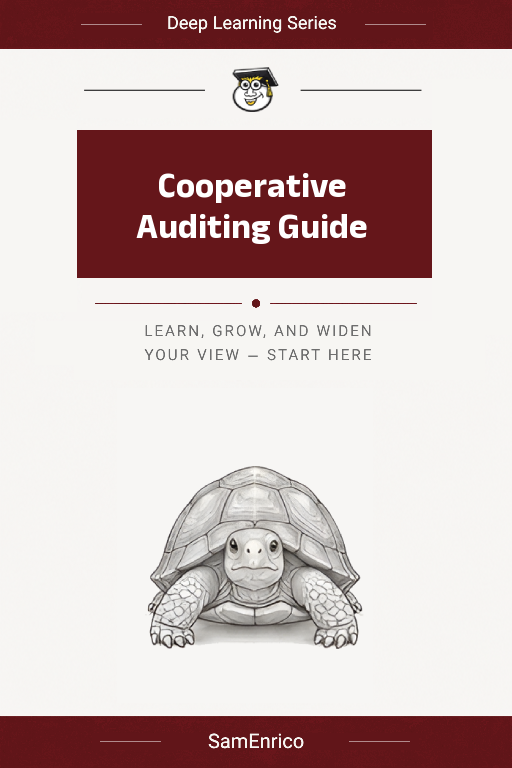
Non-FictionBusiness BriefAlternative Structures
Cooperative Auditing Guide eBook
Audit cooperatives in East Africa. Internal and ex
by Crane Merna
Audit cooperatives in East Africa. Internal and external audit requirements for compliance.
Formats
Free sample
Chapter 1: Beyond the Numbers--–- The first time a cooperative auditor realizes they have been misled, it is almost never about a missing dollar. It is about a missing meeting.I learned this lesson in a cramped boardroom in Arusha, Tanzania, fifteen years ago. I was a junior auditor assigned to review a savings and credit cooperative that had been operating for eleven years. The financial statements looked pristine. Loan repayments were current.
Cash balances reconciled. The member register was neatly typed and bound. My senior auditor, a woman named Fatima who had been auditing cooperatives since before I finished primary school, asked me a question I did not expect."Where are the minutes from the 2015 annual general meeting?"I flipped through the file. The minutes were there, dated properly, signed by the chairperson and secretary. Fatima read them carefully, then pointed to the attendance sheet.
"Look at the member signatures," she said. "Twenty-three members attended."I looked. Twenty-three signatures filled the page.Fatima handed me a copy of the cooperative's by-laws. "Read Article 14," she said.Article 14 stated, in plain language: "The annual general meeting shall be valid only if at least fifty members are present in person or by proxy."The cooperative had been holding invalid annual general meetings for seven years. Every resolution passed in those meetings—election of board members, approval of financial statements, authorization of loans—was legally void.
The cooperative was not a cooperative at all. It was a private club operating under false pretenses.The financial statements were accurate. The cash was there. The loans were performing. But none of that mattered because the cooperative's governance had been fundamentally broken for nearly a decade.
My senior auditor did not issue a qualified opinion. She issued an adverse opinion—the most severe possible—because the cooperative could not demonstrate that its leadership had legitimate authority to act.The board was furious. "We didn't steal anything," the chairperson shouted. "Why are you destroying us?" Fatima explained patiently that the cooperative was already destroyed. She was merely documenting the wreckage.That SACCO collapsed two years later.
The members lost their savings. The board members, who had never intended any harm, were personally sued by the members for acting without authority. They lost their homes.This book exists because that story is not rare. It is, tragically, the norm. Across East Africa, thousands of cooperatives receive clean audit opinions every year while their internal governance decays from within.
The problem is not bad auditors, though some are bad. The problem is a fundamental misunderstanding of what an audit is supposed to achieve in a cooperative context.Most auditors working in East Africa today were trained in the corporate tradition. They learned to verify that transactions exist, that amounts are accurate, that assets are owned, and that liabilities are owed. These are the four pillars of the corporate audit: existence, accuracy, rights and obligations, and valuation. These pillars are necessary.
But in a cooperative, they are not sufficient.A corporation is a machine for generating shareholder value. Shareholders invest capital. They expect a return. If the board makes a bad decision, the shareholder sells the shares and moves on. The shareholder's relationship with the corporation is contractual and transactional.
The shareholder does not care about the process by which decisions are made, so long as the outcome is profitable.A cooperative is not a machine for generating member value. It is a machine for generating member value through democratic participation. The member does not invest capital in the same way a shareholder does. The member contributes capital as a condition of membership, but the primary return comes not from capital appreciation but from patronage—the member's transactions with the cooperative. A farmer who sells coffee through a cooperative does not earn dividends based on how many shares she owns.
She earns based on how much coffee she delivered. A teacher who saves with a SACCO does not earn interest based on her savings alone. She earns based on her savings activity combined with her borrowing history.This difference has profound implications for auditing. In a corporation, the auditor's primary question is: "Are the numbers right?" In a cooperative, the auditor's primary question must be: "Did the members agree to this?"The Trust Contract Explained Every cooperative is built on an invisible foundation: the trust contract. This is not a legal document you can hold in your hands.
It is a set of expectations that members hold about how the cooperative will operate. Members trust that their savings will be safe. They trust that loans will be available when needed. They trust that the board will act in the collective interest. And most fundamentally, they trust that they will have a voice in decisions that affect their money.The auditor's job is to verify whether that trust is justified.
This goes far beyond checking numbers. It requires examining the processes, the governance structures, and the democratic mechanisms that make a cooperative different from any other business entity.I have seen the trust contract broken in a hundred different ways. A board that approves a loan to a relative without following the by-laws. A manager who signs checks alone when the by-laws require two signatures. A general meeting that is called with only three days' notice when the by-laws require fourteen.
None of these violations involve stolen money. But each one erodes the trust that holds the cooperative together.The most dangerous part of a trust contract violation is that it compounds. The first violation goes unnoticed or unpunished. The board learns that rules can be bent. The second violation is easier.
The third is routine. By the time the auditor arrives, the cooperative has been operating outside its by-laws for years. The members do not know because no one has told them. The board does not care because no one has stopped them. The auditor issues a clean opinion because the numbers add up.Then something goes wrong.
A loan defaults. A market shifts. A regulator investigates. And suddenly the entire fragile structure collapses because the trust contract was never verified.Why Corporate Auditing Fails Cooperatives The corporate audit model is designed for a world where shareholders delegate authority completely to management and the board. Shareholders do not participate in daily operations.
They do not vote on routine matters. They elect directors once a year, approve major transactions occasionally, and otherwise remain passive. The auditor's job is to ensure that management has not misused that delegated authority in ways that harm shareholder value.Cooperatives invert this model. Members do not delegate authority completely. They retain significant decision-making power through the general assembly.
The board and management are agents of the members, not principals in their own right. Every significant decision—approval of annual accounts, election of board members, authorization of major loans, amendment of by-laws—belongs to the general assembly, not to the board.The corporate-trained auditor arrives at a cooperative and looks for the usual evidence: bank confirmations, invoice samples, fixed asset registers. Finding these in order, the auditor prepares to issue an unqualified opinion. But the cooperative auditor must ask additional questions. Was the general assembly properly called?
Were members given adequate notice? Was quorum present? Were the votes correctly counted and recorded?I have seen corporate-trained auditors miss…
This is the end of the free sample. Get the eBook to keep going. Buy now
About this book
Details
- Author
- Crane Merna
- Publisher
- SamEnrico
- Language
- English
- Genre
- Non-Fiction, Business Brief, Alternative Structures
- Released
- 2026-05-29
- Pages (approx.)
- 153
- Available as
- eBook, Audiobook

Read better in the ZLOADR app
Your eBooks on your phone or tablet. Sign in with your SamEnrico account and start reading.
More by Crane Merna
 Internal Comms Escalation MatrixCrane Merna$11.99
 Workaholism in AcademiaCrane Merna$11.99
 Celiac Disease HandbookCrane Merna$11.99
 The InsurTech Capital StrategyCrane Merna$11.99
 Anger for PilotsCrane Merna$11.99
 The Navigator of the Seas: Pedro Álvares Cabral and the Birth of the Portuguese EmpireCrane Merna$11.99
 Assistant Operations ManagerCrane Merna$11.99
 Understanding Spondylometaphyseal DysplasiaCrane Merna$17.99
 How to Become a Piped-pocket-machine OperatorCrane Merna$11.99
You may also like
 Hong Kong Handover 1997Dunn Johnnie$11.99
 Zumba For Postnatal Recovery CourseNeal Christian$11.99
 Zumba for BeginnersLadner Nikia$11.99
 YouTube Comment Mining GuideHumes Pandora$12.99
 Worry Box MeditationCarlin Rudy$11.99
 Workplace Stress MeditationNguyen Lynn$11.99
 Workplace Stress and Sleep RepairHawley Ivory$11.99
 Workplace Perfectionism CureDelaney Jeffry$11.99
 Workplace Injustice Anger GuideWallen Isabelle$11.99
 Work Addiction and Burnout LinkGreenwood Ester$11.99
 Women in Yoga and WellnessBeattie Galina$11.99
 Women in Stand Up ComedyChun Evangeline$11.99