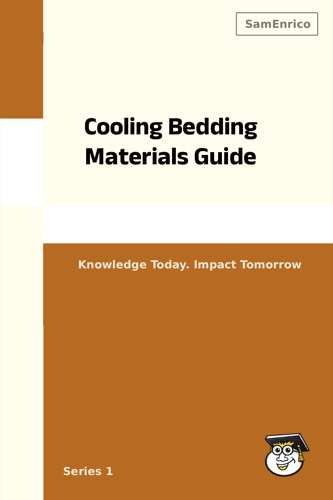
Cooling Bedding Materials Guide eBook
Choose bamboo, linen, or cotton sheets that wick m
Choose bamboo, linen, or cotton sheets that wick moisture and prevent night sweats.
Formats
Free sample
Chapter 1: The 3AM Awakening--–- The pillow is soaked. Your partner is sleeping peacefully three feet away, but you might as well be lying in a puddle. The sheets cling to your back like wet plastic wrap. Your skin is clammy, your hair is damp at the temples, and somewhere in the fog of half-sleep, you feel the first chill of evaporating sweat on exposed skin. You kick off the blanket.
Ten minutes later, you're shivering. You pull the blanket back up. Twenty minutes after that, you're drenched again.This is not a nightmare. This is not a fever. This is not, as you may have privately worried, some undiagnosed medical condition spiraling out of control.
This is a thermoregulation crisis, and it is happening to nearly forty percent of adults on any given night. The difference between you and the person sleeping soundly next to you is not better health, better genes, or better luck. The difference is fabric.Welcome to the single most misunderstood problem in modern sleep. You have been told, probably for your entire adult life, that night sweats are a personal failing. Maybe you need to lose weight.
Maybe your hormones are out of balance. Maybe you're more anxious than you want to admit. Maybe it's perimenopause or andropause or some other biological clock you cannot stop. The bedding industry has fed this shame quietly for decades, because a customer who believes their own body is broken is a customer who will keep buying products trying to fix it. Cooling pillows.
Gel mattress toppers. Fans that blow air directly onto your chest. None of them work for long, because none of them address the real problem.The real problem is sitting right underneath you, wrapped around you, tucked over you. Your bedding is trapping your body heat and blocking your sweat from evaporating. That's not a metaphor.
That is physics. And until you understand how heat and moisture move between your skin and your sheets, you will continue to wake up at 3AM feeling like you've lost a fight with a radiator.THE STATISTIC THAT SHOULD SCARE YOULet's start with a number that the mattress industry does not want you to see. Sleeping in a room temperature above 75 degrees Fahrenheit reduces restorative deep sleep — the stage of sleep technically known as slow-wave sleep — by up to twenty percent. That is not a minor inconvenience. That is the difference between waking up feeling human and waking up feeling like you've been hit by a truck.But here is the twist that changes everything.
Most people who wake up drenched are not sleeping in rooms above 75 degrees. They are sleeping at 68, 69, 70 degrees — perfectly reasonable temperatures. Their thermostats are set correctly. Their fans are running. Their windows might even be cracked open in January.
And they are still waking up soaked.Why? Because room temperature is only half the equation. The other half is fabric temperature, and fabric temperature is determined by something most people have never considered: how well your sheets allow your body to use evaporation as a cooling mechanism.Your body is a remarkably efficient cooling machine. When you sleep, your core temperature naturally drops by about one to two degrees. This drop is not optional.
It is a biological requirement for entering deep sleep. Your body achieves this drop primarily through two mechanisms: radiating heat from your skin and evaporating sweat from your skin's surface. Radiation works when the ambient temperature is lower than your skin temperature. Evaporation works regardless of ambient temperature, as long as the air can accept more moisture.Synthetic bedding — microfiber, polyester, nylon, and their many branded cousins — blocks both mechanisms. It traps radiated heat against your body like a mylar blanket.
It prevents sweat from evaporating by holding moisture in a tight web of plastic fibers. The result is not just discomfort. The result is a physiological blockade that prevents your body from doing what it needs to do to sleep.THE THREE WAYS HEAT MOVES (AND HOW YOUR SHEETS BREAK THEM)To understand why your sheets are failing you, you need to understand how heat moves. There are exactly three modes of heat transfer in the known universe. Every cooling technology ever invented relies on one or more of them.
Your bedding is no exception.Conduction is heat transfer through direct contact. When you lie down on a sheet, your body heat conducts directly into the fabric. Some materials conduct heat well — metal, for example, feels cold because it pulls heat away from your skin rapidly. Other materials conduct heat poorly — wood or foam feel warmer because they resist heat flow. Your sheets fall somewhere in the middle, but here is the critical variable: dense, tight-weave fabrics conduct heat poorly.
They act as insulators. Loose, open-weave fabrics allow heat to move away from your body more quickly. A sheet that feels cool to the touch is conducting heat away from your hand. A sheet that feels neutral or warm is not.Convection is heat transfer through moving air. This is what happens when a fan blows across your skin.
The moving air carries heat away from your body and replaces it with cooler air. For convection to work through your bedding, air must be able to pass through the fabric. This is called air permeability. A sheet with high air permeability allows convective cooling. A sheet with low air permeability traps a boundary layer of warm, humid air against your skin.
That boundary layer is a convection killer. You can have a fan on full blast three feet away, and if your sheets are not breathable, that air will never touch your skin.Evaporation is the most powerful cooling mechanism your body has. When liquid sweat turns into water vapor, it absorbs heat from your skin in the process. That is why you feel cold immediately after getting out of a shower — the water evaporating off your body pulls heat with it. For evaporation to work, two things must happen.
First, sweat must move away from your skin so that fresh sweat can take its place. Second, the air above the fabric must be able to accept more water vapor. If the fabric holds sweat against your skin, evaporation cannot occur. If the fabric is coated with fabric softener or made from non-absorbent synthetic fibers, the sweat has nowhere to go.Here is what most people get wrong. They assume that if they are sweating, they must be too hot.
But often, the sweating is not the problem — it is the body's desperate attempt to solve the problem. Your body is sweating because it needs to cool down. The sweat is not evaporating because your sheets are blocking evaporation. So your body sweats more. And more.
And more. By the time you wake up drenched, your body has produced two, three, even four times the amount of sweat it would need in breathable bedding. The sweat is not the failure. The sweat is the evidence of the failure.THE GREAT SYNTHETIC LIELet me tell you a story about a fifty-dollar bill. You walk into a home goods store.
You see a set of sheets for thirty dollars. They are soft. They are silky. They come in a beautiful…
This is the end of the free sample. Get the eBook to keep going. Buy now
About this book
Details
- Author
- Michael Renata
- Publisher
- SamEnrico
- Language
- English
- Genre
- Non-Fiction, Health & Wellness, Bedding
- Released
- 2026-06-06
- Pages (approx.)
- 135
- Available as
- eBook, Audiobook

Read better in the ZLOADR app
Your eBooks on your phone or tablet. Sign in with your SamEnrico account and start reading.
More by Michael Renata
 Blue Zone Nut Snacking GuideMichael Renata$11.99
 Gut Health for HormonesMichael Renata$11.99
 Chronic Pain MeditationMichael Renata$11.99
 The Moonlit Pact: A Yokai's Forbidden LoveMichael Renata$11.99
 Fireworks PhotographyMichael Renata$11.99
 State Franchise Tax for Non Resident LLCsMichael Renata$12.99
 How to Produce Bungee CordsMichael Renata$11.99
 How to Start a Paper and Paperboard Production Machinery (wholesale) Business (Beginners Guide)Michael Renata$11.99