
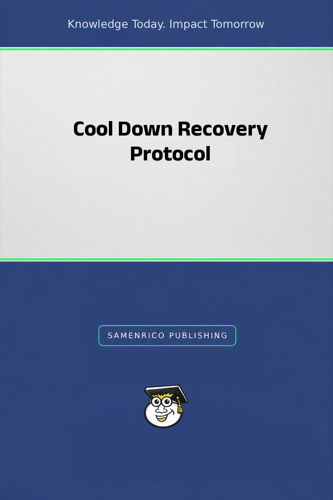
Non-FictionHealth & WellnessCool Down
Cool Down Recovery Protocol eBook
Teaches static stretching and light cardio to enha
by Byrd Phillip
Teaches static stretching and light cardio to enhance post-exercise recovery.
Formats
Free sample
Chapter 1: The Cold Stop--–- The squat rack was loaded with 315 pounds. Marcus had just completed his fifth set of five, a personal record he had been chasing for eighteen months. His legs were trembling, his heart was hammering against his ribcage, and sweat was pooling on the rubber mat beneath his feet. He felt triumphant. He felt exhausted.
And then, like almost everyone in every gym across the world, he did exactly what his body told him to do: he sat down.He found a bench near the water fountain, dropped his head into his hands, and waited for his breathing to return to normal. Five minutes passed. Ten minutes. He drove home, showered, ate dinner, and went to bed feeling proud of his achievement.The next morning, Marcus could not walk down the stairs of his own apartment without holding the railing with both hands. His quads felt like concrete that had been poured into his skin and left to cure overnight.
Every step was a wince. Every time he stood up from his desk chair, he made a sound somewhere between a groan and a curse. By day two, the soreness had peaked. By day three, he was still limping. On day four, he finally felt human again—just in time for his next leg workout, when the entire cycle would repeat.Marcus is not real.
But you know Marcus. You might be Marcus.This is the hidden epidemic of fitness: not injury, not lack of motivation, not poor nutrition—but the silent, predictable, crushing cycle of post-exercise soreness that drives more people out of consistent training than any other factor. According to sports science literature, approximately 67% of recreational athletes report that delayed onset muscle soreness (DOMS) negatively impacts their adherence to training programs. More tellingly, a 2019 survey of gym dropouts found that the number one reason people quit was not boredom or lack of results—it was the simple fact that they could not function normally for two to three days after each workout. They could not play with their children.
They could not climb stairs without pain. They could not sleep comfortably because turning over in bed meant activating sore glutes and hamstrings.And here is the cruelest irony of all: most of these people are doing the hard work correctly. They are showing up. They are lifting heavy, running far, pushing hard. They are disciplined in the gym.
But they are being betrayed by what they do—or more precisely, what they do not do—in the twenty minutes immediately following their final rep.This book is called Cool Down Recovery Protocol, and it exists to solve one specific problem: the gap between the exercise you perform and the recovery your body desperately needs. The solution is not more expensive supplements, not cryotherapy chambers, not compression boots that cost as much as a used car. The solution is a systematic, science-backed, twenty-minute ritual that combines two things you already know how to do—light cardio and static stretching—in a specific sequence and intensity that transforms how your body processes the damage you just inflicted upon it.But before we can fix the problem, we must understand it. And to understand it, we must travel deep inside the muscle itself.The Perfect Storm: What Actually Happens Inside Your Body During Exercise Let us begin with a fundamental truth: exercise is a controlled act of destruction. This is not a flaw.
This is the entire point.When you lift a heavy weight, sprint up a hill, or push through the final minutes of a high-intensity interval session, you are deliberately damaging your own muscle tissue. The body responds to this damage by rebuilding the tissue stronger than before—a process called supercompensation. This is how progress happens. This is how a 135-pound bench press becomes 225 pounds. This is how a ten-minute mile becomes an eight-minute mile.
Without microscopic damage, there is no adaptation. Without adaptation, there is no growth.But here is what most fitness enthusiasts do not understand: the damage itself is not the primary cause of the soreness you feel twenty-four to forty-eight hours later. The soreness—that deep, aching, stiff sensation that makes you walk like a robot—comes from something else entirely. It comes from the metabolic aftermath of the damage.During high-intensity exercise, your muscles rely on a process called anaerobic glycolysis to produce energy quickly. This process does not require oxygen, which is why you can sprint at maximum effort even when your lungs are burning.
But anaerobic glycolysis has a dirty byproduct: hydrogen ions. These ions accumulate in the muscle tissue faster than the bloodstream can carry them away, and they cause the p H of the muscle to drop from its normal level of about 7.1 down to 6.5 or even lower. That acidity is what creates the familiar "burn" during your final reps. It is your nervous system screaming at you to stop.Lactic acid has been unfairly blamed for this sensation for decades. In fact, lactate—the molecule that forms when lactic acid donates a hydrogen ion—is actually a valuable fuel source that the body can recycle for energy.
The real villain is the hydrogen ion itself, along with other metabolic byproducts like inorganic phosphate and reactive oxygen species. These molecules accumulate in the spaces between your muscle fibers, creating an inflammatory environment that sensitizes pain receptors and attracts immune cells to the area.Now add the physical damage to this chemical storm. Every time you lower a heavy weight during a squat or a bench press, you are creating microscopic tears in the sarcomeres—the tiny contractile units that stack end to end inside each muscle fiber. These tears are not catastrophic; they are intentional. But they create gaps in the muscle membrane, allowing enzymes like creatine kinase to leak out into the bloodstream.
This leakage is a signal to your immune system that something has gone wrong, and your immune system responds with characteristic aggression.Within hours of your workout, neutrophils and macrophages—the front-line soldiers of your immune system—march into the damaged tissue. They release inflammatory cytokines that increase blood flow to the area (causing swelling and warmth) and sensitize local nerve endings (causing pain). This inflammatory response is essential for clearing away cellular debris and initiating the repair process. But it is also exquisitely painful.By the time you wake up the morning after a hard workout, you are experiencing the perfect storm: hydrogen ions and other metabolic waste trapped in the tissue, microscopic tears in the sarcomeres, and an active inflammatory response that has turned your muscles into a construction zone with no noise ordinances.This is DOMS. And it is miserable.But here is the question that almost no one asks: why does this misery last for days?
Why does the body not clear the waste and calm the inflammation within hours? The answer lies in something called the skeletal muscle pump—and the catastrophic mistake almost everyone makes the moment their workout ends.The Skeletal Muscle Pump: Your Body's Built-In Flushing System Your circulatory system is often compared to a network of pipes, with the heart as the central pump…
This is the end of the free sample. Get the eBook to keep going. Buy now
About this book
Details
- Author
- Byrd Phillip
- Publisher
- SamEnrico
- Language
- English
- Genre
- Non-Fiction, Health & Wellness, Cool Down
- Released
- 2026-06-10
- Pages (approx.)
- 154
- Available as
- eBook, Audiobook

Read better in the ZLOADR app
Your eBooks on your phone or tablet. Sign in with your SamEnrico account and start reading.
More by Byrd Phillip
 Immigrant Laundromat To Empire GuideByrd Phillip$11.99
 Active Listening In Couples GuideByrd Phillip$11.99
 Fear of Failure CreativityByrd Phillip$11.99
 Highway Confrontation EscapeByrd Phillip$11.99
 The Laptop SmashByrd Phillip$11.99
 Wholesaling Email Campaign GuideByrd Phillip$11.99
 Social Exclusion Child WorthByrd Phillip$11.99
 Baldwin Dynasty - Daniel BaldwinByrd Phillip$11.99
 The Merger That Shook the World: How a Corporate Marriage Reshaped Global TechByrd Phillip$11.99
 The Kiwi Sound: How a Small Label Shaped a Nation's MusicByrd Phillip$11.99
 Dwarka: The Sunken City Beneath the WavesByrd Phillip$11.99
 Growing MachaerantheraByrd Phillip$11.99
You may also like
 Hong Kong Handover 1997Dunn Johnnie$11.99
 Zumba For Postnatal Recovery CourseNeal Christian$11.99
 Zumba for BeginnersLadner Nikia$11.99
 YouTube Comment Mining GuideHumes Pandora$12.99
 Worry Box MeditationCarlin Rudy$11.99
 Workplace Stress MeditationNguyen Lynn$11.99
 Workplace Stress and Sleep RepairHawley Ivory$11.99
 Workplace Perfectionism CureDelaney Jeffry$11.99
 Workplace Injustice Anger GuideWallen Isabelle$11.99
 Work Addiction and Burnout LinkGreenwood Ester$11.99
 Women in Yoga and WellnessBeattie Galina$11.99
 Women in Stand Up ComedyChun Evangeline$11.99