
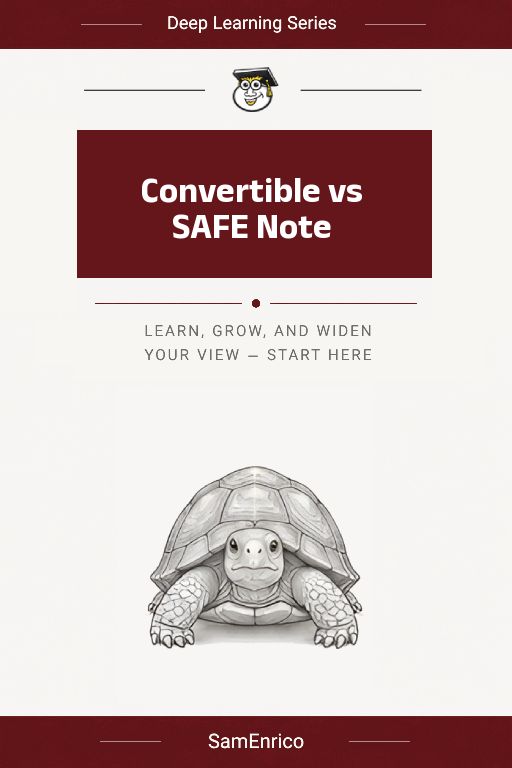
Non-FictionStartup GuideFundraising InstrumentsSAFE vs Convertible
Convertible vs SAFE Note eBook
Use SAFE for simpler US fundraising and convertibl
Use SAFE for simpler US fundraising and convertible notes for UK/EU rounds.
Formats
Free sample
Chapter 1: The $14 Million Handshake--–- The email arrived at 11:47 PM on a Tuesday. Sarah, the founder of a Berlin-based AI startup, had just finished her second glass of wine when her phone buzzed. The subject line read: "Urgent: Legal Action – Personal Liability."She had raised €450,000 eighteen months earlier using a US-style SAFE document she found online. Her investors were German angels, sophisticated professionals who had signed without hesitation. The startup had failed – as most do – but Sarah had done everything right.
She had communicated transparently, returned the remaining capital, and shut down operations cleanly.Or so she thought.The email was from a law firm representing one of her angel investors. The claim: because the SAFE was not a recognized financial instrument under German civil law, the investor argued that the €50,000 they had given her was not an investment but a loan. And loans, under German law, must be repaid – personally, by the founder, if the company cannot pay.Sarah's Gmb H had no money. But Sarah herself had a savings account, a car, and a future salary. The investor wanted €50,000 from her personal assets.She spent the next six months and €38,000 in legal fees to settle the case.
She paid €25,000 out of her own pocket. She did not start another company for three years.The handshake that raised €450,000 cost her €63,000.This is not an outlier. This is what happens when founders choose the wrong instrument for the wrong jurisdiction. And it is the reason you are holding this book.Welcome to the most expensive handshake in early-stage finance.The Great Confusion: Treating a SAFE Like a Loan The most common and costly mistake in early-stage fundraising is treating a SAFE (Simple Agreement for Future Equity) as if it were a loan. It is not.
It has never been a loan. And confusing the two has destroyed more cap tables than bad product-market fit.Let us start with the fundamental distinction that drives every subsequent decision in this book.A Convertible Note is legally debt. It has an issuer (the startup) and a holder (the investor). It accrues interest, typically 6-8 percent annually. It has a maturity date – usually 18 to 24 months after issuance – on which the Note must either convert into equity or be repaid in cash.
If the startup fails, the Convertible Note holder stands in line as a creditor, ahead of equity holders, with a legal claim against the company's remaining assets. In a bankruptcy, Note holders get paid before founders, before employees, and before any other equity holder.A SAFE is not debt. It is a contractual right to receive equity in a future priced round. It has no interest, no maturity date, and no repayment obligation. If the startup never raises a priced round – because it becomes profitable, dies slowly, or gets acquired for less than the cap – the SAFE holder has no contractual right to demand money back.
They have a right to wait. And wait. And wait.This distinction is not academic. It determines whether you, as a founder, can sleep at night when the company hits a rough patch.The Naked Cap Trap: Why 5Million Is Not5 Million Is Not 5Million Is Not5 Million Before we go further, we must kill a myth that has misled an entire generation of founders: the belief that a valuation cap is a valuation.A valuation cap is not a valuation. It is a ceiling on the conversion price, not a floor.
A 5millioncapdoesnotmeanyourcompanyisworth5 million cap does not mean your company is worth 5millioncapdoesnotmeanyourcompanyisworth5 million. It does not mean investors think you are worth 5million.Itdoesnotmeanyouhavea5 million. It does not mean you have a 5million.Itdoesnotmeanyouhavea5 million valuation.Here is what a 5millioncapactuallymeans:whenconversionhappens–typicallyata Series Around–theinvestor′spricepersharewillbecalculatedasifthecompanywereworthnomorethan5 million cap actually means: when conversion happens – typically at a Series A round – the investor's price per share will be calculated as if the company were worth no more than 5millioncapactuallymeans:whenconversionhappens–typicallyata Series Around–theinvestor′spricepersharewillbecalculatedasifthecompanywereworthnomorethan5 million at the time of their investment, regardless of what the Series A valuation actually is.Let me give you an example. You raise 500,000ona500,000 on a 500,000ona5 million cap. Eighteen months later, you raise a Series A at a 20millionpre−moneyvaluation.Your SAFEinvestorsdonotconvertat20 million pre-money valuation.
Your SAFE investors do not convert at 20millionpre−moneyvaluation.Your SAFEinvestorsdonotconvertat20 million. They convert at $5 million. They receive four times as many shares as the Series A investors for the same dollar amount.That is the power of a low cap. And that is why sophisticated investors will fight for the lowest cap they can get.But here is the trap: many founders, especially first-time founders, mistakenly believe that a 5millioncapmeanstheircompanyis"valuedat5 million cap means their company is "valued at 5millioncapmeanstheircompanyis"valuedat5 million." They tell their friends, their advisors, and their future investors, "We raised at a $5 million valuation." This is false. It is dangerous.
And it leads to catastrophic mispricing in later rounds.Brad Feld, in the seminal book Venture Deals, calls this the "naked cap" problem. A cap without a corresponding equity round is just a number. It has no legal standing as a valuation. It is simply a contractual ceiling.The only true valuation is the one set in a priced equity round – a Series Seed, a Series A, or any round where shares are issued at a fixed price per share with a defined set of investor rights. Everything else is a promise.The Geographic Divide: Why US Founders Love SAFEs and Europeans Fear Them The central thesis of this book is that the "best" instrument depends entirely on where you are raising money and what legal entity you have created.In the United States, the SAFE has become the standard instrument for pre-seed and seed rounds.
According to data from Carta and Y Combinator, approximately 90 percent of US pre-seed rounds now use SAFEs. The reasons are simple: speed, simplicity, and the absence of maturity date pressure. US angels are accustomed to high risk and high reward. They do not want to negotiate interest rates or maturity dates. They want to write a check, sign a four-page document, and move on to the next deal.In Europe, the Convertible Note remains dominant.
In Germany, France, Italy, Spain, and most of continental Europe, the SAFE is either legally unenforceable or so legally uncertain that sophisticated investors refuse to touch it. Civil law systems – which derive from Roman law and are used throughout continental Europe – prefer debt instruments with clear creditor status, defined interest rates, and mandatory maturity dates. A "promise of future equity" without a fixed valuation or maturity date lacks the certainty required for a binding contract in many European jurisdictions.In the United Kingdom, neither the US SAFE nor the standard European Convertible Note is optimal. The UK has its own unique instrument: the Advance Subscription Agreement (ASA), which we will cover in depth in Chapter 7. The ASA functions like a SAFE but is structured to qualify for SEIS and EIS tax relief, which gives UK investors 30-50 percent of their money back from the government.The consequences of ignoring geography are severe.
Sarah, the Berlin founder who opened this chapter, learned this lesson the hard way. Her US-style SAFE was perfectly valid…
This is the end of the free sample. Get the eBook to keep going. Buy now
About this book
Details
- Author
- Nieves Latanya
- Publisher
- SamEnrico
- Language
- English
- Genre
- Non-Fiction, Startup Guide, Fundraising Instruments, SAFE vs Convertible
- Released
- 2026-06-01
- Pages (approx.)
- 150
- Available as
- eBook, Audiobook

Read better in the ZLOADR app
Your eBooks on your phone or tablet. Sign in with your SamEnrico account and start reading.
More by Nieves Latanya
 Chiropractic for VeteransNieves Latanya$11.99
 Messner Solo Everest ClimbNieves Latanya$11.99
 Networking for Franchise OwnersNieves Latanya$11.99
 Twelve Step for AtheistsNieves Latanya$11.99
 Rabbi Samson Raphael HirschNieves Latanya$11.99
 The Middle East Capital OutlookNieves Latanya$11.99
 Emotional Intelligence for ArchitectsNieves Latanya$11.99
 Copywork Creative HabitNieves Latanya$11.99
 Trance For Abandonment FearsNieves Latanya$11.99
 The Daring Dancers of the Renaissance: How Circus Performers Redefined RoyaltyNieves Latanya$11.99
 The Crown’s Shadow: How a Teenage Queen Outmaneuvered Europe’s Power BrokersNieves Latanya$11.99
 Quetzalcoatl's Skybridge: The Architect of the Fifth WorldNieves Latanya$11.99
You may also like
 Hong Kong Handover 1997Dunn Johnnie$11.99
 Zumba For Postnatal Recovery CourseNeal Christian$11.99
 Zumba for BeginnersLadner Nikia$11.99
 YouTube Comment Mining GuideHumes Pandora$12.99
 Worry Box MeditationCarlin Rudy$11.99
 Workplace Stress MeditationNguyen Lynn$11.99
 Workplace Stress and Sleep RepairHawley Ivory$11.99
 Workplace Perfectionism CureDelaney Jeffry$11.99
 Workplace Injustice Anger GuideWallen Isabelle$11.99
 Work Addiction and Burnout LinkGreenwood Ester$11.99
 Women in Yoga and WellnessBeattie Galina$11.99
 Women in Stand Up ComedyChun Evangeline$11.99