
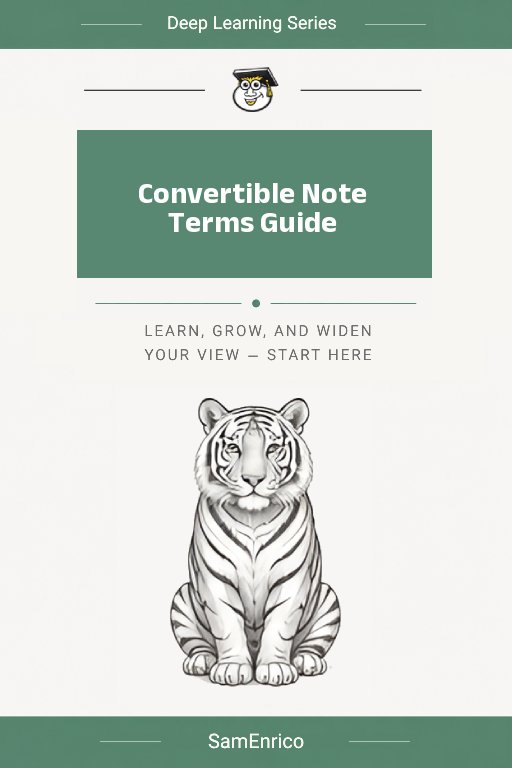
Non-FictionStartup GuideVenture Funding
Convertible Note Terms Guide eBook
Structure convertible notes for pre-seed round. Di
by Wahl Onita
Structure convertible notes for pre-seed round. Discounts, caps, and interest rates across markets.
Formats
Free sample
Chapter 1: The Price Later Paradox--– The email arrived at 11:47 PM on a Tuesday. Sarah, the founder of a promising B2B Saa S startup, had just finished her third term sheet negotiation of the week. The investor was offering 500,000.Thevaluationproposedwas500,000. The valuation proposed was 500,000.Thevaluationproposedwas12 million. But there was a catch: the entire deal was structured as a priced round.
By the time her lawyers calculated the legal fees, the dilution, and the seven weeks of distraction from building her product, she realized something terrible. The round she thought would accelerate her company was actually putting it at risk of running out of cash before closing. That night, Sarah discovered the price later paradox: sometimes, setting a price today is the most expensive thing you can do.This chapter opens by diagnosing the core problem that convertible instruments solve: priced rounds are expensive, slow, and divisive at the pre-seed stage. Founders and angels often disagree on valuation when a company has little more than a pitch deck and a prototype. Legal fees for a priced round can run 15,000to15,000 to 15,000to40,000, while a convertible note costs a fraction of that.
More importantly, a priced round forces a valuation discussion that neither side is ready to have. The founder fears leaving money on the table. The investor fears overpaying for an unproven idea. The result is weeks of negotiation, bruised egos, and deals that fall apart over a $2 million difference in valuation for a company that may not exist in eighteen months.The logic of deferring valuation—waiting until the company has real traction, revenue, users, or a Series A round—rests on three pillars: speed, cost savings, and alignment. Speed matters because startups die of indigestion, not starvation.
The fastest way to kill a pre-seed company is to spend three months negotiating a priced round while your competitor launches, iterates, and captures the market. Cost savings matter because every dollar spent on legal fees is a dollar not spent on engineering, sales, or marketing. Alignment matters because valuation fights create adversarial relationships before the real work begins. When founders and investors agree to price later, they agree to focus on building value first and arguing about division second.The Two Instruments That Changed Early-Stage Finance Before 2013, almost every startup round was priced. Convertible notes existed but were primarily used for bridge financing between institutional rounds.
The explosion of pre-seed and angel investing changed everything. Two instruments emerged as the dominant solutions: the Simple Agreement for Future Equity, or SAFE, created by Y Combinator, and the convertible note, which had been adapted from its bridge round origins. Both share the same core premise: delay the valuation question until a future priced round provides a clear market price. But they achieve this through very different legal mechanisms.A SAFE, as the name suggests, is simple. It is not debt.
It has no interest rate. It has no maturity date—at least the standard Y Combinator version does not, though founders should always confirm which version they are using because non-standard variants exist. A SAFE is a contractual promise to issue shares in a future priced round at a price determined by a valuation cap and/or discount. If the startup fails, the SAFE holder gets nothing—they are not creditors. If the startup succeeds, the SAFE converts into equity.
This simplicity has made SAFEs overwhelmingly popular in US tech hubs.A convertible note, in contrast, is debt. It has an interest rate that accrues over time. It has a maturity date. If the startup fails, note holders are creditors, meaning they stand ahead of equity holders in the liquidation preference. If the startup succeeds, the note converts into equity at the better of a valuation cap or discount, plus accrued interest.
The debt nature provides investors with downside protection, which is why convertible notes remain popular among traditional venture capitalists, family offices, and international investors who view debt as more familiar and enforceable than a SAFE.Market Realities: Where SAFEs Rule and Where Notes Remain Strong Using current market data (the most recent available at time of publication, recognizing that markets evolve and founders should always seek up-to-date information), SAFEs dominate 85 to 90 percent of pre-seed deals in US tech hubs like Silicon Valley, Seattle, Austin, and Los Angeles. The reasons are cultural and practical. Tech hub investors have internalized the logic of deferring valuation. They trust the Y Combinator standard documents. They value speed above all else.
A SAFE can be signed in forty-eight hours with 2,000inlegalfees.Aconvertiblenote,withitsinterestcalculationsandmaturitydatenegotiations,mighttaketwoweeksandcost2,000 in legal fees. A convertible note, with its interest calculations and maturity date negotiations, might take two weeks and cost 2,000inlegalfees.Aconvertiblenote,withitsinterestcalculationsandmaturitydatenegotiations,mighttaketwoweeksandcost5,000 to $10,000.But convertible notes remain strong in specific markets. Traditional US finance hubs like New York, Boston, and Chicago see more convertible notes, particularly when investors come from family offices or traditional venture backgrounds. These investors grew up with debt instruments. They feel uncomfortable with the "nothing if you fail" nature of a SAFE.
They want the creditor protection that a note provides, even if that protection is often theoretical—most pre-seed startups that fail have no assets to distribute to creditors anyway.International deals also favor convertible notes. In many jurisdictions, SAFEs have no legal precedent. Local investors and regulators understand debt. They do not understand a "simple agreement for future equity" that is neither debt nor equity. Founders raising from investors in London, Singapore, Tokyo, or Berlin will often be asked to use a convertible note simply because it fits into the local legal framework.
Bridge rounds, which occur between a Seed round and a Series A, also favor convertible notes because later-stage investors demand the maturity date as a forcing mechanism to ensure the startup raises its next round on time.Why "Price Later" Wins: The Three Pillars in Practice The first pillar is speed. Consider two identical startups raising $500,000. Startup A uses a convertible note with standard terms. Startup B uses a priced round. Startup A's lawyers draft a note purchase agreement in three days.
Investors sign over two weeks. Money is in the bank by day eighteen. Startup B's lawyers spend a week drafting the incorporation documents, another week negotiating the stock purchase agreement, and a third week handling investor questionnaires and compliance. By day twenty-one, Startup B's lawyers are still redlining. Startup A has already hired two engineers and launched a beta.
That three-week difference at the pre-seed stage can determine market leadership.The second pillar is cost savings. A priced round for 500,000mightcost500,000 might cost 500,000mightcost25,000 in legal fees—5 percent of the entire raise. A convertible note for the same amount might cost 6,000.That6,000. That 6,000.That19,000 difference is not trivial. It represents a full month of runway for a lean startup.
It represents the difference between hiring a growth marketer and hoping for organic traction. Every dollar saved on legal fees is a dollar that stays in the company, extending runway and increasing the probability of reaching the milestones needed for a successful Series A.The third pillar is alignment. Valuation fights at the pre-seed stage are absurd. Founders and investors argue over whether the company is worth 8millionor8 million or 8millionor12…
This is the end of the free sample. Get the eBook to keep going. Buy now
About this book
Details
- Author
- Wahl Onita
- Publisher
- SamEnrico
- Language
- English
- Genre
- Non-Fiction, Startup Guide, Venture Funding
- Released
- 2026-05-29
- Pages (approx.)
- 152
- Available as
- eBook, Audiobook

Read better in the ZLOADR app
Your eBooks on your phone or tablet. Sign in with your SamEnrico account and start reading.
More by Wahl Onita
 Growth Mindset For Public SpeakersWahl Onita$11.99
 Recovery Housing OptionsWahl Onita$11.99
 Anger Thought Change GuideWahl Onita$11.99
 Debt Freedom for ShopaholicsWahl Onita$11.99
 The Fear of Technology GuideWahl Onita$11.99
 Jade Serpent's Lament: The Forgotten Ballads of the Celestial DragonWahl Onita$11.99
 Understanding Uniparental DisomyWahl Onita$17.99
 ERP ManagerWahl Onita$11.99
 10 Ways to Use Dash (Recipe Book)Wahl Onita$11.99
 Canadian Export Eco StandardsWahl Onita$12.99
You may also like
 Hong Kong Handover 1997Dunn Johnnie$11.99
 Zumba For Postnatal Recovery CourseNeal Christian$11.99
 Zumba for BeginnersLadner Nikia$11.99
 YouTube Comment Mining GuideHumes Pandora$12.99
 Worry Box MeditationCarlin Rudy$11.99
 Workplace Stress MeditationNguyen Lynn$11.99
 Workplace Stress and Sleep RepairHawley Ivory$11.99
 Workplace Perfectionism CureDelaney Jeffry$11.99
 Workplace Injustice Anger GuideWallen Isabelle$11.99
 Work Addiction and Burnout LinkGreenwood Ester$11.99
 Women in Yoga and WellnessBeattie Galina$11.99
 Women in Stand Up ComedyChun Evangeline$11.99