
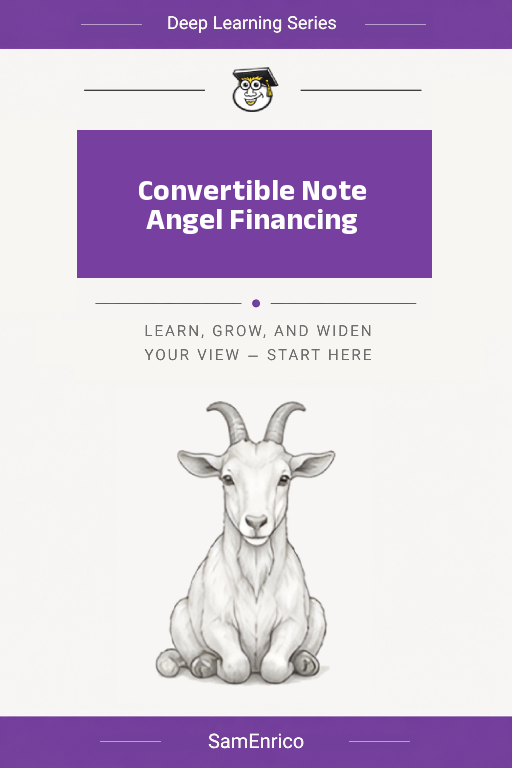
Convertible Note Angel Financing eBook
Raise angel funding using convertible notes with v
Raise angel funding using convertible notes with valuation caps and discounts, delaying price negotiation until later Series A round.
Formats
Free sample
Chapter 1: The Valuation Trap...–- Sarah had done everything right. She had a working prototype, three paying beta customers, and a term sheet from a respectable angel syndicate. The valuation was 10million.Shewas28yearsold,andshewasgoingtobeaunicornfounder.Eighteenmonthslater,thatsamecompanyraiseda Series Aata10 million. She was 28 years old, and she was going to be a unicorn founder. Eighteen months later, that same company raised a Series A at a 10million.Shewas28yearsold,andshewasgoingtobeaunicornfounder.Eighteenmonthslater,thatsamecompanyraiseda Series Aata7 million valuation—a down round that wiped out 40% of her ownership, cost her two co-founders, and left her sleeping on a friend's couch.
The problem wasn't her product, her team, or her market. The problem was that she agreed to a valuation before she had earned it.This chapter dismantles the single most dangerous assumption in early-stage startup financing: that a high valuation in your seed round is a victory. It is not. In fact, for most pre-revenue or early-revenue startups, a high valuation is a poison pill that will destroy your ability to raise subsequent capital, demoralize your team, and hand control of your company to investors who have no incentive to help you grow. You will learn why sophisticated founders deliberately delay valuation negotiations, how convertible notes solve the "valuation trap," and why the fastest-growing startups in the last decade—including the ones you admire—almost never raised priced seed rounds at inflated numbers.By the end of this chapter, you will never look at a term sheet the same way again.The $10 Million Mistake Let me tell you about a company I'll call "Nex Gen Health." The founders had built a beautiful MVP for remote patient monitoring.
They had letters of intent from two small hospital systems. They were invited to pitch at a prestigious angel conference in San Francisco.An angel group fell in love with them. The group offered 500,000ata500,000 at a 500,000ata10 million pre-money valuation. The founders were ecstatic. They had friends who raised at 6million.Theyhadclassmateswhocouldn′traiseatall.6 million.
They had classmates who couldn't raise at all. 6million.Theyhadclassmateswhocouldn′traiseatall.10 million meant they were special. They signed the term sheet within a week.Here is what happened next, month by month:Months 1–6: The founders hired aggressively. They rented office space. They bought expensive software licenses.
After all, they were a $10 million company. They had to look the part.Months 7–12: Sales were slower than projected. The hospital systems kept pushing back their decisions. The founders needed more capital, but every VC they met asked the same question: "You raised at a $10 million cap? What have you done since then to justify a higher valuation?"Months 13–18: The founders had grown revenue to 200,000annually.Notbad,butnot200,000 annually.
Not bad, but not 200,000annually.Notbad,butnot10 million good. VCs valued the company at 6millionto6 million to 6millionto8 million. Every single one. The founders faced an impossible choice: raise a down round at $7 million (which would trigger anti-dilution protections for the angel investors, crushing the founders' ownership) or run out of cash in 60 days.They took the down round. The angel investors' 20% ownership jumped to 34% due to full-ratchet anti-dilution.
The founders' collective ownership dropped from 80% to 46%. Two co-founders quit within six months.This is the valuation trap. And it happens every single day.Why Founders Crave High Valuations (And Why That Urge Will Destroy You)The psychology is understandable. You have worked nights and weekends. You have sacrificed salary, relationships, and sanity.
When an investor offers a high valuation, it feels like validation. It feels like the market agrees with you that you are building something enormous.But here is the truth that no one tells you at the demo day after-party: valuation is not a score. It is a tax on your future.Every dollar of valuation you take today is a dollar of expectation you must meet tomorrow. When you raise at a 10millionpre−moneyvaluation,youaretellingtheworldthatyourcompanywillbeworthatleast10 million pre-money valuation, you are telling the world that your company will be worth at least 10millionpre−moneyvaluation,youaretellingtheworldthatyourcompanywillbeworthatleast15 million to $20 million within 12 to 18 months. Because that is what the next investor will need to see to give you a higher price.If you fail to meet that expectation—if your revenue, traction, or team progress falls short—you will not simply "flat line." You will fall into a down round.
And down rounds have consequences that most founders cannot imagine until they are living through them.The Three Horsemen of the Down Round Apocalypse Horseman #1: Anti-Dilution Protections Most priced round term sheets include weighted average anti-dilution protection. Some include full-ratchet anti-dilution, which is even more punishing. When you raise a down round, these provisions automatically grant your previous investors additional shares to compensate for the lower price. The math is brutal:You raise 500,000ata500,000 at a 500,000ata10 million pre-money valuation. Investors get 5% of the company.Eighteen months later, you raise 1millionata1 million at a 1millionata7 million pre-money valuation.With standard weighted average anti-dilution, your previous investors' 5% ownership might jump to 7% or 8% without them putting in another dollar.With full-ratchet anti-dilution, their 5% ownership would adjust to whatever percentage 500,000representsatthenew500,000 represents at the new 500,000representsatthenew7 million valuation—approximately 7.14%—again, for free.Where does that extra ownership come from?
It comes from you, the founders, and from your employee option pool. You are literally giving away your own shares to compensate investors for your company's failure to grow fast enough.Horseman #2: Broken Momentum A down round signals to the market that something is wrong. It does not matter if the "something" is a macroeconomic downturn, a seasonal sales slump, or a competitor's temporary advantage. The signal is the same: this company could not hit its numbers.Employees will leave. Recruiting will become impossible.
Customers will ask questions. Partners will delay contracts. The down round becomes a self-fulfilling prophecy of decline.Horseman #3: Investor Dysfunction The worst consequence of a down round is what happens inside your cap table. Your early investors feel burned. They trusted you with a high valuation, and you failed to justify it.
They will not lead your next round. They will not make introductions. They will not go to bat for you when things get hard.And your new investors? They know they have you over a barrel. They gave you a low valuation because they could.
They will demand board seats, veto rights, and liquidation preferences that lock in their advantage. You will spend the next two years fighting with your own investors instead of building your company.The Hidden Truth: Convertible Notes as Escape Velocity Now for the good news. You do not have to play this game.Convertible notes were invented to solve exactly this problem. A convertible note is debt that converts into equity during a future financing round, typically a Series A. It has four key features that make it the perfect instrument for early-stage uncertainty:No valuation at the time of investment.
Instead of setting a fixed price, the note includes a "valuation cap" and a "discount rate" that determine the conversion price later.Debt seniority. If the company fails, note holders are creditors. They get paid before equity holders. This gives angels downside protection that priced rounds do not offer.Interest accrual. Notes pay interest (typically 2–6% annually) that converts into additional shares…
This is the end of the free sample. Get the eBook to keep going. Buy now
About this book
Details
- Author
- Griffis Clarence
- Publisher
- SamEnrico
- Language
- English
- Genre
- Non-Fiction, Startup Guide
- Released
- 2026-06-01
- Pages (approx.)
- 147
- Available as
- eBook, Audiobook

Read better in the ZLOADR app
Your eBooks on your phone or tablet. Sign in with your SamEnrico account and start reading.
More by Griffis Clarence
 Accepting What IsGriffis Clarence$11.99
 Calcium Without Dairy GuideGriffis Clarence$11.99
 Winter Vacation For SADGriffis Clarence$11.99
 De escalation for SecurityGriffis Clarence$11.99
 Workplace Muscle Tension ReleaseGriffis Clarence$11.99
 Feedback Loops for GroupsGriffis Clarence$11.99
 Silent Generation Auto IntentGriffis Clarence$11.99
 Networking for Job SeekersGriffis Clarence$11.99
 The Silk Road Pioneers: Marco Polo and the West's Global AwakeningGriffis Clarence$11.99
 The Poisoned Inkwell: The Forbidden Verses of the Last Qing Dynasty PoetGriffis Clarence$11.99
 A Collector's Handbook to the Mazda 1500Griffis Clarence$11.99
 Federal Contract RenewalGriffis Clarence$12.99
You may also like
 Hong Kong Handover 1997Dunn Johnnie$11.99
 Zumba For Postnatal Recovery CourseNeal Christian$11.99
 Zumba for BeginnersLadner Nikia$11.99
 YouTube Comment Mining GuideHumes Pandora$12.99
 Worry Box MeditationCarlin Rudy$11.99
 Workplace Stress MeditationNguyen Lynn$11.99
 Workplace Stress and Sleep RepairHawley Ivory$11.99
 Workplace Perfectionism CureDelaney Jeffry$11.99
 Workplace Injustice Anger GuideWallen Isabelle$11.99
 Work Addiction and Burnout LinkGreenwood Ester$11.99
 Women in Yoga and WellnessBeattie Galina$11.99
 Women in Stand Up ComedyChun Evangeline$11.99