

Non-FictionSelf-HelpMicro Spending
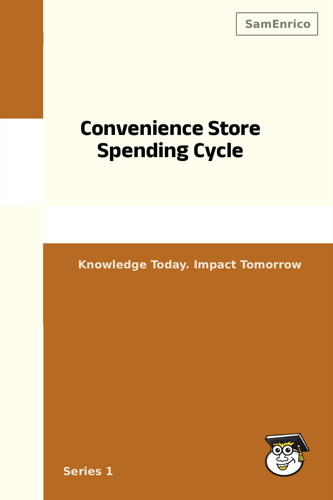
Convenience Store Spending Cycle eBook
Breaks daily small purchases at gas stations and c
Be the first to reviewBreaks daily small purchases at gas stations and corner stores.
Formats
Free sample
Chapter 1: The $170,000 Leak--–- The fluorescent lights hummed overhead, casting a sterile glow on rows of candy bars and energy drinks. You swipe your card, grab a soda, and walk out. Thirty seconds, maybe less. The transaction feels so small, so insignificant, that your brain barely registers it as a financial event. And that is exactly the problem.Every day, millions of people do exactly what you just did.
They stop at a gas station or corner store for something small—a drink, a snack, a pack of gum, a lottery ticket. They spend two, five, maybe eight dollars. Then they get back in their car and drive away, never once considering that they just made a decision that could cost them a small fortune over a lifetime.This chapter is not about making you feel guilty for buying a Slurpee on a hot day. It is not about shaming you for grabbing a protein bar when you are running late. It is about something far more powerful and far more useful: awareness.
Because once you see the true cost of your convenience store habit, you cannot unsee it. And once you cannot unsee it, you cannot continue to participate in it without making a conscious choice.The goal of this chapter is simple: to reframe how you think about small, daily purchases. We will introduce the concept of opportunity cost—not in the abstract, academic sense, but in the visceral, gut-level way that changes behavior. We will calculate what your personal "convenience number" really costs you over 10, 20, and 30 years. And we will begin the process of tracking your spending so that you have real data, not guesses, about where your money is going.By the end of this chapter, you will never look at a $5 bill the same way again.The Psychology of Small Expenses Why is it so easy to spend money at a convenience store?
Part of the answer is physiological. Your brain processes a $2 purchase and a $20 purchase very differently. Small purchases slip under the radar of your rational decision-making system. They feel like rounding errors, like nothing. But nothing compounds into something faster than most people realize.Psychologists call this phenomenon the penny gap—the tendency to treat small expenses as financially meaningless while simultaneously wondering at the end of the month where all the money went.
It is the same cognitive blind spot that allows someone to spend $8 a day on lunch without blinking but to agonize over a $200 car repair. The brain uses different mental accounting systems for different sizes of expense, and small purchases get the least scrutiny.Consider this: If someone asked you to write a check for $1,000 right now, you would hesitate. You would ask questions. You would want to know what you were getting. But if that same $1,000 were broken into $3 and $5 increments spread out over six months, you would probably not notice.
That is not a flaw in your character. It is a flaw in how the human brain evolved to handle abstract value in a world of instant transactions.Convenience stores exploit this cognitive blind spot ruthlessly. They are not in the business of selling groceries. They are in the business of selling frictionless micro-transactions. Every aspect of the store design—the lighting, the layout, the placement of items, the payment systems—is optimized to make spending feel as effortless as breathing.
You are not supposed to think. You are just supposed to swipe.But you are about to start thinking.The Mathematics of Micro-Spending Let us run the numbers. And because everyone's spending is different, we will build a formula that works for your specific situation, not some hypothetical average.First, let us establish a baseline example. Imagine you spend $5 per day at convenience stores. Maybe that is one energy drink and a pack of gum.
Maybe it is a sandwich and a water. Maybe it is a lottery ticket and a candy bar. The exact items do not matter. What matters is the total outflow.Now, take that $5 per day and multiply it by 365 days. That is **$1,825 per year**.
Still does not sound like much, does it? That is the cost of a modest vacation or a few car payments. Noticeable, but not life-altering.But money does not sit still. Money grows when it is invested. And here is where the numbers become genuinely shocking.If you took that same $5 per day and invested it instead of spending it, earning a conservative 7% annual return (the long-term average of the stock market, adjusted for inflation), here is what happens:After 10 years: approximately $25,000After 20 years: approximately $80,000After 30 years: approximately $170,000 to $180,000That is not a typo.
Five dollars a day, every day, for thirty years, invested at 7%, grows to nearly one hundred and seventy thousand dollars. That is a down payment on a house in many parts of the country. That is a child's college education at a public university. That is eight to ten years of grocery bills in retirement. That is the difference between working an extra five years and retiring early.And here is the kicker: that calculation uses 7%, which is conservative.
The historical average return of the S&P 500 is closer to 10% before inflation. If you achieved 9%, your $5 a day would grow to over **$250,000** in 30 years. If you are younger and have a 40-year time horizon, that same $5 a day grows to over **$600,000**.Let those numbers land. Let them sit in your chest for a moment.Every time you buy that energy drink, you are not spending $5. You are spending the **future value** of that $5.
You are taking a small loan from your retired self at an astronomical interest rate—except you are the one making the payment, and you are the one losing the growth.Finding Your Personal Convenience Number Of course, not everyone spends exactly $5 a day. Some people spend $2. Some spend $12. Some spend nothing for five days and then $30 on a single gas station run that includes snacks for the whole family. The key is to find your number, not someone else's.This is where the Convenience Number Worksheet comes in.
For the next seven days, you are going to track every single purchase you make at a gas station, corner store, bodega, or convenience mart. And when I say every single purchase, I mean every single purchase. That pack of gum. That bottle of water. That lottery ticket.
That bag of chips. That 99-cent coffee. All of it.You do not need a special app or a fancy spreadsheet. A note in your phone or a small notebook in your glove compartment will work perfectly. Each time you make a purchase, write down:The date The store name What you bought How much it cost At the end of the seven days, add up the total.
Then divide by seven. That is your Personal Daily Convenience Number. This is the amount of money you are currently leaking, on average, every single day.Let us run three examples to show the range:Example A: The Light Spender Daily average: $2.50Monthly: $75Yearly: $91230-year invested value (7%): approximately $85,000Example B: The Moderate Spender Daily average: $5.00Monthly: $150Yearly: $1,82530-year invested value (7%): approximately $170,000Example C: The…
This is the end of the free sample. Get the eBook to keep going. Buy now
About this book
Details
- Author
- Quintana Jerlene
- Publisher
- SamEnrico
- Language
- English
- Genre
- Non-Fiction, Self-Help, Micro Spending
- Released
- 2026-06-09
- Pages (approx.)
- 140
- Available as
- eBook, Audiobook
Reader reviews
No reviews yet — be the first to share what you thought.
Write a review
Reviews are from readers with a SamEnrico account. Please keep them about the book.
Sign in to write a review
Read better in the ZLOADR app
Your eBooks on your phone or tablet. Sign in with your SamEnrico account and start reading.
More by Quintana Jerlene
 Rewire Parent Guilt TalkQuintana Jerlene$11.99
 Daniel Loeb Third PointQuintana Jerlene$11.99
 Medicine Nobel Breakthroughs GuideQuintana Jerlene$11.99
 The Physics Nobel LasersQuintana Jerlene$11.99
 Swallowing Hard Stress SignalQuintana Jerlene$11.99
 Anapanasati in NatureQuintana Jerlene$11.99
 Amy Schumer LeatherQuintana Jerlene$11.99
 The Lost Gold of Lima: A Million-Dollar Heist from the DeepQuintana Jerlene$11.99
 Shadows Over Saigon: The CIA's Secret War in LaosQuintana Jerlene$11.99
 The Last Stand of the Entebbe Hostages: A Delta Force MiracleQuintana Jerlene$11.99
 How to Produce Body ScrubQuintana Jerlene$11.99
 Growing ConicosiaQuintana Jerlene$11.99
You may also like
 Hong Kong Handover 1997Dunn Johnnie$11.99
 Zumba For Postnatal Recovery CourseNeal Christian$11.99
 Zumba for BeginnersLadner Nikia$11.99
 YouTube Comment Mining GuideHumes Pandora$12.99
 Worry Box MeditationCarlin Rudy$11.99
 Workplace Stress MeditationNguyen Lynn$11.99
 Workplace Stress and Sleep RepairHawley Ivory$11.99
 Workplace Perfectionism CureDelaney Jeffry$11.99
 Workplace Injustice Anger GuideWallen Isabelle$11.99
 Work Addiction and Burnout LinkGreenwood Ester$11.99
 Women in Yoga and WellnessBeattie Galina$11.99
 Women in Stand Up ComedyChun Evangeline$11.99