
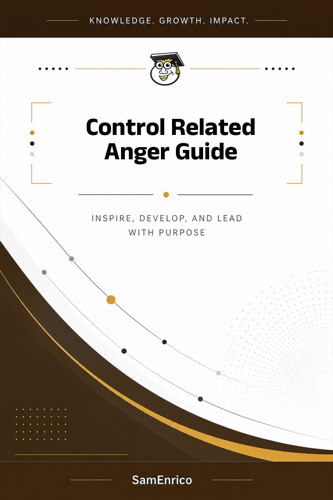
Non-FictionSelf-HelpControl Issues
Control Related Anger Guide eBook
Discover how situations outside your control like
by Orosco Doria
Discover how situations outside your control like traffic or waiting become anger triggers.
Formats
Free sample
Chapter 1: The Should Monster--–- You are not angry because of what happened. You are angry because of what you told yourself should have happened instead.The light turns red forty feet before you reach the intersection. You tap the brake. Then you tap it again, harder than necessary. Your jaw tightens.
Your phone buzzes with a calendar reminder: you are already running three minutes behind. The car ahead does not accelerate the instant the light turns green. Your hand finds the horn before your brain approves the motion. The driver ahead finally moves. You pass them aggressively, steering with one hand while gesturing with the other.
Your heart pounds. Your face is hot. You have done nothing physical—you have not run, fought, or lifted anything heavy—but your body behaves as though you have just escaped a predator.You have not escaped anything. You have sat in a climate-controlled box, pressed a pedal, and waited.This is the central mystery of control-related anger, and this entire book exists to solve it. Why does waiting—doing nothing, going nowhere, losing nothing except a few minutes—produce a physical response more appropriate for a battlefield?
Why do frozen screens, long lines, automated phone trees, and slow drivers generate a rage that lingers for hours? And why does that rage feel so justified, so righteous, so entirely the fault of the traffic light, the cashier, the algorithm, the stranger who dared to exist in your path?The answer is not in the traffic. The answer is in the should.The Cognitive-Behavioral Model: Your Brain’s Hidden Formula Before we can dismantle your anger, we have to understand its architecture. Most people believe that anger works like this:Event → Emotion → Reaction Something happens (a car cuts you off). You feel angry (a hot, righteous surge).
You react (you honk, yell, or seethe silently). This model feels true because the anger arrives so quickly that no thought seems to intervene. But cognitive-behavioral therapy—one of the most rigorously tested psychological frameworks in existence—has demonstrated that this model is incomplete. The actual sequence is:Event → Thought → Emotion → Reaction Between the event and the emotion, there is always a thought. It happens so fast that you do not notice it, like a single frame of film flashing past your eyes.
But it is there. And that thought determines everything.Consider two drivers stuck in the exact same traffic jam. Driver A thinks: “This is annoying, but there must be an accident up ahead. I’ll call and say I’m running late.” Driver A feels mild frustration, then patience. Driver B thinks: “This shouldn’t be happening.
These people shouldn’t be on the road. My time is valuable, and they are stealing it.” Driver B feels rage. Same event. Different thoughts. Different emotions.
Different reactions.The thought is the lever. Pull it one way, and you get frustration. Pull it another way, and you get fury. The event itself does not decide—you decide, with the thoughts you allow to run through your mind.This is not victim-blaming. Traffic lights are real.
Delays are real. Rude people are real. The point is not that you should pretend these things do not bother you. The point is that your reaction is not inevitable. You have more power than you think, and that power lives in the split second between the event and the thought you choose to believe.Introducing the Should Monster Let us name the most dangerous thought pattern driving your anger.
It is a creature that lives in every human brain, though it is louder in some than in others. We will call it the Should Monster.The Should Monster speaks in demands. Its vocabulary consists of a single word—should—deployed in every direction, at every delay, toward every person and system that fails to obey your preferences. When you are stuck behind a slow driver, the Should Monster whispers: “They should move faster.” When you are placed on hold for the third time, it hisses: “This company should have better service.” When your computer freezes before you saved your work, it roars: “This should not be happening to me.”The Should Monster is not evil. It is trying to protect you from the discomfort of unpredictability.
Your brain craves certainty because certainty meant safety on the savanna. A predictable environment is a survivable environment. The Should Monster is your brain’s primitive attempt to enforce predictability by demanding that reality conform to your expectations.The problem is that reality never listens.Every should is a demand you make on the universe. And the universe, as far as anyone can tell, has never once complied with a should. The light does not turn green because you think it should.
The driver does not accelerate because you think they should. The customer service agent does not magically appear because you think the company should hire more staff. Your shoulds are not instructions to reality. They are invitations to your own suffering.Demand Thinking vs. Preference Thinking The single most important distinction in this entire book is the difference between demand thinking and preference thinking.
Master this distinction, and you will cut the legs out from under most of your anger.Demand thinking sounds like this:“This light must be green.”“That driver has to move faster.”“They should not treat me this way.”“I need this line to move now.”Demand thinking is rigid, absolute, and intolerant of alternatives. It treats your preferences as universal laws. When reality violates a demand, your brain experiences that violation as an injustice, a personal attack, a crack in the moral order of the universe. And the brain’s response to injustice is anger.Preference thinking sounds like this:“I would prefer this light to be green.”“I’d like that driver to move faster.”“I wish they treated me differently.”“I prefer that this line move quickly.”Preference thinking is flexible, realistic, and tolerant of alternatives. It acknowledges your desires without elevating them to commands.
When reality violates a preference, you feel disappointment, annoyance, or mild frustration—not rage. The difference between “I prefer green lights” and “This light must be green” is the difference between a minor inconvenience and a volcanic eruption.This is not about pretending you don’t care. You care. That’s fine. The question is whether your caring turns into a demand on reality.
A preference keeps you in the driver’s seat of your own emotional response. A demand hands the wheel to the traffic light.The Gap: Where Anger Lives Between your expectation and reality, there is a gap. When the gap is small—you expected green and got green—you feel nothing. When the gap is moderate—you expected green and got red—you feel frustration. When the gap is large—you expected clear roads and got a parking lot—you feel anger.
When the gap is enormous—you expected respect and got humiliation—you feel rage.The gap is not created by reality. Reality just is what it is. The gap is created by your expectation. If you expect nothing, you are never disappointed. If you expect everything, you…
This is the end of the free sample. Get the eBook to keep going. Buy now
About this book
Details
- Author
- Orosco Doria
- Publisher
- SamEnrico
- Language
- English
- Genre
- Non-Fiction, Self-Help, Control Issues
- Released
- 2026-06-08
- Pages (approx.)
- 112
- Available as
- eBook, Audiobook

Read better in the ZLOADR app
Your eBooks on your phone or tablet. Sign in with your SamEnrico account and start reading.
More by Orosco Doria
 Growth Hacking Team StructureOrosco Doria$11.99
 Anger From Night Wakings GuideOrosco Doria$11.99
 Time Boxing Vs Time Blocking GuideOrosco Doria$11.99
 Starlight Serpent: The Lost Odyssey of QuetzalcoatlOrosco Doria$11.99
 The Frozen Echo: The Lost Transmissions of North Pole-22Orosco Doria$11.99
 Epic TrainerOrosco Doria$11.99
 Australian Trade Recognition HandbookOrosco Doria$12.99
 2026-2030 Energy Storage OutlookOrosco Doria$12.99
 Understanding Hyperkeratosis Lenticularis PerstansOrosco Doria$17.99Epic TrainerOrosco Doria$11.99
 A Beginners Guide to Basketball (Volume 1)Orosco Doria$11.99
You may also like
 Hong Kong Handover 1997Dunn Johnnie$11.99
 Zumba For Postnatal Recovery CourseNeal Christian$11.99
 Zumba for BeginnersLadner Nikia$11.99
 YouTube Comment Mining GuideHumes Pandora$12.99
 Worry Box MeditationCarlin Rudy$11.99
 Workplace Stress MeditationNguyen Lynn$11.99
 Workplace Stress and Sleep RepairHawley Ivory$11.99
 Workplace Perfectionism CureDelaney Jeffry$11.99
 Workplace Injustice Anger GuideWallen Isabelle$11.99
 Work Addiction and Burnout LinkGreenwood Ester$11.99
 Women in Yoga and WellnessBeattie Galina$11.99
 Women in Stand Up ComedyChun Evangeline$11.99