
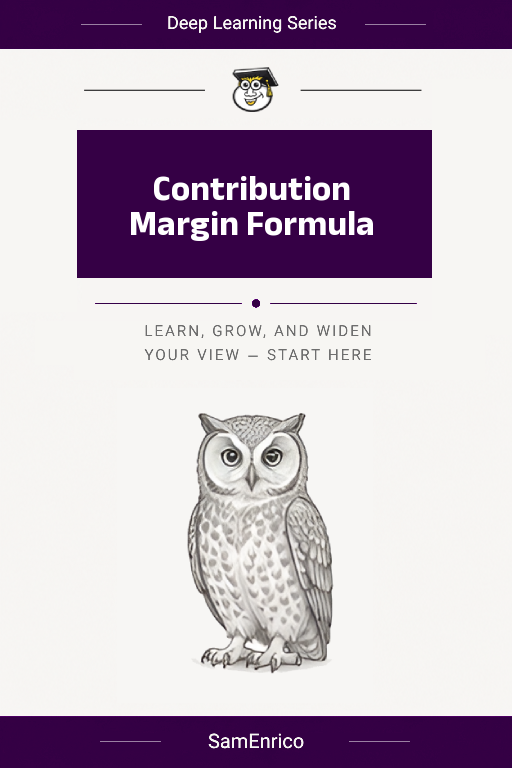
Contribution Margin Formula
Calculate per unit contribution as Price minus Var
Calculate per unit contribution as Price minus Variable Cost to cover fixed costs.
Formats
About this book
Free sample
Chapter 1: The Profit Mirage--–- In the winter of 2003, a third-generation furniture manufacturer in North Carolina called Mitchell & Sons did something that, by every traditional accounting measure, made perfect sense. They accepted a large, seemingly profitable order from a national retail chain. The order would keep their factory running at full capacity for six months. Their gross margin looked healthy on paper. Their banker was pleased.
Their accountant signed off on the projections. Eighteen months later, Mitchell & Sons filed for Chapter 7 bankruptcy. The company had been in business for sixty-two years. The founder’s grandson, who had taken over just two years earlier, sat across from the bankruptcy trustee utterly bewildered. “We were profitable on every sale,” he reportedly said.
“How can you go bankrupt when every sale makes money?”That question—how can you go bankrupt when every sale makes money?—is the single most dangerous question in business. It is dangerous because it seems logical. It is dangerous because most traditional accounting systems reinforce the illusion that it cannot happen. And it is dangerous because the answer requires a complete shift in how you think about costs, profit, and the very purpose of a sale.This book exists to ensure you never have to ask that question. The answer lies in a single number: the Contribution Margin.
And before we write a single formula or calculate a single break-even point, we must first understand why the standard financial statements that most business owners and managers rely upon are not just incomplete—they are actively misleading when used for internal decision-making.The Two Seldom-Asked Questions That Separate Survivors from Statistics Every sale generates revenue. Every sale incurs costs. The relationship between the two determines whether a business thrives or dies. But the question “Did we make money on that sale?” is actually two separate questions, and traditional accounting answers only one of them while ignoring the other entirely.Question One (The One Accounting Answers): After paying for the materials, direct labor, and other expenses directly tied to producing the product, how much remains?Traditional accounting calls this Gross Profit. It is useful for…
This is the end of the free sample. Get the eBook to keep going. Buy now
Contents
- Chapter 1
- Chapter 2
- Chapter 3
- Chapter 4
- Chapter 5
- Chapter 6
- Chapter 7
- Chapter 8
- Chapter 9
- Chapter 10
- Chapter 11
- Chapter 12
Details
- Author
- Olson Melissa
- Publisher
- SamEnrico
- Language
- English
- Genre
- Non-Fiction, Student's Shortcut, Cost Volume Profit
- Released
- 2026-06-01
- Pages (approx.)
- 153
- Available as
- eBook, Audiobook

Read better in the ZLOADR app
Your eBooks on your phone or tablet. Sign in with your SamEnrico account and start reading.
More by Olson Melissa
 Chess Opening PalaceOlson Melissa$11.99
 Assertiveness for Dating GuideOlson Melissa$11.99
 The Stem Cell ED GuideOlson Melissa$11.99
 Pet Loss Hotline GuideOlson Melissa$11.99
 Medication Induced NightmaresOlson Melissa$11.99
 Wholesaling Title SearchOlson Melissa$11.99
 Lifestyle Changes for EDOlson Melissa$11.99
 Freelance While Graduate StudentOlson Melissa$11.99
 The Great Cookie Exchange: How a 1970s Recipe Sparked a Global TraditionOlson Melissa$11.99
 Sumo in the Sands: The Unlikely Rise of Middle Eastern Sumo Wrestling (1980s-1990s)Olson Melissa$11.99
 A Collector's Handbook to the Alfa Romeo SprintveloceOlson Melissa$11.99
 How to Start a Art Film Theater BusinessOlson Melissa$11.99