
Non-FictionAI OperatorProcurement Legal
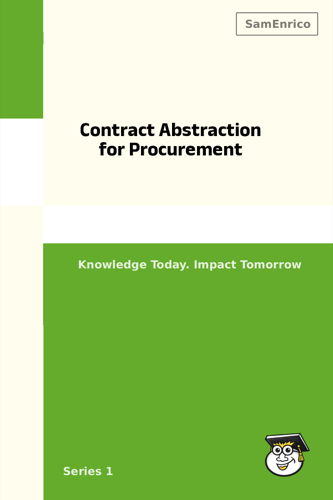
Contract Abstraction for Procurement eBook
Extract supplier pricing, delivery terms, and qual
by Rees Arlinda
Extract supplier pricing, delivery terms, and quality standards from purchase orders and supply agreements.
Formats
Free sample
Chapter 1: The Silent Killer--–- On a Tuesday morning in March, a procurement director at a mid-sized manufacturing firm received an email that would cost her company $847,000. The email was brief: a supplier was terminating a five-year supply agreement effective immediately. The contract had an automatic renewal clause requiring 180 days' written notice of non-renewal. That notice had never been sent. The procurement team had negotiated favorable pricing, secured volume discounts, and built in quality penalties.
None of that mattered. The contract was dead. The company would spend the next eight months buying at spot market rates while scrambling to qualify new suppliers.The tragedy was not that the clause did not exist. It was that no one knew it existed. The contract had been signed, scanned, uploaded to a shared drive, and never opened again.
Seventy-four percent of procurement disputes, according to industry benchmarks, originate from clauses that were either never extracted from contracts or were fundamentally misunderstood at the time of signing. This is the "Sign and Store" problem—the silent killer of procurement value.The Illusion of a Closed Deal Most procurement professionals believe their job ends when the contract is signed. The negotiation is complete. The terms are agreed. The supplier has committed.
This belief is comforting, professional, and catastrophically wrong.A signed contract is not a finished product. It is raw material. It contains data—pricing formulas, delivery deadlines, quality specifications, renewal windows, penalty clauses, and force majeure provisions—that must be extracted, structured, and made accessible to the systems and people who need them. Without extraction, a contract is a tombstone. It marks the spot where value was buried.Consider the anatomy of a typical procurement failure.
A buyer negotiates a volume discount that kicks in at 10,000 units annually. Six months into the contract, purchasing reaches 9,800 units. No one knows about the threshold. The buyer pays full price on the next 500 units, losing $12,000 in a single order. A supplier agrees to a "most favored nation" clause guaranteeing the buyer receives the lowest prices offered to any customer.
A competitor later negotiates a 15% lower price. The buyer never claims the difference because no one abstracted the clause. A quality agreement requires a Certificate of Analysis with every shipment, but receiving accepts goods without it. Six months later, a contamination issue triggers a recall. The buyer cannot prove the supplier failed to provide the Co A because no one abstracted the requirement.These are not hypotheticals.
They happen daily in procurement organizations of every size, across every industry. The common denominator is not bad suppliers or poor negotiation. It is failed abstraction.The Cost of Non-Abstraction: A Mathematical Framework To understand the scale of the problem, we must quantify what is lost when contracts remain unabstracted. The Cost of Non-Abstraction (CNA) can be calculated using a simple formula applied across four categories of risk.Category One: Missed Deadlines and Renewals The formula: (Contract Value × Renewal Price Increase Percentage) + (Spot Market Premium × Months Without Contract)In the opening example, the procurement director faced both components. The automatic renewal would have locked in pricing for another three years.
Without it, the company paid an average 22% premium for eight months. The calculation: ($4.2M annual spend × 0% renewal increase because pricing was fixed) + ($350,000 monthly spend × 0.22 premium × 8 months) = $616,000 in direct overpayment plus $231,000 in supplier qualification costs = $847,000 total.Category Two: Unclaimed Discounts and Rebates The formula: (Eligible Spend × Discount Percentage) + (Volume Threshold Missed × Penalty Rate)A purchasing organization with $50M in annual supplier spend typically has 3-7% in unclaimed discounts from volume rebates, early payment terms, and tiered pricing. A manufacturing company discovered, during a post-audit, that it had failed to claim $1.4M in volume rebates over two years because no one had abstracted the rebate schedule from four separate supply agreements. The rebate clauses were present. They were negotiated intentionally.
They were never operationalized.Category Three: Penalties and Avoidable Charges The formula: (Late Fees × Occurrences) + (Automatic Price Increases × Months Unnoticed)A logistics contract with a major carrier contained a fuel surcharge formula tied to the weekly DOE average diesel price. The formula was complex but favorable: surcharge applied only when diesel exceeded $3.50 per gallon. For eighteen months, the buyer paid surcharges automatically invoiced by the carrier. Diesel had never exceeded $3.25. The overpayment: $94,000.
The clause was in the contract. No one had abstracted it.Category Four: Dispute Resolution and Litigation Costs The formula: (Legal Fees + Internal Time) × Disputes Attributable to Poor Abstraction Organizations with mature abstraction processes report 40-60% lower dispute resolution costs than those without. The reason is simple: when key terms are extracted and accessible, disputes are resolved at the contract management stage rather than escalating to legal. A study of 200 procurement organizations found that companies without formal abstraction averaged 3.7 contract disputes per year requiring legal involvement, at an average cost of $47,000 each. Companies with abstraction averaged 1.2 disputes at $18,000 each.The cumulative cost of non-abstraction across a typical enterprise with $500M in annual spend ranges from $3M to $8M annually.
This is not an operating expense. It is value that was negotiated, documented, and then abandoned.The Abstraction Mindset: From Data Entry to Risk Intelligence The single greatest barrier to effective abstraction is not technology, budget, or time. It is mindset. Most procurement professionals view abstraction as administrative work—data entry, a necessary evil, something to be outsourced to the lowest-cost resource or automated as quickly as possible.This view is expensive.The Abstraction Mindset reframes the work entirely. Abstraction is not data entry.
It is risk intelligence. It is the process of converting negotiated rights and obligations into actionable data that protects the organization, drives compliance, and enables proactive decision-making.Consider the difference between data entry and risk intelligence. Data entry asks: "What does this field say?" Risk intelligence asks: "What does this clause mean for our operations?" Data entry produces a database of text strings. Risk intelligence produces a decision-support system that triggers alerts, validates compliance, and identifies opportunities.A concrete example illustrates the distinction. A standard MSA contains a force majeure clause.
Data entry abstracts: "Force majeure includes acts of God, war, terrorism, labor strikes, and government action." This is correct but nearly useless. Risk intelligence abstracts: "Force majeure notice required within 10 days of event. Event must directly impact supplier's ability to perform. Burden of proof on supplier. Buyer has right to verify.
No price increase during force majeure. Alternative sourcing permitted without penalty."The second abstraction is longer, but it is actionable. It tells the procurement team what to do when a supplier calls claiming force majeure. It establishes the notice deadline, the burden of proof, the verification right, and the buyer's mitigation options. This is the difference between knowing a clause exists and being able to act on it.Contracts as Tradable Data Assets The most powerful shift in the Abstraction Mindset is understanding contracts as data assets rather than legal documents.
A data asset has three characteristics: it is structured, it is searchable, and it is usable by systems.A traditional contract in PDF format is none of these things. It is unstructured text. It is searchable only by opening the file and using Ctrl+F. It is usable only by humans reading it. A contract that has…
This is the end of the free sample. Get the eBook to keep going. Buy now
About this book
Details
- Author
- Rees Arlinda
- Publisher
- SamEnrico
- Language
- English
- Genre
- Non-Fiction, AI Operator, Procurement Legal
- Released
- 2026-06-11
- Pages (approx.)
- 152
- Available as
- eBook, Audiobook

Read better in the ZLOADR app
Your eBooks on your phone or tablet. Sign in with your SamEnrico account and start reading.
More by Rees Arlinda
 Nkrumah GhanaRees Arlinda$11.99
 Imposter Neurodivergent GuideRees Arlinda$11.99
 Africa Bribery Enforcement LogRees Arlinda$11.99
 LTC Benefit Period Selection GuideRees Arlinda$11.99
 Indigenous Conflict Resolution GuideRees Arlinda$11.99
 The Reformation ExecutionersRees Arlinda$11.99
 Parent Time MeditationRees Arlinda$11.99
 Active Listening for KidsRees Arlinda$11.99
 The Lost City of Z: The Real-Life Indiana JonesRees Arlinda$11.99
 The Great Escape: The Untold Story of the 1977 New York BlackoutRees Arlinda$11.99
 The Silk and the Stars: How the Medici Bank Financed the Renaissance of the CosmosRees Arlinda$11.99
 Growing Platanus (Plane Tree, Sycamore)Rees Arlinda$11.99
You may also like
 Hong Kong Handover 1997Dunn Johnnie$11.99
 Zumba For Postnatal Recovery CourseNeal Christian$11.99
 Zumba for BeginnersLadner Nikia$11.99
 YouTube Comment Mining GuideHumes Pandora$12.99
 Worry Box MeditationCarlin Rudy$11.99
 Workplace Stress MeditationNguyen Lynn$11.99
 Workplace Stress and Sleep RepairHawley Ivory$11.99
 Workplace Perfectionism CureDelaney Jeffry$11.99
 Workplace Injustice Anger GuideWallen Isabelle$11.99
 Work Addiction and Burnout LinkGreenwood Ester$11.99
 Women in Yoga and WellnessBeattie Galina$11.99
 Women in Stand Up ComedyChun Evangeline$11.99