
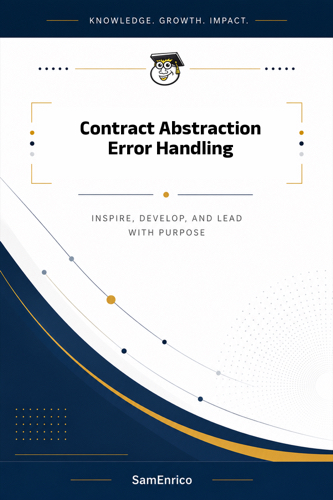
Non-FictionAI OperatorError Management
Contract Abstraction Error Handling eBook
Identify when AI misinterprets ambiguous clauses a
Identify when AI misinterprets ambiguous clauses and implement correction protocols immediately.
Formats
Free sample
Chapter 1: The Million-Dollar Comma--The phone rang at 11:47 on a Tuesday night. Sarah, the head of contract operations at a mid-sized logistics firm, almost didn’t answer. When she did, the voice on the other end was trembling.“We have a problem. The AI approved the delivery schedule three months ago. We just got sued for seven million dollars.”The clause in question was six words long: “Delivery within a reasonable time after notice.” The AI had abstracted it as “30 days.” The operations team built their entire Q4 around that date.
The counterparty interpreted “reasonable time” as 90 days. By the time anyone noticed the discrepancy, trucks had been dispatched, penalties had triggered, and a key customer had walked.This is not a cautionary tale. It is a representative sample.Ambiguity in contract language is the single most underestimated risk in commercial operations today. And the problem is getting worse, not better, because we have handed the keys to systems that are uniquely blind to the very danger that destroys the most value.--The Perceptual Gap That Changes Everything Let me tell you something that will unsettle you. When non-lawyers read an ambiguous clause, they do not see ambiguity.
They see clarity. In fact, research published in the Journal of Empirical Legal Studies found that non-experts rate ambiguous contractual language as significantly clearer than legal experts do. The gap is not small. It is a chasm.Here is what happens. An engineer builds an AI system to extract contract data.
She reads a clause that says “Supplier will use best efforts to deliver by Q3.” She thinks: “Best efforts means try hard. Q3 means September 30th. Done.” She writes a prompt, tests it on ten contracts, and deploys to production.Six months later, the legal team discovers that “best efforts” in this industry’s case law means something much closer to “guaranteed delivery” when the supplier has unique capabilities. And “Q3” in the counterparty’s fiscal calendar ends on October 31st. The AI was wrong.
The engineer never saw it coming because she could not see the ambiguity in the first place.This perceptual gap is the root cause of most AI abstraction failures. It is not a training problem. It is not a model problem. It is a human problem that we have unknowingly baked into our automated systems.The hard truth is this: people who are not legally trained systematically overestimate the clarity of ambiguous contract language. They then build AI systems that inherit this blind spot.
The AI does not know it is guessing. The engineer does not know the clause is ambiguous. And the business suffers the consequences.--A Brief History of a Very Expensive Mistake Let me walk you through a real case. The names have been changed, but the numbers have not.A global manufacturing company deployed a contract abstraction tool to process 15,000 vendor agreements per year. The tool used a large language model to extract key terms: payment dates, delivery windows, termination notice periods, and liability caps.Six months into production, the company’s finance team noticed a discrepancy.
Revenue recognition was off by nearly eight million dollars. The cause traced back to a single clause repeated across 1,200 contracts: “Payment shall be made within a reasonable time following invoice.”The AI had abstracted “reasonable time” as 30 days. The accounting team booked revenue accordingly. But the counterparties—a consortium of smaller suppliers—understood “reasonable time” to mean 60 days, consistent with industry custom. When the company stopped paying at 30 days, suppliers slowed deliveries.
Production lines idled. Penalties accrued.The company sued the AI vendor. The AI vendor pointed to their terms of service: “Output may contain errors. User assumes all risk.” The company’s legal team then looked internally. Who had approved the abstraction logic?
An operations director with no legal training. Who had reviewed the sample output? The same director, plus two data analysts. No lawyer had ever looked at the “reasonable time” abstraction.The company ate the loss. Eight million dollars.
Plus legal fees. Plus the cost of re-abstraction. Plus the damage to supplier relationships.Here is what kills me. This was entirely preventable. Not with a better model.
Not with more data. With a different process.--The Three-Tiered Risk Framework Ambiguity in contract abstraction creates risk in three distinct layers. Most organizations address only the first. That is why they fail.Legal Risk The most obvious layer. An ambiguous clause that the AI misinterprets leads to an unenforceable obligation or a void provision.
Consider a non-compete that says “within a reasonable geographic radius.” A court might strike it down entirely for vagueness. Your AI says “50 miles.” Your business acts on that. You are now in breach of the non-compete you thought you had, plus you may have violated other agreements based on your incorrect interpretation.Legal risk is the layer that keeps general counsel awake at night. But it is not the most expensive layer. That distinction belongs elsewhere.Financial Risk This is the layer that actually destroys enterprise value.
Financial risk from ambiguous abstraction manifests in three ways:First, missed obligations. The AI fails to flag that the supplier must provide audited financials “promptly upon request.” You never request. You never receive. You violate your own compliance requirements.Second, incorrect revenue recognition. As in the manufacturing example, misinterpreting payment timing or milestone definitions leads to booking revenue in the wrong period.
For public companies, this is a securities law exposure.Third, penalty triggers. A clause says the buyer must provide forecasts “from time to time.” The AI abstracts “quarterly.” The buyer provides quarterly forecasts. The contract counterparty later argues that “from time to time” means monthly, because that is what the parties actually did for the first three months. Penalties apply. The difference is hundreds of thousands of dollars.Operational Risk The least visible but most pervasive layer.
Operational risk occurs when downstream systems act on incorrect abstractions.Imagine an AI extracts a delivery window of “10 business days” from a clause that actually says “10 business days following final approval of samples.” The samples are never approved. The AI populates the delivery date anyway. Your inventory system orders safety stock. Your warehouse staff schedules labor. Your customer service team promises a date to end customers.None of those downstream systems know that the underlying abstraction was conditional on an event that never happened.
They just execute. And they execute incorrectly, at scale, every single day.Operational risk is dangerous because it is silent. No one raises a red flag when an inventory system orders too much stock. They just see higher carrying costs. No one blames the AI when a delivery is late because the abstraction missed a condition.
They blame the supplier or the logistics team.The AI becomes invisible. The errors become embedded. And the business slowly bleeds value.--Two Kinds of Errors: Why Most Teams Focus on the Wrong One Let me draw a distinction that will reappear throughout this book. It is the single most important conceptual framework you will learn.Entity errors occur when the AI pulls the wrong data point. The contract says “December 31.” The AI extracts “January 1.” The contract says “Supplier.” The AI extracts “Buyer.” Entity errors are…
This is the end of the free sample. Get the eBook to keep going. Buy now
About this book
Details
- Author
- Petit Shawnta
- Publisher
- SamEnrico
- Language
- English
- Genre
- Non-Fiction, AI Operator, Error Management
- Released
- 2026-06-10
- Pages (approx.)
- 136
- Available as
- eBook, Audiobook

Read better in the ZLOADR app
Your eBooks on your phone or tablet. Sign in with your SamEnrico account and start reading.
More by Petit Shawnta
 Social Worker Child ProtectionPetit Shawnta$11.99
 Networking Name PalacePetit Shawnta$11.99
 Djed Pillar GuidePetit Shawnta$11.99
 Leadership Emotion RegulationPetit Shawnta$11.99
 Deep Sea Vision Loss LogPetit Shawnta$11.99
 The Breath Sounds MeditationPetit Shawnta$11.99
 Anger Management for Menopause at WorkPetit Shawnta$11.99
 Self Talk For Health AnxietyPetit Shawnta$11.99
 The Balkan Powder Keg: How the Yugoslav Wars Ignited Europe's Drug CartelsPetit Shawnta$11.99
 The Enigma of Enigma: Alan Turing’s War of Codes and SecretsPetit Shawnta$11.99
 The Dancer's Guide to BreakawayPetit Shawnta$11.99
 AI Prompts for Civic CommunicationPetit Shawnta$11.99
You may also like
 Hong Kong Handover 1997Dunn Johnnie$11.99
 Zumba For Postnatal Recovery CourseNeal Christian$11.99
 Zumba for BeginnersLadner Nikia$11.99
 YouTube Comment Mining GuideHumes Pandora$12.99
 Worry Box MeditationCarlin Rudy$11.99
 Workplace Stress MeditationNguyen Lynn$11.99
 Workplace Stress and Sleep RepairHawley Ivory$11.99
 Workplace Perfectionism CureDelaney Jeffry$11.99
 Workplace Injustice Anger GuideWallen Isabelle$11.99
 Work Addiction and Burnout LinkGreenwood Ester$11.99
 Women in Yoga and WellnessBeattie Galina$11.99
 Women in Stand Up ComedyChun Evangeline$11.99