
Non-FictionSelf-HelpDaily Practice
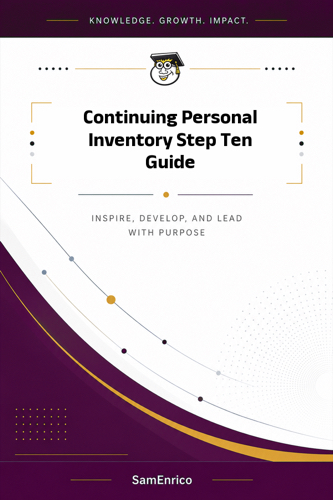
Continuing Personal Inventory Step Ten Guide eBook
Maintain daily recovery with step ten's continuous
Maintain daily recovery with step ten's continuous inventory practice using this maintenance handbook.
Formats
Free sample
Chapter 1: The Sweeping Lie--–- Most people relapse because they believe they are already fixed.They complete Step Four. They write out their resentments, fears, and harms. They share it with their sponsor. They feel the extraordinary relief of confession, the lightness of having finally told another human being the full, unvarnished truth about who they have been. And then they do something that seems entirely reasonable, entirely logical, and entirely wrong.They stop.Not entirely, of course.
They still go to meetings. They still call their sponsor once a week. They might even recite the Tenth Step at the end of a meeting: "Continued to take personal inventory and when we were wrong promptly admitted it." But they recite it the way someone recites the Pledge of Allegiance—mouth moving, mind elsewhere, the words having lost their meaning through familiarity.The lie they have swallowed is this: Step Four was the hard part. Everything after is just maintenance.This lie is seductive because it contains a grain of truth. Step Four is brutally difficult.
Sitting down with paper and pen, often for the first time in your life, and writing an unflinching moral inventory of your entire existence—that takes courage. That takes hours. That takes tears, sometimes rage, sometimes the humiliating realization that you have been the architect of most of your own suffering. Compared to that, Step Ten looks easy. A daily inventory?
A spot-check here and there? An occasional apology? How hard could that be?Hard enough to kill you. Hard enough that more people drift out of recovery during the maintenance Steps than during any other phase.Here is the truth that the best-selling recovery books have danced around but never quite said plainly: Step Four is excavation. Step Ten is occupation.
Excavation is dramatic. You dig up the past. You find buried things—old resentments, forgotten shames, the bones of relationships you destroyed. Everyone applauds the excavation. But occupation—the daily, boring, unglamorous work of holding the ground you have gained—that is where recoveries are either secured or lost.No one writes songs about the soldier who stands guard on an empty wall for a thousand consecutive days.
But that soldier is the reason the wall has not fallen.This book is for that soldier.The False Finish Line Every recovery community has a version of the following scene. A person with six months, one year, or even five years of sobriety walks into a meeting and says, "I don't know what happened. Everything was fine. I was working my program. Then one day, I just… stopped.
Not drinking, at first. I stopped calling my sponsor. I stopped doing my nightly review. I told myself I was busy. Then one bad day came, and I didn't have any tools left.
And now I'm back at thirty days."If you listen carefully to these stories, you will notice a pattern. The relapse was not caused by a single catastrophic event. It was not a divorce, a job loss, or a death in the family. Those things happened, yes. But they happened to everyone.
The relapse was caused by the slow, almost invisible erosion of the daily discipline that had kept them sober for years.They stopped sweeping.And then they were surprised when the floor became unlivable.This chapter is going to name something uncomfortable: the belief that Step Four "fixed" you is the most dangerous thought in recovery. Not because Step Four is unimportant—it is essential. Without it, you are sweeping a floor while the original debris still sits in piles. But Step Four is not a cure. It is not a destination.
It is a starting point. It is the map you draw before you begin the daily journey of living differently.Think of it this way. If you hired a contractor to demolish a crumbling house on your property, you would not then declare the job complete and move into the empty foundation. The demolition was necessary. It cleared the way.
But the demolition did not build a new house. The building happens later, brick by brick, day by day, in weather fair and foul.Step Four is the demolition. Step Ten is the construction. And construction never ends because you are never finished becoming the person you want to be.The Archaeology of the Self Let us be precise about what Step Four actually does and, just as importantly, what it does not do.Step Four—the "big inventory"—is an archaeological expedition into your past. You dig down through the layers of your life.
You uncover patterns. You see, often for the first time, the connection between your childhood wounds and your adult acting out. You identify the specific people, institutions, and principles you have resented. You trace your fears back to their origins. You catalog the harms you have caused and the harms you have suffered.This is invaluable work.
No one should skip it or rush through it. A person who has not done a thorough Fourth Step is like a doctor trying to treat a patient without running any tests—guessing at best, dangerous at worst.But here is what Step Four does not do. It does not remove your character defects. It does not rewire your automatic emotional reactions. It does not make you a different person.
It only makes you an informed person. You now know, intellectually, that you have a pattern of reacting to criticism with rage or to abandonment with self-pity. Knowing this is not the same as stopping.A smoker knows that cigarettes cause cancer. That knowledge does not extinguish the craving. A person with a gambling addiction knows the statistical probability of losing.
That knowledge does not prevent them from placing the bet. Knowledge is necessary but insufficient. What changes behavior is practice—the daily, repetitive, sometimes boring application of a different response until that response becomes automatic.Step Four gives you the knowledge. Step Ten gives you the practice.The Two Kinds of Relapse The recovery literature distinguishes between two kinds of relapse: the sudden explosion and the slow drift. They look very different on the surface, but they share a common root.The sudden explosion is what most people imagine when they hear the word "relapse." A person with years of sobriety experiences a devastating life event—a death, a betrayal, a financial ruin—and within hours or days, they are drunk or using again.
This looks like a lightning strike. It looks unpredictable. But in almost every case, the lightning struck tinder that had been drying out for months or years. The person was not doing their daily maintenance. They had stopped calling their sponsor.
They had stopped their nightly inventory. They had let small resentments accumulate because they "didn't want to make a big deal out of it." The life event did not cause the relapse. It just provided the spark for a fire that was already waiting to burn.The slow drift is more common and more insidious. There is no dramatic event. The person simply wakes up one day and realizes they have not done an honest inventory in three weeks.
They have been irritable, distant, and secretly self-pitying. They have been lying to themselves about how they are feeling. And…
This is the end of the free sample. Get the eBook to keep going. Buy now
About this book
Details
- Author
- Delgado Faith
- Publisher
- SamEnrico
- Language
- English
- Genre
- Non-Fiction, Self-Help, Daily Practice
- Released
- 2026-06-06
- Pages (approx.)
- 147
- Available as
- eBook, Audiobook

Read better in the ZLOADR app
Your eBooks on your phone or tablet. Sign in with your SamEnrico account and start reading.
More by Delgado Faith
 Personal Ing For Success Competitive AnalysisDelgado Faith$11.99
 The Global Talent Mobility ROIDelgado Faith$11.99
 Intuitive Eating For Orthorexia Recovery HandbookDelgado Faith$11.99
 Pain Medication Side Effect ManualDelgado Faith$11.99
 The Last Whale Hunter: A Voyage Through Time and IceDelgado Faith$11.99
 Shadows of the Iron Phoenix: The Untold Story of Admiral Yi Sun-sinDelgado Faith$11.99
 Security Awareness TrainerDelgado Faith$11.99
 Bootcamp Portfolio That WinsDelgado Faith$12.99
 Funding Your Non Resident LLCDelgado Faith$12.99
 Ultimate Handbook Guide to Rajkot : (India) Travel GuideDelgado Faith$11.99
 Understanding Biotin DeficiencyDelgado Faith$17.99
You may also like
 Hong Kong Handover 1997Dunn Johnnie$11.99
 Zumba For Postnatal Recovery CourseNeal Christian$11.99
 Zumba for BeginnersLadner Nikia$11.99
 YouTube Comment Mining GuideHumes Pandora$12.99
 Worry Box MeditationCarlin Rudy$11.99
 Workplace Stress MeditationNguyen Lynn$11.99
 Workplace Stress and Sleep RepairHawley Ivory$11.99
 Workplace Perfectionism CureDelaney Jeffry$11.99
 Workplace Injustice Anger GuideWallen Isabelle$11.99
 Work Addiction and Burnout LinkGreenwood Ester$11.99
 Women in Yoga and WellnessBeattie Galina$11.99
 Women in Stand Up ComedyChun Evangeline$11.99