
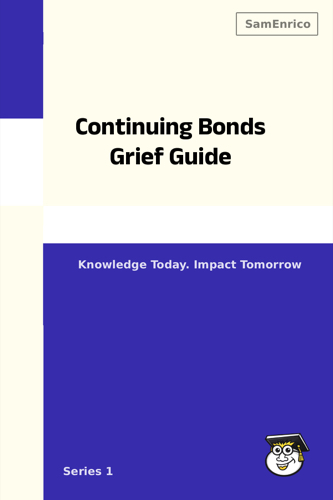
Non-FictionSelf-HelpContinuing Bonds
Continuing Bonds Grief Guide eBook
Maintains healthy connection to deceased without s
by Covey Jamar
Maintains healthy connection to deceased without stuck grief.
Formats
Free sample
Chapter 1: The Myth of Closure...–- You are sitting in a coffee shop, or maybe lying awake at 3:00 AM, or standing in the grocery store aisle staring at their favorite brand of soup. Someone said it to you yesterday, or perhaps you have been saying it to yourself: “Shouldn’t you be over this by now?” The question lands like a stone in your chest. You want to be over it. You have tried to be over it. You have packed away their clothes, avoided their favorite songs, stopped saying their name out loud because every time you do, someone shifts uncomfortably.
And yet, here you are. Still thinking about them. Still talking to them in your head. Still feeling their absence like a missing limb.This chapter is not going to tell you to let go. In fact, it is going to tell you the opposite.
It is going to tell you that the pressure you feel to “move on” is based on a lie—a well-intentioned, century-old, culturally enforced lie that has caused more suffering than almost any other myth about grief. The lie is this: that healthy grieving requires you to sever your emotional bond with the person who died. That holding on means staying stuck. That closure is the goal.Welcome to the first chapter of a different kind of grief guide. One that is going to ask you to do something that might feel forbidden at first.
It is going to ask you to stop trying to let go. And instead, it is going to teach you how to hold on differently.The Moment Everything Changed Before we go any further, let us name something that most grief books dance around. You are not here because you want to forget them. You are here because you want to find a way to keep loving them without that love destroying you. You want to be able to laugh at a memory without collapsing into tears five minutes later.
You want to look at their photo and feel warmth instead of an electric shock of pain. You want to live your life—truly live it, not just survive it—without feeling like you are betraying them.That is not a contradiction. That is the most human desire in the world.For most of the twentieth century, psychology got this wrong. Sigmund Freud, the father of modern psychotherapy, argued that healthy grieving required something he called decathexis—the gradual withdrawal of emotional energy from the deceased. In his model, the goal of grief was to detach, to relocate that energy onto new relationships and new pursuits.
If you found yourself still talking to your dead spouse six months later, that was considered a failure of the grieving process. A sign that you were “stuck.”Here is the problem with that model. It was based on theory, not on evidence. And when researchers finally went out and studied actual grieving people—not patients on a therapist’s couch, but ordinary human beings navigating loss—they discovered something remarkable. The healthiest grievers were not the ones who had let go.
The healthiest grievers were the ones who had found a way to transform their bond with the deceased.This was the groundbreaking finding of Klass, Silverman, and Nickman in their 1996 book Continuing Bonds: New Understandings of Grief. They found that across cultures and circumstances, people who maintained an ongoing inner relationship with their loved ones—who talked to them, who asked “What would they say?”, who kept their photos visible and their memories alive—were not more depressed. They were often more resilient. They adapted better to loss because they did not have to pretend that someone they loved had suddenly become a stranger.The Cultural Lie We Have All Been Taught Let me be more specific about the lie, because it is everywhere. It is in the greeting cards that say “Time heals all wounds.” It is in the well-meaning friend who tells you, “They wouldn’t want you to be sad.” It is in the workplace policy that gives you three days of bereavement leave and then expects you to return to full productivity.
It is in the expectation that after a year—one single trip around the sun—you should be “back to normal.”None of this is true. And none of it is helpful.Time does not heal wounds. Time simply passes. What heals wounds is what you do with that time. And if what you are being told to do is to pretend that someone who shaped your life no longer matters to you, then time will not heal you.
It will simply bury you deeper under a layer of unexpressed love and unspoken grief.The phrase “They wouldn’t want you to be sad” is particularly insidious. It sounds compassionate. It sounds like the person who died is looking out for you from beyond. But think about what it actually implies. It implies that your sadness is a betrayal of their wishes.
It implies that the only appropriate response to their death is to stop feeling anything about it. That is not love. That is emotional erasure.And the one-year timeline? Entirely arbitrary. There is no scientific evidence that grief resolves itself in twelve months.
In fact, research shows that for many people, the second year of grief can be harder than the first—because the shock has worn off, the support has dried up, and the reality of a lifetime without them begins to settle in.You are not broken because you are still grieving. You are not broken because you still think about them every day. You are not broken because you cried at a memory three years later. You are a human being who loved someone. That love does not have an expiration date.The Continuing Bonds Model: A Different Way So what is the alternative?
If letting go is not the answer, what is?The alternative is called the Continuing Bonds model. It is not a new age philosophy or a spiritual practice (though it can include those things if you want it to). It is a evidence-based understanding of how human attachment works in the face of loss.Here is the core idea in one sentence: The goal of grief is not to sever your bond with the deceased, but to find a new place for them in your ongoing life.That is it. That is the entire paradigm shift.Before death, your relationship with this person was built on physical presence, shared activities, future plans, and daily interactions. After death, those things are no longer possible.
But that does not mean the relationship has to end. It means the relationship has to change form.Think about it this way. If someone you love moves to another continent, you do not stop loving them. You do not pack away their photos and refuse to say their name. You find new ways to connect—phone calls, letters, memories of past times together, plans for future visits.
The relationship changes, but it continues.Death is the most extreme form of relocation. Your loved one has moved to a place where you cannot…
This is the end of the free sample. Get the eBook to keep going. Buy now
About this book
Details
- Author
- Covey Jamar
- Publisher
- SamEnrico
- Language
- English
- Genre
- Non-Fiction, Self-Help, Continuing Bonds
- Released
- 2026-06-09
- Pages (approx.)
- 128
- Available as
- eBook, Audiobook

Read better in the ZLOADR app
Your eBooks on your phone or tablet. Sign in with your SamEnrico account and start reading.
More by Covey Jamar
 Benzo Recovery Meditation GuideCovey Jamar$11.99
 Floating in Dead SeaCovey Jamar$11.99
 Bill Gates WindowsCovey Jamar$11.99
 Phone Distraction OverhaulCovey Jamar$11.99
 Daily Time Blocking WorkbookCovey Jamar$11.99
 CRE Exit Strategy PlanningCovey Jamar$11.99
 Resume Online Portfolio GuideCovey Jamar$11.99
 Nuclear Sub OfficerCovey Jamar$11.99
 The Last Broadcast of the SS ValenciaCovey Jamar$11.99
 The Last Stand of the Honey Badger: A Tale of DefianceCovey Jamar$11.99
 The Blood Alchemist: How an 18th-Century Surgeon Defied DeathCovey Jamar$11.99
 Understanding Alpha-ketoglutarate Dehydrogenase DeficiencyCovey Jamar$17.99
You may also like
 Hong Kong Handover 1997Dunn Johnnie$11.99
 Zumba For Postnatal Recovery CourseNeal Christian$11.99
 Zumba for BeginnersLadner Nikia$11.99
 YouTube Comment Mining GuideHumes Pandora$12.99
 Worry Box MeditationCarlin Rudy$11.99
 Workplace Stress MeditationNguyen Lynn$11.99
 Workplace Stress and Sleep RepairHawley Ivory$11.99
 Workplace Perfectionism CureDelaney Jeffry$11.99
 Workplace Injustice Anger GuideWallen Isabelle$11.99
 Work Addiction and Burnout LinkGreenwood Ester$11.99
 Women in Yoga and WellnessBeattie Galina$11.99
 Women in Stand Up ComedyChun Evangeline$11.99