
Non-FictionHealth & WellnessBehavioral Economics
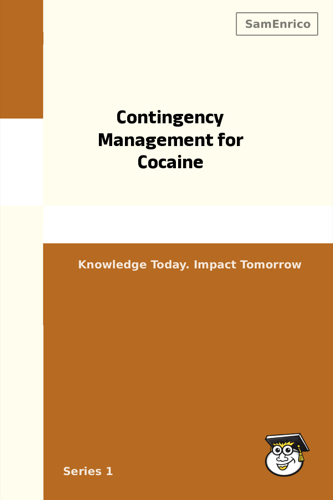
Contingency Management for Cocaine
Explains voucher based reinforcement for stimulant
Explains voucher based reinforcement for stimulant abstinence.
Formats
About this book
Free sample
Chapter 1: The Broken Compass--–- In the summer of 1991, while most Americans were listening to Nirvana’s Nevermind for the first time, a quiet revolution was taking place in a modest research clinic in Burlington, Vermont. A behavioral psychologist named Stephen Higgins did something that seemed almost absurd at the time: he offered people struggling with crack cocaine addiction a modest voucher—worth roughly $2.50—every time they provided a urine sample that tested negative for cocaine. His colleagues thought he was wasting grant money. His clinical staff worried they were enabling bad behavior. And his patients?
They thought it was a trick. No one had ever paid them to get clean before. Within twelve weeks, something remarkable happened. The patients receiving vouchers achieved nearly twice the rate of sustained cocaine abstinence compared to those receiving only standard counseling. The "Higgins voucher study" became an instant landmark in addiction science—and yet, more than three decades later, the vast majority of cocaine users in the United States have never been offered a single voucher for their abstinence.
This book exists to close that gap.The premise of Contingency Management for Cocaine is simple but radical: the most effective treatment for cocaine use disorder is not a new medication, a novel psychotherapy, or a spiritual awakening. It is a set of behavioral principles discovered in the 1930s by B.F. Skinner, refined over decades of animal and human research, and now supported by more than one hundred randomized controlled trials. Contingency Management (CM) works because it targets the core mechanism that keeps people addicted in the first place: the brain’s reward system. Cocaine hijacks this system by flooding the nucleus accumbens with dopamine, creating a feeling of euphoria so powerful that it overwrites virtually every other source of reward in the person’s life—food, sex, social connection, even survival itself.
CM does not try to block dopamine receptors the way methadone blocks opioid receptors. Instead, it introduces a competing reward—a voucher, a prize, a gift card—that is delivered immediately and consistently every time the patient provides evidence of abstinence. Over…
This is the end of the free sample. Get the eBook to keep going. Buy now
Contents
- Chapter 1
- Chapter 2
- Chapter 3
- Chapter 4
- Chapter 5
- Chapter 6
- Chapter 7
- Chapter 8
- Chapter 9
- Chapter 10
- Chapter 11
- Chapter 12
Details
- Author
- Womack Elvera
- Publisher
- SamEnrico
- Language
- English
- Genre
- Non-Fiction, Health & Wellness, Behavioral Economics
- Released
- 2026-06-10
- Pages (approx.)
- 133
- Available as
- eBook, Audiobook

Read better in the ZLOADR app
Your eBooks on your phone or tablet. Sign in with your SamEnrico account and start reading.
More by Womack Elvera
 Jealousy and Possessive AngerWomack Elvera$11.99
 Teen Appearance AcceptanceWomack Elvera$11.99
 Voice Actor Identity CrisisWomack Elvera$11.99
 Slack Community GuideWomack Elvera$11.99
 Veterinarian Euthanasia StressWomack Elvera$11.99
 Bodyweight HIIT Workout GuideWomack Elvera$11.99
 Farm Animal Loss GriefWomack Elvera$11.99
 The Drums of Montcalm: Music, War, and the Fall of New FranceWomack Elvera$11.99
 The Velvet Revolution: John Tristram and the Birth of Modern New Zealand TheatreWomack Elvera$11.99
 Pop Up Holiday Market Strategy WorkbookWomack Elvera$12.99
 Growing AristolochiaWomack Elvera$11.99
 US Disability Wage Certificates GuideWomack Elvera$12.99
You may also like
 Hong Kong Handover 1997Dunn Johnnie$11.99
 Zumba For Postnatal Recovery CourseNeal Christian$11.99
 Zumba for BeginnersLadner Nikia$11.99
 YouTube Comment Mining GuideHumes Pandora$12.99
 Worry Box MeditationCarlin Rudy$11.99
 Workplace Stress MeditationNguyen Lynn$11.99
 Workplace Stress and Sleep RepairHawley Ivory$11.99
 Workplace Perfectionism CureDelaney Jeffry$11.99
 Workplace Injustice Anger GuideWallen Isabelle$11.99
 Work Addiction and Burnout LinkGreenwood Ester$11.99
 Women in Yoga and WellnessBeattie Galina$11.99
 Women in Stand Up ComedyChun Evangeline$11.99