
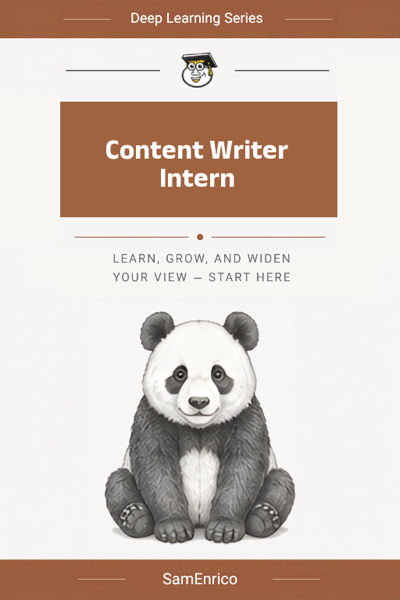
Non-FictionInformativeEducational
Content Writer Intern eBook
A Coursebook on Content Writer Intern
A Coursebook on Content Writer Intern
Formats
Free sample
Chapter 1: You're Not in School Anymore--–- The first time your manager sends back a draft covered in red comments, you will feel a familiar sensation. It is the same sensation you felt when you received a C-minus on a paper you thought was brilliant. Your face will flush. Your stomach will clench. Your inner voice will whisper: "They don't get it." Stop right there.
That voice is your academic training speaking, and it will get you fired. In school, complexity was rewarded. Long sentences, big words, dense paragraphs—these signaled intelligence. Your professors wanted you to demonstrate everything you knew. They gave you page minimums.
They praised elaborate arguments. The more you wrote, the smarter you looked. Business writing is the opposite. Business writing rewards clarity, brevity, and action. If your reader has to read a sentence twice to understand it, you have failed.
If your reader reaches the end of your paragraph and cannot summarize it in one phrase, you have failed. If your reader finishes your article and does nothing differently, you have failed. This chapter is about unlearning everything school taught you about writing. It is about understanding why companies hire writers, what they expect from you, and how to start thinking like a professional before you write a single word for publication.The Academic Trap Let us name the enemy. Academic writing trains you to write for one person: your professor.
Your professor is paid to read your work. Your professor has no choice but to finish your paper. Your professor is looking for evidence that you understood the material and can manipulate it in sophisticated ways. Business writing trains you to write for a very different person: a busy, distracted, skeptical reader who will click away from your article if the first sentence does not hook them. That reader has no obligation to finish what you wrote.
That reader will not give you partial credit for effort. That reader has a thousand other tabs open.Consider the difference. An academic sentence: "It is important to note that the implementation of content marketing strategies, when executed with careful attention to audience segmentation and channel selection, can potentially result in significant improvements in key performance indicators related to customer acquisition and retention." A business sentence: "Good content marketing brings in more customers. Target the right audience. Pick the right channels.
Watch your numbers grow." The academic sentence has forty-three words, passive constructions, and no clear point until the end. The business sentence has twenty-one words, active verbs, and delivers its message immediately.If you submitted the academic sentence as a blog post, your manager would delete it. If you submitted the business sentence, your manager would publish it. That is the difference between a student and a professional.The Content Ecosystem: Where Your Words Live Before you can write professionally, you need to understand where your writing will appear and what each format demands. The content ecosystem is vast, but as an intern, you will likely work with a subset of these formats.
Here is your field guide.Blog posts are the workhorse of content marketing. They live on a company's website, and their job is to attract strangers through search engines and social media. A good blog post answers a question the reader actually asked. A bad blog post answers a question no one asked, in far too many words.Email newsletters go to people who have already given the company permission to contact them. These readers are warmer than blog readers.
They already know the brand. Your job is to keep them engaged, deliver value, and occasionally nudge them toward a purchase.Web copy lives on the permanent pages of a website: the homepage, the about page, the product page. Web copy has to work harder than any other format because it is often the first thing a potential customer sees. It must establish trust, communicate value, and guide action.White papers are long-form, research-heavy documents designed to demonstrate expertise. They are the closest format to academic writing, but they still require clarity and accessibility.
If a white paper is too dense, no one will read it.Case studies tell the story of a customer who succeeded using the company's product or service. They are persuasive because they show, not tell. A good case study includes a problem, a solution, and measurable results.Landing pages are single-purpose pages designed to convert visitors into leads or customers. Everything on a landing page points toward one action: filling out a form, clicking a button, making a purchase.Social media posts are short, punchy, and platform-specific. What works on Linked In (professional, slightly formal) will not work on Tik Tok (fast, visual, informal).As an intern, you will likely start with blog posts and social media.
These are the top-of-funnel formats (more on that in Chapter 2). They are less risky than landing pages or email sequences because a bad blog post costs less than a bad email campaign. Do not feel insulted by this. Everyone starts at the top.The Economics of Content: Why Companies Pay Writers Companies do not hire writers because they love literature. They hire writers because content generates money.
Understanding this economics is the single most important shift you can make in your mindset.Every piece of content is an investment. The company pays you to write it, pays an editor to review it, pays a designer to illustrate it, pays a social media manager to promote it, and pays for the software to publish and track it. In return, the company expects a return on that investment.What does that return look like? It depends on the content type and where it sits in the customer journey. A blog post might generate traffic, measured in page views.
An email might generate opens and clicks. A landing page might generate conversions, measured in form fills or purchases. A white paper might generate leads, measured in downloads.These are key performance indicators, or KPIs. Your manager will care about them. You should care about them too.
A writer who understands that their blog post is measured by traffic will write headlines that attract clicks. A writer who understands that their landing page is measured by conversions will write copy that pushes readers toward a button. A writer who does not understand these metrics is guessing. Guessing is not a strategy.Let us define the most common KPIs you will encounter. Traffic is the number of people who visit a page.
Leads are people who have expressed interest in a product or service, usually by providing contact information. Conversions are people who complete a desired action, such as making a purchase or signing up for a demo. Customer retention measures whether existing customers continue to buy. Each of these KPIs ties back to revenue. More traffic can lead to more leads.
More leads can lead to more conversions. More conversions can lead to more revenue.When you write, ask yourself: what KPI does this piece serve? If you cannot answer, ask your manager before you write another word.Professional Ethics: The Non-Negotiable Rules You are entering a profession with rules. Break them, and you will not last…
This is the end of the free sample. Get the eBook to keep going. Buy now
About this book
Details
- Author
- Berman Dorris
- Publisher
- SamEnrico
- Language
- English
- Genre
- Non-Fiction, Informative, Educational
- Released
- 2026-05-06
- Pages (approx.)
- 108
- Available as
- eBook, Audiobook

Read better in the ZLOADR app
Your eBooks on your phone or tablet. Sign in with your SamEnrico account and start reading.
More by Berman Dorris
 Brand Ranking Talent MagnetismBerman Dorris$11.99
 Scaling Customer OnboardingBerman Dorris$11.99
 Governor of the Rust BeltBerman Dorris$11.99
 Financial Stress and Impulse SpendingBerman Dorris$11.99
 The Troll King’s Last Stand: A Saga of Stone and ShadowBerman Dorris$11.99
 The Phantom of the Pentagon: Inside the 1962 Spy Balloon That Almost Started WWIIIBerman Dorris$11.99
 Spain Digital Nomad Visa WorkbookBerman Dorris$12.99
 Europe Telehealth OutlookBerman Dorris$12.99
 Understanding Hypercalcemia, Familial Benign Type 1Berman Dorris$17.99
 How to Become a Screen TackerBerman Dorris$11.99
You may also like
 Hong Kong Handover 1997Dunn Johnnie$11.99
 Zumba For Postnatal Recovery CourseNeal Christian$11.99
 Zumba for BeginnersLadner Nikia$11.99
 YouTube Comment Mining GuideHumes Pandora$12.99
 Worry Box MeditationCarlin Rudy$11.99
 Workplace Stress MeditationNguyen Lynn$11.99
 Workplace Stress and Sleep RepairHawley Ivory$11.99
 Workplace Perfectionism CureDelaney Jeffry$11.99
 Workplace Injustice Anger GuideWallen Isabelle$11.99
 Work Addiction and Burnout LinkGreenwood Ester$11.99
 Women in Yoga and WellnessBeattie Galina$11.99
 Women in Stand Up ComedyChun Evangeline$11.99