
Non-FictionAI OperatorCreative Operations
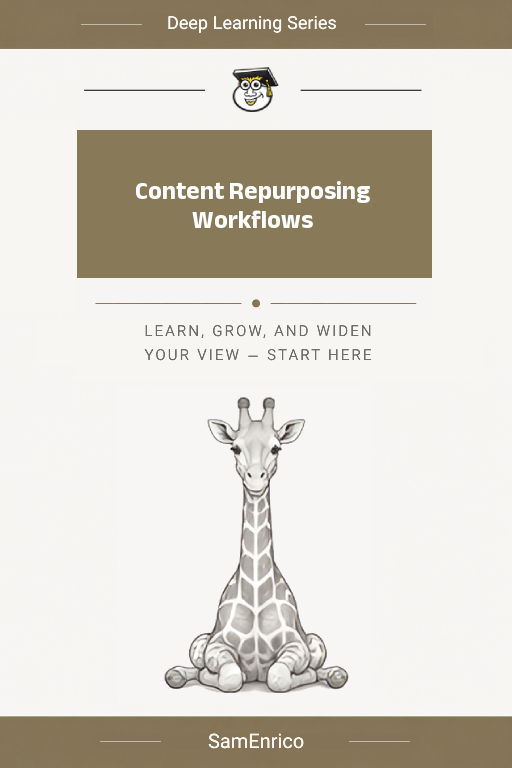
Content Repurposing Workflows eBook
Turn one piece of content into multiple formats: b
Turn one piece of content into multiple formats: blog to social posts, video to article, webinar to clips.
Formats
Free sample
Chapter 1: The Content Trap...--–- You are about to discover something that most creators never realize until it is too late. The average content creator spends eighty percent of their time creating and only twenty percent distributing. The top one percent do the opposite. They build one asset. Then they multiply it.
This chapter will show you why your current approach is failing, how the "content hamster wheel" is killing your creativity, and why the solution is simpler than you think.The Exhaustion You Didn't Sign Up For Let me describe a morning that might feel familiar.You wake up at 6:30 AM. Before you brush your teeth, you check your phone. Your last Instagram Reel underperformed. Your Linked In post got eleven likes, three of which are from your mother and your two co-founders. Your newsletter open rate dropped two percent.
Your podcast downloads have plateaued. And somewhere in the back of your mind, a voice whispers: You need to post more.So you drag yourself to your desk. You open a blank document. You need to write a blog post. Then you need to turn that blog post into five tweets.
Then you need to record a video for You Tube. Then you need to clip that video for Tik Tok and Reels. Then you need to write a newsletter. Then you need to engage in the comments. Then you need to start all over again tomorrow.This is the content hamster wheel.
It is exhausting. It is unsustainable. And it is built on a fundamental misunderstanding of how attention actually works.The lie that keeps you running is simple: More content equals more growth. More blog posts. More videos.
More podcasts. More tweets. More, more, more. The algorithms seem to demand it. The gurus preach it.
Your competitors appear to be doing it. So you run faster and faster, producing more and more, while feeling like you are somehow falling further behind.But here is the truth that changes everything. You do not have a content creation problem. You have a content repurposing problem.The Data That Should Scare You Before I offer the solution, let me show you the scope of the problem. The numbers are not abstract statistics.
They are the lived reality of creators just like you.A 2023 survey of over one thousand content marketers found that eighty-four percent report experiencing burnout related to content production. Eighty-four percent. That means if you are reading this chapter in a room with five other creators, four of them are exhausted, resentful, or actively considering quitting. The fifth one has either figured out the system or is lying.The same survey found that the average piece of content receives only twelve percent of its potential reach. Twelve percent.
The other eighty-eight percent is wasted because creators move on too quickly. They publish a blog post, share it once on social media, and then forget about it while they rush to produce the next thing. That is like filling a bathtub with the drain open. You are working harder than ever, but the water level never rises.Here is another number that should stop you cold. The top one percent of creators produce sixty percent less net-new content than the bottom eighty percent.
Read that sentence again. The people who are winning are creating less. They are not working harder. They are working smarter. They have figured out that the secret to scaling attention is not producing more ideas.
It is multiplying the ideas you already have.I have worked with hundreds of creators, from solo You Tubers to Fortune 500 marketing teams. The pattern is always the same. The ones who are burning out are the ones who treat every platform as a separate content factory. The ones who are thriving are the ones who treat their content as raw material to be refined, reshaped, and redistributed across every channel.The Real Cost of Starting from Scratch Let me be specific about what the content hamster wheel costs you. These are not theoretical costs.
They are the daily taxes you pay for a broken system.The Cost of Context Switching Every time you switch from writing a blog post to recording a video to designing a graphic, your brain pays a cognitive penalty. Research on task switching shows that it takes an average of twenty-three minutes to fully regain focus after switching between complex tasks. If you switch formats four times per day, you lose nearly two hours of productive focus. Two hours. Every day.
That is ten hours per week. That is five hundred hours per year. That is the equivalent of twelve full work weeks lost to the friction of switching contexts.The Cost of Diminishing Returns The first piece of content you create in a day is usually your best. Your energy is fresh. Your ideas are clear.
Your voice is strong. The fifth piece of content you create in the same day? It is garbage. You know it. Your audience knows it.
But you publish it anyway because the calendar demands output. This is the law of diminishing returns applied to creativity. The more you force, the worse the result. And the worse the result, the less engagement. And the less engagement, the more you feel pressure to create even more.
It is a death spiral.The Cost of Audience Fatigue Your audience does not need more content. They need better content. They need content that respects their attention. They need content that delivers value without asking them to wade through filler. When you publish five mediocre pieces instead of one great piece, you are not serving your audience.
You are spamming them. And eventually, they will unsubscribe, unfollow, and forget you ever existed.The Cost of Your Own Creativity This is the most painful cost of all. You did not become a creator to spend your days grinding out average tweets and forgettable blog posts. You became a creator because you have something to say. You have a unique perspective.
You have expertise that can help people. But the hamster wheel leaves no room for the deep thinking, the reflection, the experimentation, and the rest that creativity requires. You are so busy producing that you have stopped creating. The machine has eaten its operator.The One Percent Secret: The Content Hub Model So what do the top one percent do differently? They have abandoned the factory model of content creation and adopted what I call the Content Hub Model.The Content Hub Model is simple in concept but radical in practice.
Instead of creating unique content for every channel, you invest deeply in one "pillar" asset. That single asset becomes your hub. Everything else becomes a spoke.Here is how it works.A pillar asset is a substantial piece of content that delivers genuine value. It might be a three-thousand-word blog post that solves a specific problem. It might be a sixty-minute You Tube tutorial that walks through a process step by step.
It might be a live webinar where you answer audience questions in real time. It might be a book chapter that introduces a new framework. The format does not matter.…
This is the end of the free sample. Get the eBook to keep going. Buy now
About this book
Details
- Author
- Wilbanks Oren
- Publisher
- SamEnrico
- Language
- English
- Genre
- Non-Fiction, AI Operator, Creative Operations
- Released
- 2026-06-01
- Pages (approx.)
- 140
- Available as
- eBook, Audiobook

Read better in the ZLOADR app
Your eBooks on your phone or tablet. Sign in with your SamEnrico account and start reading.
More by Wilbanks Oren
 Meth Dental Restoration GuideWilbanks Oren$11.99
 The Motherless Daughter GuideWilbanks Oren$11.99
 Headache Journal WorkbookWilbanks Oren$11.99
 Parent Child Listening SkillsWilbanks Oren$11.99
 The Iron Spire: Frederick the Great and the Birth of Prussian DisciplineWilbanks Oren$11.99
 How to Become a Popcorn-candy MakerWilbanks Oren$11.99
 Condominium ManagerWilbanks Oren$11.99
 Learn to Play the Nose FluteWilbanks Oren$11.99
You may also like
 Hong Kong Handover 1997Dunn Johnnie$11.99
 Zumba For Postnatal Recovery CourseNeal Christian$11.99
 Zumba for BeginnersLadner Nikia$11.99
 YouTube Comment Mining GuideHumes Pandora$12.99
 Worry Box MeditationCarlin Rudy$11.99
 Workplace Stress MeditationNguyen Lynn$11.99
 Workplace Stress and Sleep RepairHawley Ivory$11.99
 Workplace Perfectionism CureDelaney Jeffry$11.99
 Workplace Injustice Anger GuideWallen Isabelle$11.99
 Work Addiction and Burnout LinkGreenwood Ester$11.99
 Women in Yoga and WellnessBeattie Galina$11.99
 Women in Stand Up ComedyChun Evangeline$11.99