
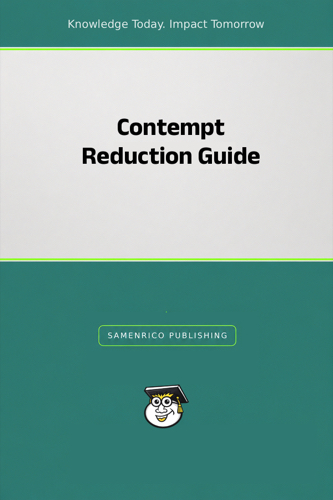
Contempt Reduction Guide eBook
Stop eye-rolling, sarcasm, and name-calling that e
by Jones Kelli
Stop eye-rolling, sarcasm, and name-calling that erodes love.
Formats
Free sample
Chapter 1: The Lip Curl--–- You don't think of yourself as someone who rolls their eyes at their partner. That's something other couples do. Annoying couples. Couples who don't really like each other. You love your partner.
You chose them. You built a life with them. So when your eyes roll upward—just a fraction, just for a moment—you don't even register it as an event. It's punctuation. It's a sigh with a physical component.
It's nothing.Except it's not nothing.The eye-roll is the single most dangerous micro-behavior in any intimate relationship. Not because it's violent. Not because it's loud. But because it reveals something that no argument, no slammed door, no raised voice ever does. The eye-roll says, quietly and unmistakably, "I am better than you.
You are beneath me. Your words do not deserve my attention."This chapter is about that moment. The split second when your face moves before your brain catches up. The curl of the lip that you don't even feel happening. The tiny sneer that you would deny if your partner pointed it out—and you would mean that denial, because you didn't intend to hurt them.
You were just tired. Just frustrated. Just done.But contempt does not require intent. It requires only the belief, buried somewhere beneath your conscious thoughts, that your partner is not quite your equal. And that belief leaks out of your face long before it reaches your mouth.By the end of this chapter, you will understand what contempt actually is (and what it isn't).
You will learn to see it in yourself before it escapes. You will have a map of the Sarcasm Spectrum, which will serve as the backbone of every tool in this book. And you will complete a 24-hour exercise that will change how you hear your own voice.Let's start with the face.The Anatomy of a Micro-Expression Human faces are capable of producing over ten thousand distinct expressions. Most of them are combinations of seven universal emotions that cross every culture, language, and border: happiness, sadness, anger, fear, surprise, disgust, and contempt.Notice that contempt is separate from anger. This is crucial.
When you are angry at your partner, you are still engaged. Anger says "I am upset, and I want you to fix something." Anger, for all its discomfort, is a bid for connection—a messy, loud, sometimes terrifying bid, but a bid nonetheless. Anger means you still believe your partner is capable of hearing you and responding.Contempt says something different. Contempt says "You are not worth my anger. You are not worth my engagement.
You are an inconvenience, an obstacle, a fool." Contempt does not seek repair. Contempt seeks distance. It is the emotional equivalent of hanging up the phone while the other person is still talking.The physical signature of contempt is the unilateral lip curl. One corner of the mouth pulls up and back, asymmetrically, as if tasting something spoiled. This is not a learned behavior.
Infants who are born blind still make this face when presented with something bitter. It is hardwired. Evolution gave us the contempt expression to signal rejection of something that might harm us—spoiled food, contaminated water, a threat to our survival.But somewhere along the way, we started using that same face on our partners.The eye-roll is the junior version of the lip curl. It is contempt diluted for social consumption. A full lip curl in a business meeting would be career suicide.
An eye-roll, however, can be passed off as a tic, a reaction to something else, or "just how my face looks when I'm thinking." The eye-roll is contempt with plausible deniability. And that is precisely what makes it so insidious.You can roll your eyes at your partner fifteen times in a single dinner conversation and never once think of yourself as a contemptuous person. Because each roll is tiny. Each roll is justified. Each roll feels like a response to something they actually did wrong.But fifteen tiny cuts still bleed.The Gateway Behavior In the 1970s, psychologist John Gottman began what would become a forty-year study of thousands of couples.
He filmed them arguing, coded their facial expressions, tracked their heart rates, and followed them for decades. His goal was simple: predict which couples would stay together and which would divorce.He found many predictors. Criticism was bad. Defensiveness was worse. Stonewalling—the silent treatment—was devastating.But one behavior stood above all others.
One behavior predicted divorce with such accuracy that Gottman could watch fifteen minutes of a couple arguing and predict, with over ninety-three percent accuracy, whether they would be divorced within ten years.That behavior was contempt.Not anger. Not disagreement. Not even infidelity in all cases. Contempt.Here is what Gottman found: couples who expressed contempt toward each other—through eye-rolling, sneering, sarcasm, name-calling, or mockery—had divorce rates nearly six times higher than couples who did not. Contempt was the single strongest predictor of relationship dissolution.
Stronger than frequency of fighting. Stronger than financial stress. Stronger than differences in parenting styles.Why? Because contempt is not a complaint. It is not a request for change.
It is a verdict. When you roll your eyes at your partner, you are not saying "I wish you would do something differently." You are saying "You are the kind of person who does things like this. You will always be that person. And I am superior to you."That verdict leaves no room for repair. How do you apologize for being beneath someone?
How do you fix being the kind of person who deserves an eye-roll? You can't. So you withdraw. Or you counter-attack. Or you stop trying entirely.Gottman called contempt the "sulfuric acid of love" because it corrodes everything it touches.
And here is the cruelest part: contempt often emerges in couples who love each other deeply. It is not the absence of love that produces contempt. It is the presence of something else—something we will explore throughout this book.For now, understand this: the eye-roll is not a personality quirk. It is not a harmless habit. It is the most dangerous thing you can do to your relationship that is not illegal.But you are not a monster.
You are not a bad partner. You are someone who has learned, somewhere along the way, that contempt works. It works to create distance when you feel suffocated. It works to assert superiority when you feel small. It works to end an argument when you are exhausted.
Contempt is effective. That is why we use it.The problem is that what works in the moment destroys over time. And this book is about learning other tools that work just as well in the moment—and leave the relationship intact.The Sarcasm Spectrum Not all sarcasm is contempt. Not every teasing remark is a relationship hazard. This is important to acknowledge because many readers will have tried to stop being sarcastic before and failed.
They felt like they were being asked to become boring, humorless robots. That is not what this book asks.The difference between bonding sarcasm and contemptuous sarcasm is…
This is the end of the free sample. Get the eBook to keep going. Buy now
About this book
Details
- Author
- Jones Kelli
- Publisher
- SamEnrico
- Language
- English
- Genre
- Non-Fiction, Self-Help
- Released
- 2026-06-08
- Pages (approx.)
- 147
- Available as
- eBook, Audiobook

Read better in the ZLOADR app
Your eBooks on your phone or tablet. Sign in with your SamEnrico account and start reading.
More by Jones Kelli
 Personal Branding on LinkedInJones Kelli$11.99
 Stress and Hot FlashesJones Kelli$11.99
 Menopause And Asthma GuideJones Kelli$11.99
 Parenting Confidence HypnosisJones Kelli$11.99
 Weekly Meal Review GuideJones Kelli$11.99
 Lise Meitner Nuclear FissionJones Kelli$11.99
 Attention Residue ReductionJones Kelli$11.99
 The Battle of Kadesh: Ramses II vs. the Hittite StormJones Kelli$11.99
 Love, Lies, and a Royal Split: The Untold Story of Prince Andrew and Sarah FergusonJones Kelli$11.99
 How to Start a Hobby in CryptographyJones Kelli$11.99
 How to Produce Play Money and BankingJones Kelli$11.99
 Exploring Chalk: Soft Drawing & Pastel TechniquesJones Kelli$11.99
You may also like
 Hong Kong Handover 1997Dunn Johnnie$11.99
 Zumba For Postnatal Recovery CourseNeal Christian$11.99
 Zumba for BeginnersLadner Nikia$11.99
 YouTube Comment Mining GuideHumes Pandora$12.99
 Worry Box MeditationCarlin Rudy$11.99
 Workplace Stress MeditationNguyen Lynn$11.99
 Workplace Stress and Sleep RepairHawley Ivory$11.99
 Workplace Perfectionism CureDelaney Jeffry$11.99
 Workplace Injustice Anger GuideWallen Isabelle$11.99
 Work Addiction and Burnout LinkGreenwood Ester$11.99
 Women in Yoga and WellnessBeattie Galina$11.99
 Women in Stand Up ComedyChun Evangeline$11.99